
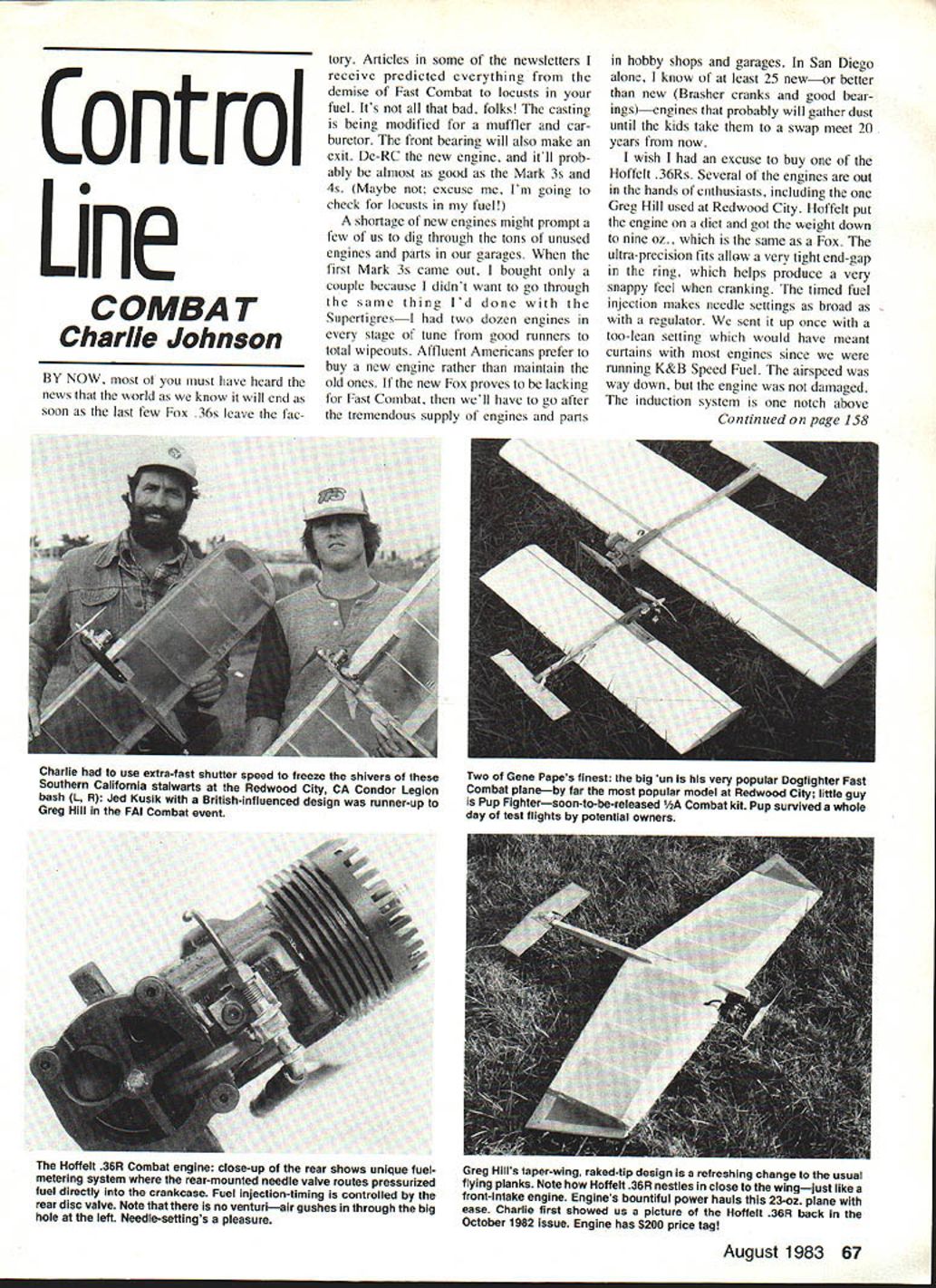
Control Line: Combat
Charlie Johnson
By now, most of you must have heard the news that the world as we know it will end as soon as the last few Fox .36s leave the factory. Articles in some of the newsletters I receive predicted everything from the demise of Fast Combat to locusts in your fuel. It's not all that bad, folks! The casting is being modified for a muffler and carburetor. The front bearing will also make an exit. De-RC the new engine, and it'll probably be almost as good as the Mark 3s and 4s. (Maybe not; excuse me, I'm going to check for locusts in my fuel.)
A shortage of new engines might prompt a few of us to dig through the tons of unused engines and parts in our garages. When the first Mark 3s came out, I bought only a couple because I didn't want to go through the same thing I'd done with the Supertigres — I had two dozen engines in every stage of tune from good runners to total wipeouts. Affluent Americans prefer to buy a new engine rather than maintain the old ones. If the new Fox proves to be lacking for Fast Combat, then we'll have to go after the tremendous supply of engines and parts in hobby shops and garages. In San Diego alone, I know of at least 25 new—or better than new (Brasher cranks and good bearings)—engines that probably will gather dust until the kids take them to a swap meet 20 years from now.
Hoffelt .36R and experimentation
I wish I had an excuse to buy one of the Hoffelt .36Rs. Several of the engines are out in the hands of enthusiasts, including the one Greg Hill used at Redwood City. Hoffelt put the engine on a diet and got the weight down to nine oz., which is the same as a Fox. The ultra-precision fits allow a very tight end-gap in the ring, which helps produce a very snappy feel when cranking. The timed fuel injection makes needle settings as broad as with a regulator. We sent it up once with a too-lean setting which would have meant curtains with most engines since we were running K&B Speed Fuel. The airspeed was way down, but the engine was not damaged.
The induction system is one notch above what we have on the typical front-induction engine. A little experimentation might be worthwhile. You could epoxy jets in various places on the case of a Fox or Tigre and see if there was any improvement. By the way, the Hoffelt's needle assembly is a Rossi rear-intake type.
New Pup Fighter and Gene Pape
The only thing more fun than a Dogfighter with a Hoffelt .36R might be the new Pup Fighter designed by Gene Pape. The soon-to-be-released kits will feature everything you need except for the engine. There's nothing very tricky about the models, except that they are very quick to build and withstand a lot of abuse. These models look like the hot tip for the unofficial V/A Combat at the Nationals this summer. (Same deal as last year: TD engines and goodies for prizes through fifth place.) All the action will take place on Thursday.
I'll bet a lot of the 42 entries last year are going to be after Gene for some Pup Fighters, so here's his home number for express service:
- Gene Pape (Dog Trainer): (503) 689-1623
Call quick, and don't tell him I sent you!
Gene told me of a technique he used to repair one of his Dogfighters that had the outboard wing destroyed. He simply cut the old one off and stuck another on. He joined the spar from the original model with that of the new wing panel using carbon fiber and 5-minute epoxy. He said that several exotic-plane builders use the same technique on their new models. There were enough Dogfighter pieces in the trash can at Redwood City that I could have built a whole new fleet.
Trimming, bellcrank failures, and safety cables
A while back, I had an article on trimming some models I'd bought from a local flier. The trimming turned out fairly well, since I placed second at a couple meets, but a very dangerous problem arose at the Redwood City meet where my model tried flying through the front door of the local police station! It wasn't cut loose as we'd thought; instead, the 1/8-in. plywood mount had broken. This bellcrank mounting arrangement is very popular in models that have the solid center rib. In the picture of Greg Hill and Jed Kusick, you'll see the type of mount I'm talking about. The 1/8-in. plywood usually works well—but it didn't in this case!
Fortunately, there was no harm done, and the local police just got a close-up look at one of our models. This very dangerous condition was solved by installing a safety cable from the bellcrank to the engine, as is now required on the FAI models. WAM has required the safety cable for years, and I got a lot of "I told you so's" from the many WAM fliers in attendance. OK, you professional rules proposers, here's something worthwhile, although not of the same rank as the size of a canopy or tail fin.
Nelson .15 and FAI Combat
Joe Klause of Kustom Kraftsmanship said that the Nelson .15 is selling at an astounding pace. FAI Combat fliers want power and recognize the Nelson as the easiest way to get it. John McCollum and others make special, high-revving props for the engine, so all you have to do is pour in the 50% nitro and go for it. It may be that with the new-found horsepower the destruction level will reach 200+ models at the Team Trials in Nashville come September 16–18. Some resourceful person will probably show up with carbon fiber and some 5-minute epoxy and build a fleet from the remains on the Combat field.
Glow plugs and fuel selection
The cold and wet weather in Redwood City showed up a fault that many Combat fliers have: they don't know how to select a glow plug or fuel. One plug-and-fuel combination doesn't always work! A cold "racing" plug and high-nitro might be the right combination one day, but not the next. You want to run the hottest plug you can get away with, not the coldest. Just as in cars, you run the cold plugs because you have to — not because you want to.
Besides a very measurable loss in power, cold plugs make for harder starting, poorer settings, and, worst of all, the dreaded flameout just when you're upwind and your opponent is hot on your tail. Another thing: if all your engines are running poorly, then invest in a gallon or two of commercially blended glow fuel and burn it exclusively for a while. Fuel manufacturers know a few things, too!
Charlie Johnson 3716 Ingraham St. San Diego, CA 92109
Transcribed from original scans by AI. Minor OCR errors may remain.

