
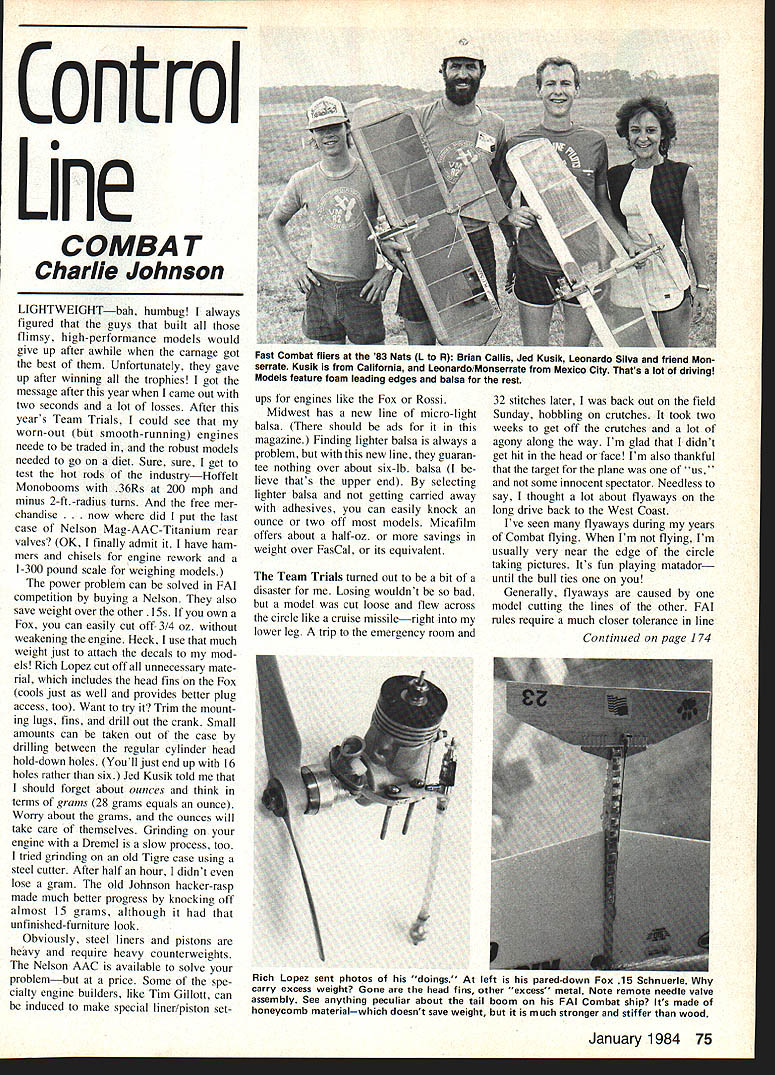
Control Line: COMBAT
Charlie Johnson
LIGHTWEIGHT
LIGHTWEIGHT—bah, humbug! I always figured that the guys who built those flimsy, high-performance models would give up after a while when the carnage got the best of them. Unfortunately, they gave up after winning all the trophies. I got the message after this year when I came out with two seconds and a lot of losses. After this year's Team Trials I could see that my worn-out (but smooth-running) engines needed to be traded in, and the robust models needed to go on a diet.
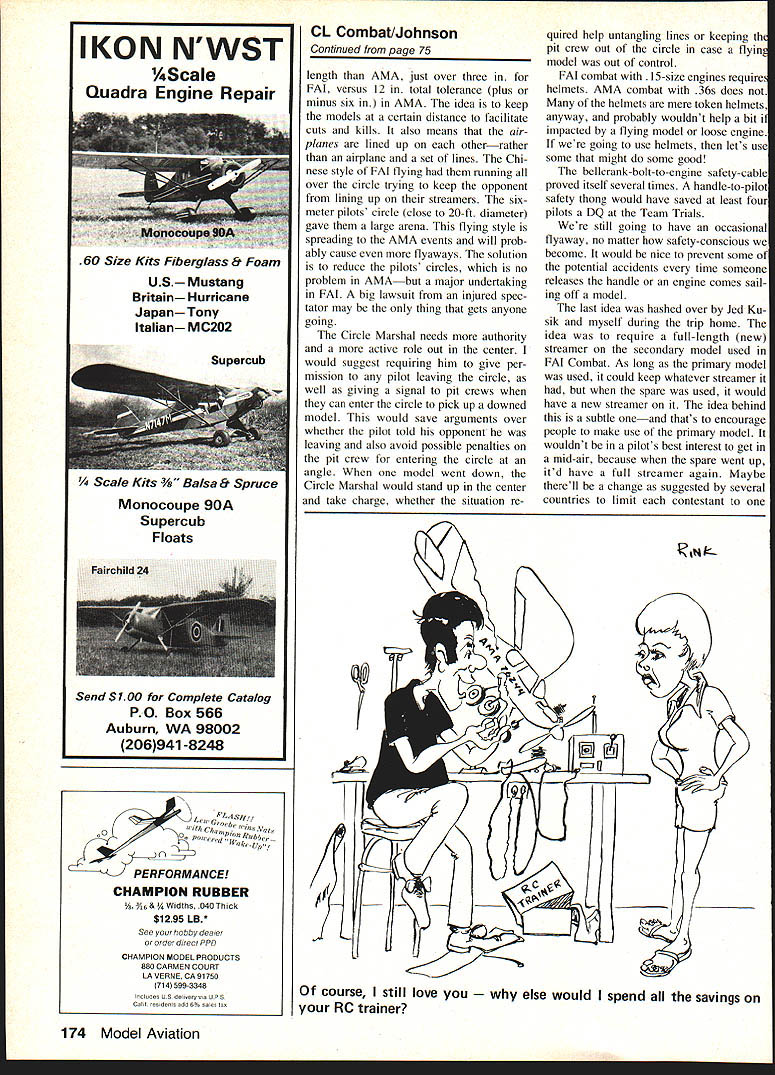
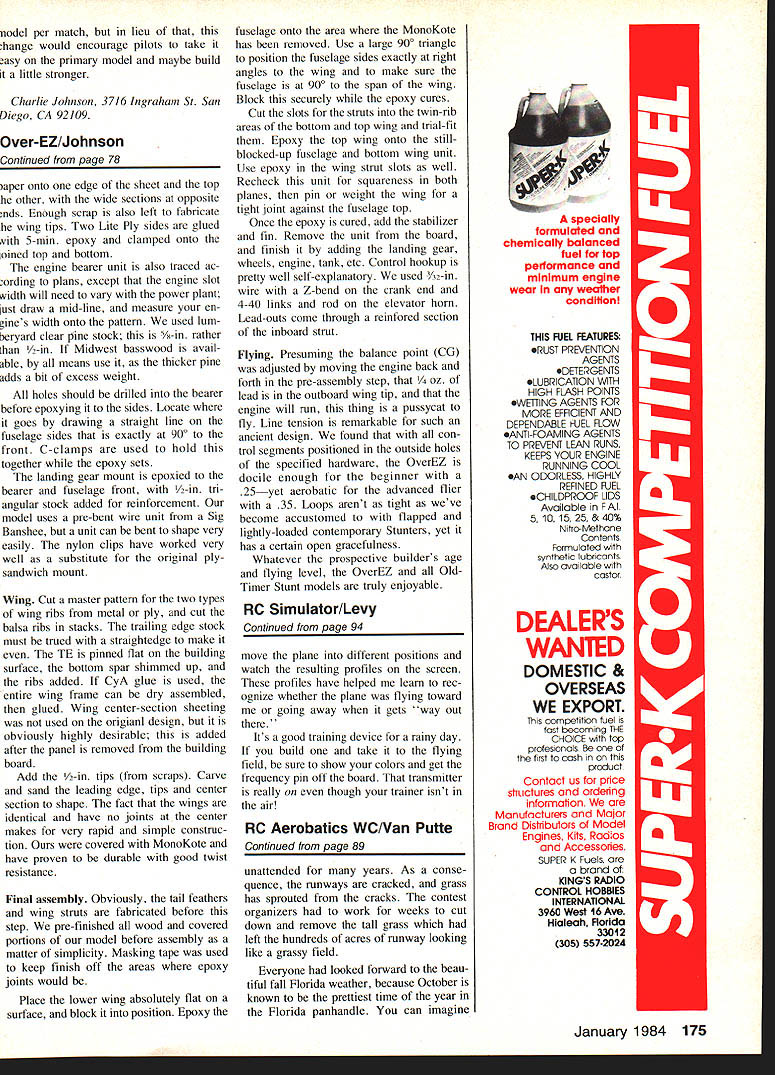
The power problem can be solved in FAI competition by buying a Nelson. They also save weight over other .15 engines. If you own a Fox, you can easily cut off 3/4 oz. without weakening the engine. Rich Lopez cuts off unnecessary material, including the head fins on the Fox (it cools just as well and provides better plug access, too). Want to try it? Trim the mounting lugs and fins, and drill out the crank. Small amounts can be removed from the case by drilling between the regular cylinder head hold-down holes—you'll just end up with 16 holes rather than six.
Jed Kusik told me to forget ounces and think in terms of grams (28 grams = 1 ounce). Worry about the grams and the ounces will take care of themselves. Grinding on an engine with a Dremel is a slow process. I tried grinding on an old Tigre case using a steel cutter; after half an hour I didn't even lose a gram. An old Johnson hacker-rasp made much better progress, knocking off almost 15 grams, although it left an unfinished-furniture look.
Obviously, steel liners and pistons are heavy and require heavy counterweights. The Nelson AAC is available to solve that problem—but at a price. Some specialty engine builders, like Tim Gillott, can be induced to make special liner/piston setups for engines like the Fox or Rossi.
Midwest has a new line of micro-light balsa (see their ads). Finding lighter balsa is always a problem, but with this new line they guarantee nothing over about six-lb. balsa (I believe that's the upper end). Selecting lighter balsa isn't getting carried away; adhesives can easily knock an ounce or two off models. Micafilm offers about a half-ounce or more savings in weight over FasCal or its equivalent.
TEAM TRIALS, FLYAWAYS, AND SAFETY
The Team Trials turned out to be a bit of a disaster for me. Losing wouldn't be so bad, but a model came loose and flew across the circle like a cruise missile—right into my lower leg. A trip to the emergency room and 32 stitches later, I was back out on the field Sunday, hobbling on crutches. It took two weeks to get off the crutches and a lot of agony along the way. I'm glad I didn't get hit in the head or face, and thankful the target was one of "us" rather than an innocent spectator. Needless to say, I thought a lot about flyaways on the long drive back to the West Coast.
I've seen many flyaways during my years of Combat flying. When I'm not flying, I'm usually very near the edge of the circle taking pictures. It's fun playing matador—until the bull ties. Flyaways are generally caused by models cutting lines or by pilots and models getting out of proper position.
Other FAI rules require much closer tolerance in line length than AMA: just over 3 in. total tolerance for FAI versus 12 in. total tolerance (±6 in.) in AMA. The idea is to keep the models at a certain distance to facilitate cuts and kills. It also means airplanes are lined up on each other rather than on an airplane-and-lines geometry.
The Chinese style of FAI flying had pilots running all over the circle trying to keep the opponent from lining up on their streamers. The six-meter pilots' circle (close to a 20-ft. diameter) gave them a large arena. This flying style is spreading to AMA events and will probably cause even more flyaways unless pilots' circles are reduced. Reducing pilots' circles is no problem in AMA, but would be a major undertaking in FAI.
A big lawsuit from an injured spectator may be the only thing that gets people moving on some of these changes, but there are practical steps that won't require litigation.
PROPOSED CHANGES AND SAFETY IMPROVEMENTS
- Give the Circle Marshal more authority and a more active role in the center:
- Require the Circle Marshal to give permission for any pilot leaving the circle.
- Require the Circle Marshal to give a clear signal to pit crews when they may enter the circle to retrieve a downed model.
- Have the Circle Marshal take charge immediately when a model goes down—either to help untangle lines or to keep pit crews out if a model is still under control.
- Improve mandatory protective equipment:
- FAI combat with .15–.65 cc engines currently requires helmets; AMA combat with .36s does not. Many helmets are token affairs and would not help much in an impact. If helmets are required, require helmets that provide real protection.
- Reinforce mechanical safety measures:
- The bellcrank-bolt-to-engine safety cable has proven itself several times—keep it mandatory.
- A handle-to-pilot safety thong (strap) would have saved at least four pilots a DQ at the Team Trials; make handle retention systems robust and mandatory.
- Discourage excessive reliance on primary models:
- Require a full-length (new) streamer on all secondary (spare) models used in FAI Combat. The primary model may keep its existing streamer, but spares must carry a new full streamer when flown. This discourages deliberate mid-airing of primaries because the spare would present a full streamer again.
- Consider limiting each contestant to one spare, as suggested by several countries.
We're still going to have occasional flyaways, no matter how safety-conscious we become, but these steps would reduce the number of preventable accidents every time someone releases the handle or an engine comes sailing off a model.
Transcribed from original scans by AI. Minor OCR errors may remain.

