


Control Line COMBAT
Charlie Johnson
Noise and mufflers
Lots of noise makes Combat more fun. It has also gotten us kicked out of many nice flying spots. I used to think I’d rather stop flying than muffle the engine — but that was before we lost our favorite flying site. Screaming engines are still more fun, but there are times when only a quiet model will do.
Mufflers don't have to hurt power a lot. It is even possible to gain a little bit of power if the chamber is designed correctly. Gary Arnold used full pipes on his models at the Team Trials to gain a performance boost; a side effect was a quieter engine (and more pieces to pick up when the model hit the ground under power).
Exhaust timing and performance
Any engine practical for Combat needs to operate over a fairly broad rpm range, so the radical timing used with full pipes is usually not appropriate. From what people tell me, about 160° of exhaust duration is about the maximum for open-face engines; anything above that belongs in the full- or mini-pipe realm. Some higher-revving Combat motors are in the 150° range, but most other engines are less.
Generally, the more exhaust duration, the higher the rev band at which maximum horsepower is produced. Also, peak horsepower will be delivered over a narrower rev range, assuming intake timing, compression, port shape, head shape, etc., are consistent with the exhaust timing. Set up a stunt engine with 160° of exhaust duration and it will probably be the doggiest engine on record because of intake restrictions. The lesson: use the least amount of exhaust timing that will put you in the rev range you want.
Slow Combat and quiet events
Slow Combat was supposed to be a slower, easier-to-fly, sporty-type event — but it has already turned into Fast Combat, Part II. There are already three other noisy Combat events (Fast, FAI, and 1/2A) that can be flown anywhere without noise restrictions. Why not have an official AMA event for restricted areas?
WAM fliers have used mufflers on all their models for years and have a great store of knowledge on enforcing such events. One argument for an official muffled event is that it is difficult to balance a model for use both with and without a muffler — compromise planes usually lose something in either or both modes. The rule-makers have suggested nearly every variation of Combat — biplane, Ringmasters-only, Quiet Combat, etc. — but an official restricted-noise event would help standardize enforcement and equipment.
Engine tuning and services
If you want someone to super-tune your engine or do a full-race cam, there are a few specialists who do custom tuning, fitting, and chrome-plating. A well-run engine is preferred for rework because parts have taken a "set" and tend not to bend around during the process.
Contacts:
- Model Engine Specialties (Bob Oge)
34W883 S. James, St. Charles, IL 60174 Phone: (312) 697-7472 Bob specializes in chroming; he offered to rework one of my old Combat engines for a comparison. He plans chrome liners and cranks and claims a chrome crank will wear well and make about as much power as an engine with a front ball bearing.
- Kustom Kraftsmanship (Joe Klause)
P.O. Box 2699, Laguna Hills, CA 92653 Joe is best known for 1/2A reworks and specialty parts (fuel stoppers, needle valves, etc.). He’s also doing a fair amount of chrome work, especially on Fox .36s. The best way to find out about his services is to send a stamped, self-addressed envelope to his P.O. box.
For superhot 1/2A Combat ships, reworked tuned-pipe Cox TDs are a good option. Columnists and tuners (for example, Gene Hempel) offer special TD mods and parts. At the ’83 Nats, builders such as Clay Larcom showed very nice models — foam leading-edge features and wood reinforcing strips near the trailing edge were common refinements.
Flying sites and soft landings
We’ve found a nice spot out in the Borrego Desert that’s great for noisy Combat models. We’ve done away with trying to catch the model in the air — we just glide the plane into the nearest pucker bush. Models that hit bushes often survive unscathed if you use FasCal-type covering and a nylon prop. Soft landing spots make noisy flying less risky.
I’ll be flying at the Buckeye Regionals (Jan 14–15, 1984) and others may find similar tolerant sites for noisy events. If you prefer quiet venues, seek sanctioned muffled events or practice with muffled engines.
Anecdotes and the changing Combat world
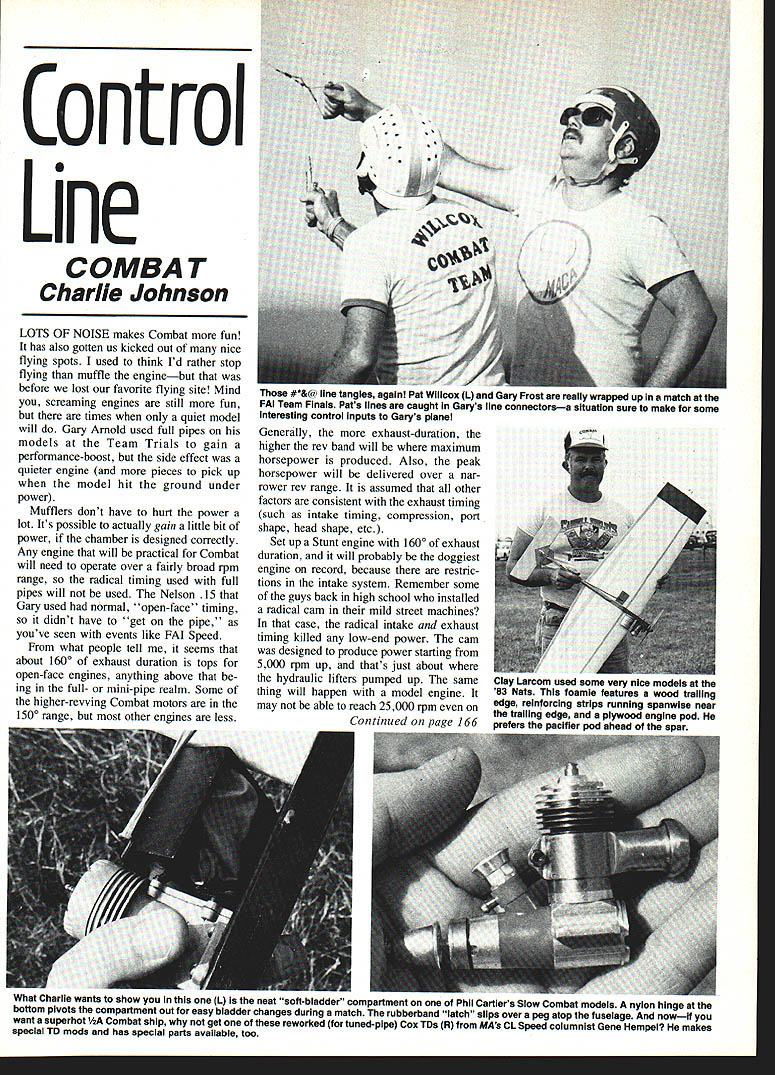
Line tangles happen — at the FAI Team Finals Pat Wilcox and Clary Frost wrapped up a match when Pat’s lines caught Gary’s line connectors, producing some interesting control inputs.
Phil Cartier’s Slow Combat models illustrate clever field-service design: a nylon hinge lets the bottom pivot out for easy bladder changes during a match, and a rubber-band latch slips over a peg atop the fuselage.
Combat has changed a lot in the last decade. Diesel-powered biplanes in Europe have given way to 1/2A-powered Jr. Satans and very sophisticated machinery. Exotic metal engines now weigh little more than half what engines did ten years ago while producing roughly double the power. Propellers have evolved from clipped nylon to carefully handcrafted carbon-fiber props. Flying styles have moved from a sportsman-like approach to a much more aggressive, physical style.
Closing
Muffling is a compromise between performance and access to flying sites. With careful design and the right tuning, mufflers need not cost you much power and can open up more places to fly. If you’re considering engine rework over the winter, contact one of the specialists listed above.
Transcribed from original scans by AI. Minor OCR errors may remain.

