
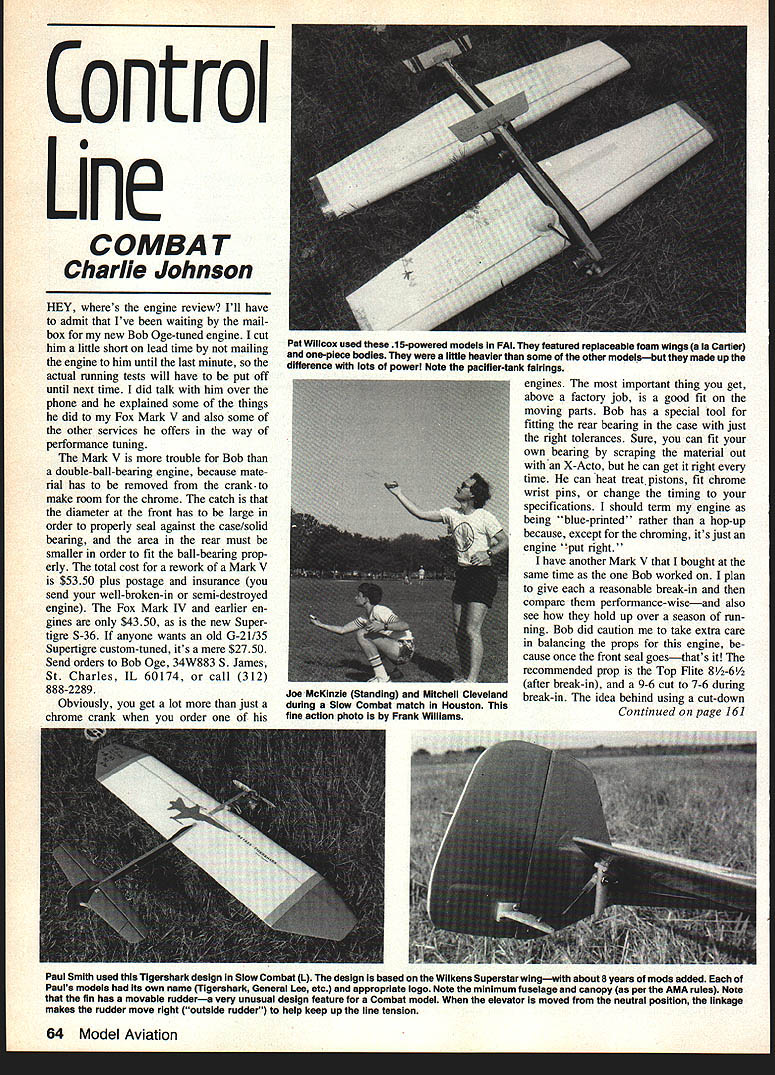

Control Line: Combat
By Charlie Johnson
Engine Tune-up by Bob Oge
HEY, where's the engine review? I'll have to admit that I've been waiting by the mailbox for my new Bob Oge–tuned engine. I cut it a little short on lead time by not mailing the engine to him until the last minute, so the actual running tests will have to be put off until next time. I did talk with him over the phone and he explained some of the things he did to my Fox Mark V and also some of the other services he offers in the way of performance tuning.
The Mark V is more trouble for Bob than a double-ball-bearing engine, because material has to be removed from the crank to make room for the chrome. The catch is that the diameter at the front has to be large in order to properly seal against the case/solid bearing, and the area in the rear must be smaller in order to fit the ball-bearing properly.
Prices (send your well-broken-in or semi-destroyed engine):
- Fox Mark V: $53.50 (+ postage and insurance)
- Fox Mark IV and earlier: $43.50
- Supertigre S-36: $43.50
- Old G-21/35 Supertigre custom-tuned: $27.50
Send orders to: Bob Oge, 34W883 S. James, St. Charles, IL 60174. Phone: (312) 888-2289.
What the rework includes
You get more than just a chrome crank when you order one of his engines. The most important thing you get, above a factory job, is properly fitted moving parts. Bob has a special tool for fitting the rear bearing in the case with just the right tolerances. Sure, you can fit your own bearing by scraping the material out with an X-Acto, but he can get it right every time. He can:
- heat-treat pistons,
- fit chrome wrist pins,
- change the timing to your specifications,
- and perform precise bearing and crankwork.
I'd call my engine "blue-printed" rather than a hop-up because, except for the chroming, it's essentially an engine "put right."
Break-in and Prop Recommendations
I have another Mark V that I bought at the same time as the one Bob worked on. I plan to give each a reasonable break-in and then compare them performance-wise—and also see how they hold up over a season of running. Bob cautioned me to take extra care in balancing the props for this engine, because once the front seal goes—that's it!
Recommended props:
- After break-in: Top Flite 8½×6
- During break-in: a 9×6 cut to 7×6 (the cut-down 9×6 is much stronger than a 7×6, important when flipping a high-compression engine)
Most people like to use this low-load prop because it lets them run the engine fast while still keeping a lot of fuel flowing to keep it cool. (Don't run an engine super-rich, because all you'll accomplish is pounding out the rod and wrist-pin boss.)
Good break-in also requires heating and cooling the engine many times. This cycling allows the piston and liner to take a set. The engine needs to get up to operating temperature or the piston never grows enough to properly wear in—and that's the most common problem with contest engines: the engine is broken in at home and at the flying field with low-nitro fuel and carefully controlled runs. When someone dumps in high-nitro fuel during a match, it can overheat the engine. The extra heat produced by the high-nitro fuel and a leaner needle setting can make the piston grow enough that it seizes in the liner or grinds away enough metal to keep running only at reduced power.
Covering and Adhesives (Metacil, 3M77)
I received a letter from Dan Rutherford (ex-Model Builder columnist). He wanted a few tips on building and flying Combat models, since he's been out of it for a while. He had a good tip concerning the use of Metacil on models: skip the Balsarite treatment and use 3M 77 spray adhesive.
A light spraying of 3M 77 works fast and is much quicker than brushing. Do the spraying in a well-ventilated area. I keep an old supply of polka-dot silk left over from the 1971 Nationals—paper and dope are different, but it still appeals to those who like to be different.
Fuel Filters and Accessories
The mail also produced some nice aluminum fuel filters from Cull Command Systems, 908 E. Rosewood, Spokane, WA 99208. They're about the right size for use as in-line filters for a pressure system. You need a good supply of them, because in the event of a midair the fuel line with the filter always flies off where you can't find it.
Useful tips and ideas:
- There’s enough extra meat on the filters that you can hollow out the inside for greater fuel capacity—handy for club events with tank restrictions.
- Mounting one in front of the venturi on my Fox as a surge compensator would be worth trying for Fast or Slow Combat.
- You can epoxy them into the top of a 1/2A tank to act as a fill-nipple, filter, and slight extra capacity if hollowed out.
- The filters have a 100-mesh screen made of plastic rather than brass, so there’s no corroding. The seal between the two halves stood up to the blast from a syringe in testing.
- Beware of cheap filters that leak on pressure systems or allow air in on suction setups—those give poor engine runs.
Mufflers, Noise, and Flying Sites
Several people wrote about the idea of muffler use, but no one really wants to go through more rule changes. Any change needs a lot of pushing to get it through—good proposals die without active support and explanation. Many of us are crisis-oriented and only worry when we lose a flying site because of noise complaints.
Our temporary loss of the flying site in San Diego was more than offset by the new facilities at Whittier Narrows. The Combat circles haven't been fixed yet, but there are three new giant 200-ft square asphalt circles for the other events. We finally have a proper site for multi-event team trials and regional contests. We may also be able to tag along with Riverside Raceway when it relocates. The choices are to move into areas no one else wants, join up with other noisy sports, or put on the mufflers.
Covering with Tissue and Silk
A couple of people asked about using tissue and silk on Combat models. That used to be all there was at one time. Both materials make the structure more rigid for flying stresses, but they do little for ground-impact resistance. Tissue is cheaper than most plastics. Silk is stronger but about as expensive as the iron-ons and much more time-consuming.
Tips for working with tissue or silk:
- Both are easiest to work with when moist. Place the tissue or silk between two moist towels while you prepare the structure.
- Apply a coat or two of clear dope to the balsa structure first.
- For super-cored foamies, dulling the white glue/water adhesive helps create an eggshell effect. You’ll still need to spray a final proofer over at least the center section.
- Silk requires pins: use pins around the leading edges and spaced every inch or so along the leading and trailing edges. Pins also help hold tissue in difficult areas.
- Silk can be stretched—don’t overdo it or you’ll create a permanent warp. Really bad warps can ruin a plane if you try to fly it.
- Cures for warps: dope one side of a panel and use weights to hold it straight while it dries; sometimes pouring boiling water on the offending panel helps.
Maybe this part should have gone first: Why would anyone put up with the time, fumes, and small cost savings (if any) over the iron-ons? People have told me they'd quit flying if they had to go back to silk, paper, and dope! In a Combat world filled with Force clones and great white foamies, I suppose it's a rare chance to be different.
Any takers? I still have a supply of polka-dot silk left over from the 1971 Nationals.
Charlie Johnson 3716 Ingraham St., San Diego, CA 92109
Transcribed from original scans by AI. Minor OCR errors may remain.

