
Control Line: Combat
Charlie Johnson
WORLD CHAMPIONSHIP COMBAT is just around the corner. The 1978 World Champs will feature FAI Combat regardless of whether the meet is in Britain, the U.S.A. or some other country. It would seem that the ultimate goal of all combat fliers would be to compete on an international basis. Many of you have never left your home town to compete in a model airplane contest much less go to Europe for a meet of this type. Even if you fancy you're not good enough now you still have lots of time to practice and that is one very important bit of experience available to the serious FAI flier.
The Dutch International will be held in Holland on the weekend of July 3 and 4, just one week prior to the official World Champs. Here's a chance to see FAI Combat as flown at international meets and prepare yourself for the big one in 1978. If you're serious about trying for the U.S.A. team in 1978 it would be a super chance to get the valuable experience. It's time to stand up and be counted.
Gary Frost remains MACA President as a result of the recent election. Bill Allen was the runner-up. MACA once again will run the Combat events at the Nationals in August. If you can help with any events please contact Gary or one of the MACA officers. The MACA Top Twenty Combat Pilots will probably be announced by the time of this printing. As an added bonus for these hot-shots they might fly three-out-of-five matches against each other at local or regional meets with the winner being matched against the open competition victor, the winner of this match becoming overall champion.
Several local service clubs have contacted me about arranging a Combat show to raise funds for various charities. Combat pilots would receive pay to help defray equipment costs. Some top fliers really could put on a show and, with a little care, minimize equipment loss. Are we ready for the semi-pro?
MACA membership, decals and a super newsletter are available to all those interested by sending MACA Treasurer Tom Southern (2207 Paul, Longview, TX 75601) your five dollars; outside U.S.A. and Canada is ten dollars. A newsletter is the best means of quick communication between combat fliers around the world and the 12 pages of comments by competitors in the latest MACA newsletter was an enlightening example of what others have on their mind.
While on the subject of the printed word I hope you've picked up copies of Model Airplane News with the articles on FAI Combat by Gary Frost and also excellent control-line coverage by Harry Higley. Dave Clarkson of Aeromodeller and Dan Rutherford of Model Builder both write general-interest control-line articles but are real thinkers on the subject of Combat. The modeling world is coming alive with great thoughts from a lot of different people. You can give something to our hobby by joining MACA and contributing your ideas and can receive something in return by reading all you can about what's going on in the different magazines. Columnist Dave Clarkson will be over from England this summer to compete in our Nationals; this is our chance to show him the "American" way of flying Combat.
In my last two articles I've been talking about a new deal for Combat fliers, one where line tanglers and bellcrank artists are not allowed to fly. After years of putting up with such poor sports and realizing that attitudes cannot be legislated, we decided to eliminate the problem. Enter the Special Pro Combat Association. The first contest found the 14 contestants flying four matches each plus some fly-offs. In all there were 54 matches and only four of these ended in mid-airs. The second meet was held March 27 and 28 and had each contestant flying three matches each day plus a flyoff for third through fifth places. The fifth round proved to be the bloodiest as the pressure was on to break a lot of planes. As a record, eight straight mid-airs occurred during that round!
The evening before had been a 30-minute challenge between the LA Skyburners and San Diego Prop Twisters with only air time and cuts counting. The Skyburners edged out the Prop Twisters by 2538 to 2500 points but the amazing part was that only two planes were damaged during this wild team melee. The bash after the close of the meet on Sunday was also spotless. When the pressure is on to "do or die" then even the good fliers seem to get into trouble, much less the guys that fly for adrenalin junk and showmanship.
I have always looked for a quick mid-air. The fliers agreed that four rounds each would be enough and that simple ribbons are sufficient. They'd rather leave the trophies to the novice since just winning a meet of this type is satisfaction enough.
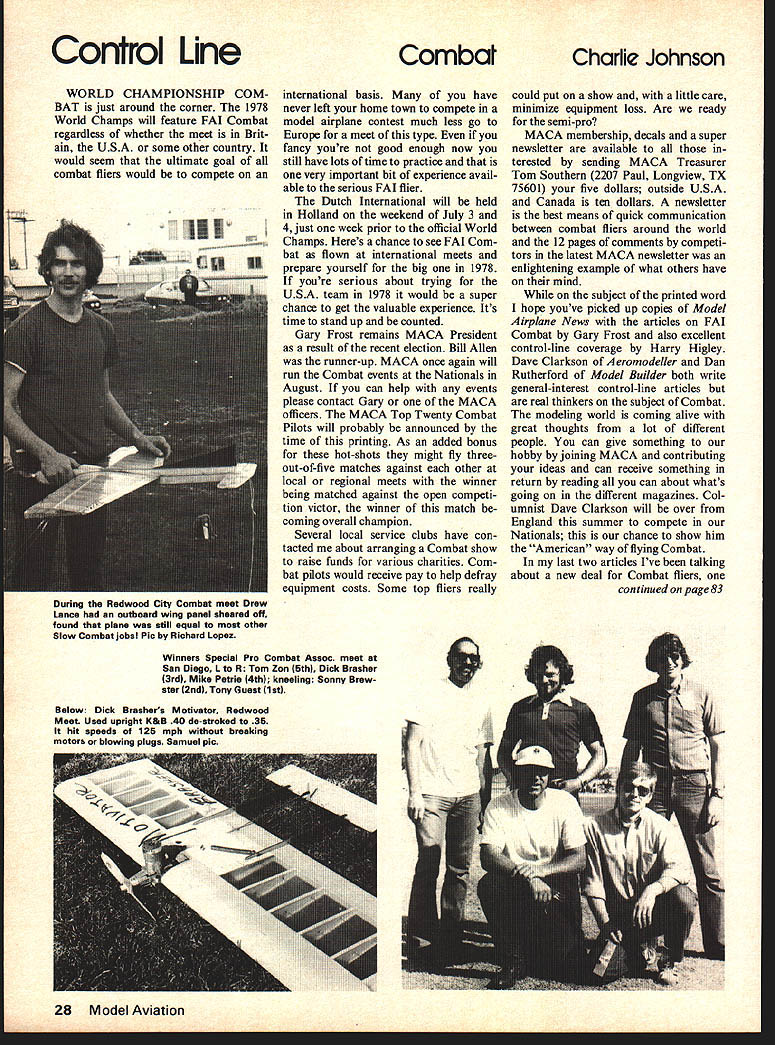
Fast things? Note the picture of Richard Brasher's "Motivator." That's a de-stroked K&B .40 sitting up front. This plane and Tony Guest's "Shrike" were the most impressive at the Special Pro meet with speeds in excess of 120 mph on every flight. The difference was that the Super Tigre on Tony's plane will break but Rich's K&B is running considerably under its design limit and doesn't even blow plugs. This time it was the horsepower machine coming out on top. Next time?
You'll notice in the picture of the winners at this meet that none of the top fliers are exactly kids. Two of them are over 30. To all the kids with quick reaction times we say humble pie; experience seemed to be more important than lightning reflexes. Also observe that Tom Zon is smoking a pipe. I was circle marshal in one match where Tom's opponent wrapped his lines around Tom's pipe and, since a pipe is to Tom as a winch is to Popeye, the pipe came off. It is not funny when it happens and points out the potential danger in getting lines caught on watches, pipes and sunglasses or, worse yet, your prescription glasses.
The Combat Advisory Committee has recommended minor changes in Fast Combat but Slow Combat probably will have a major overhaul. The main problem is that it is not slow! How to slow things down without becoming overly Mickey Mouse is the problem facing the Committee, and ultimately the Contest Board in consideration about to be given for AMA 1978-79 rules. In the latest MACA Newsletter Howard Rush claims that 120 mph is possible for a Slow Combat ship and, no doubt it would be, if you build a light, clean ship and put the tank on the inboard side of the fuselage. A fuel regulation or special venting is needed to keep the engine from going rich once you've become airborne. By restricting the uni-flow vent It is possible to get a good transition from ground to air with a normal tank. A jet from 20 to 30 thousandths will get you in the ballpark. Just put the jet in a piece of fuel tubing and slip it over the uni‑flow vent once you've fueled the tank.
Some of the suggestions others have made to keep the event under control would be requiring the tank to be completely on the outboard side of the body and in front of all portions of the leading edge, the latter requirement directed against swept‑forward wing designs. There is no need for either the 300 sq. in. wing or profile body requirement since all the better turning planes are pushing 400 sq. in. anyway, and what possible harm could there be in allowing a built‑up fuselage? The 24 in. length is a good idea, but the rest of the profile thing is a can of worms and a good place to start an argument over interpretations. Wing area and profile definitions come from racing events where they are needed and that's where they should stay.
AMA Fast Combat has no minimum requirement for wings but you'll notice that the majority of designs are all over 300 sq. in. and not one design has a built‑up body or cowled engine and these planes are lighter and faster than Slow Combat planes. Wheels and landing gear are another sore point, not only in transporting a bunch of models, but when contestants bicker over the size, shape, and whether or not the pit man assisted the airplane in take‑off. The small amount of weight and drag isn't worth the potential hassles. Prop restrictions have been tried all over the country with mixed results. The CAC had the option of voting for a 10‑6 nylon but the results are not known at this time. A 10‑6 takes the bite out of most motors and would make it cheaper to fly since they don't break as often as wood props. The bushing vs. ball‑bearing controversy goes on. Most agreed that a bushing motor could be made to go as fast as a ball‑bearing model but wouldn't stand up as long.
My favorite equalizer would be the minimum weight rule such as they have in RC Pylon Racing. For example, let's make a 30 oz. minimum for Slow ships. You could make your plane super strong at this weight and a whole lot slower through the turns. Flat‑out speeds aren't affected as much by weight. The super designers are now biting their nails, egad! A giant step backwards. It was envisioned when Slow Combat came about that there would be a place where the guy with the ringmaster would have a fair chance and at least not be humiliated by one of the kamikazes we call Slow Combat planes.
If all planes weighed 30 oz. or more the better designed and carefully built plane will still fly better but with less noticeable differences. We can fudge on just about any rule but the minimum weight rule would get them every time. When you think about any of the Combat events it's supposed to be a contest of skill, the pilot's skill, and the first thing everyone starts thinking about is how to get some advantage through faster and quicker planes and more powerful engines but not in developing his own skill. How would you like to fight a pistol duel and have the other guy decide he needs an advantage and show up with a machine gun? The only response to my asking for your favorite maneuver was from someone in Virginia that said he liked to "crash" a lot. Send letters to: Charlie Johnson, 3716 Ingraham St., San Diego, CA 92109; (714) 273‑6530.
Transcribed from original scans by AI. Minor OCR errors may remain.

