
Control Line: Combat
Charlie Johnson
Ten years ago this time of year, I was attending the British Nationals for the first time. That was back in my more serious days of flying Combat. This included a lot of Fast and Slow and some novelty models powered by .15s. I sure like those little .15-powered models that you could load into your glove compartment (since the trunk and rear seat were already taken over by the “real” airplanes).
What I saw in England was a new way of flying Combat. It was flown under FAI rules, and there were a lot of rules. It was the closing days of a Combat we’ll not likely ever see again. It was different because the better man almost always won. The luck factor hardly ever played a part, and when it did, it only shifted the ultimate honors among a small group of top fliers.
The models were very strange (according to our ideas). They were large, tight-turning, dead slow—and best of all (or worst, depending on your viewpoint) they were powered by wonderful, stinky diesels. A half-dozen models would last the whole season, which might include 20 contests and weekly practice sessions. The practice sessions involved flying Combat with one’s “mates.” Just as today, everyone hoped for a little edge with a slightly tighter plane or a specially-tuned engine that pulled the model one mph faster.
Very little support gear was required to fly such Combat: a couple of models and a small bottle of diesel fuel. No battery, plugs, extra props—not even extra lines. The favorite prop was the yellow Tornado 8-6 clipped to 7-6 and depitched by hitting the ground a few good licks. Early American observers noted that there was an awful lot of crashing going on. This was really no big thing, since the model or prop rarely broke, and many found it their advantage to shut it rather than give up a cut. Pit stops were not long, involved affairs—merely brief interruptions, since only a flip of the prop was needed. FAI Combat of this period was four minutes of chasing one another with an occasional ricochet off the turf.
Combat was immensely popular, too. They limited the number of entries at the 1974 British Nationals to the first 128 pre-entries, with about that many again wishing to get into the competition! I just arrived and, somehow, garnered one of the spots. Oh yes, they allowed foreign competition; it was unheard of for them to win the British Nationals. The contests were held under the previously mentioned FAI rules, but there was a code of sportsmanship which also prevailed.
Let’s wipe the tears of nostalgia from our eyes and compare the state to our current state of affairs. The current FAI models, not to mention the Fast Combat ships, all have Exocet-missile performance. A half-dozen models per contest is sometimes needed. Lots of backup supplies, like plugs, props, lines—and even spare engines—are also standard practice for the well-prepared competitor. Not too many people practice-fly Combat with anything other than 1/2A models, although the more practice Combat you do the fewer models are generally broken.
One reason for the low attrition rate of the early British models was their well-reinforced structure. The designs had evolved enough that any part that had broken was redesigned or reinforced. The cost for such longevity is extra weight (something like 17 ounces), which isn’t bad for a nylon-covered, nearly indestructible plane.
I didn't dare sneeze, or I'd crash it for sure. Remember, the initial reason for sealing the hinge gap was to get more lift from the tail (and boy, does that work!). Since I didn't have my adjustable handle, I thought I'd try the old “throw some weight in the nose” trick. This slowed down the response but resulted in an airplane which wouldn't stop turning, resulting in a phenomenon known in some nefarious circles as the Fancher Hop after each corner. That's no good, so out came the weight and a pocket knife.
Just before the first official flight, I performed surgery on the basic Hot Rock control handle, moving both lines closer by an eyeballed 1/4 inch total to desensitize the response. In addition, a prop with less pitch was installed and the leadouts moved forward to my arbitrary 30° sweep point, which I discussed in my second column (June 1984 Model Aviation).
The reduced prop pitch would slow response rate, and moving the lines forward (they had been changed by a variety of fliers over the years—improperly I felt) would smooth out the hop. One thing at a time, right! Well, lo and behold, after finally getting a good needle setting, all these things worked out to make the old bird much better than it had been in 1978 and, although I got beat, I wasn't embarrassed. In future columns, I plan to dwell in detail on some of those more exotic trim devices as well as on the basics. This seemed like an ideal opportunity for a preview.
I suppose there is no moral to the above story, except that despite the exciting performance of the modern models, there still is the sickening correlation between performance and model destruction and the level of participation.
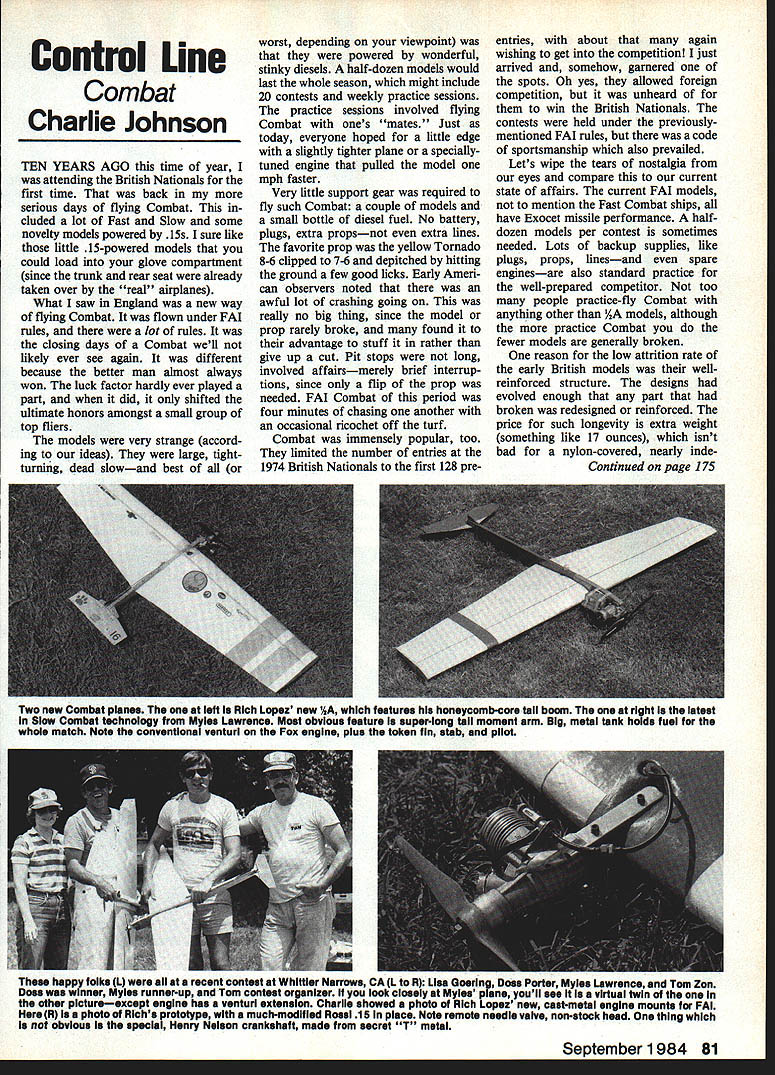
Depending on which pictures are used in this issue you may see two photos of a Slow Combat model designed by Myles Lawrence. One has the very long “cheater” venturi which simulates an inboard tank, and the other model has a conventional venturi with a giant tank which will run for the entire match. The performance setup makes for good stopwatch times, but proved to be too temperamental for Myles and many other Slow Combat fliers. It would seem that once a good setting was obtained, it should work tank after tank. But it doesn't. No one has come up with a consistent solution. (I've convinced Myles that it is the high G loads his model pulls that changes the molecular structure of his fuel.)
According to an article I read in Cycle News, the presence of water in alcohol causes some oils to come out of suspension. They were talking about gasohol, which is only 10% alcohol—and our fuels have up to 70% alcohol, depending on nitro and oil content. We all know how lousy engines run on fuel that has a lot of moisture in it, but whether the lubricating properties have anything to do with it we'll have to leave to Myles and his flying laboratory.
Next time, no more nostalgia, at least for another decade. Instead, raw horsepower and blood-curdling excitement direct from the Bladder Grabber. Wasn't that big ad in Model Aviation real class? With $5,000 worth of prizes up for grabs, the entries may be higher than at the Nationals.
Charlie Johnson 3716 Ingraham St. San Diego, CA 92109
Transcribed from original scans by AI. Minor OCR errors may remain.

