
Control Line: Combat
Charlie Johnson
Bladder Grabber IX
Last year I missed one of the greatest contests of all time, and I promised myself I'd make the next one for sure. The contest I was looking forward to wasn't the AMA Nationals or the World Championships—but the Bladder Grabber IX in Kent, WA. There are other good contests, but this has turned into the premier Fast Combat meet of the year. Look at its credentials: triple-elimination Fast Combat with 35 entries and over $5,000 in merchandise awards furnished by Carver Corporation. You can see why it's worth it to fly out to Seattle from other Combat hot spots like Texas and Detroit.
Results
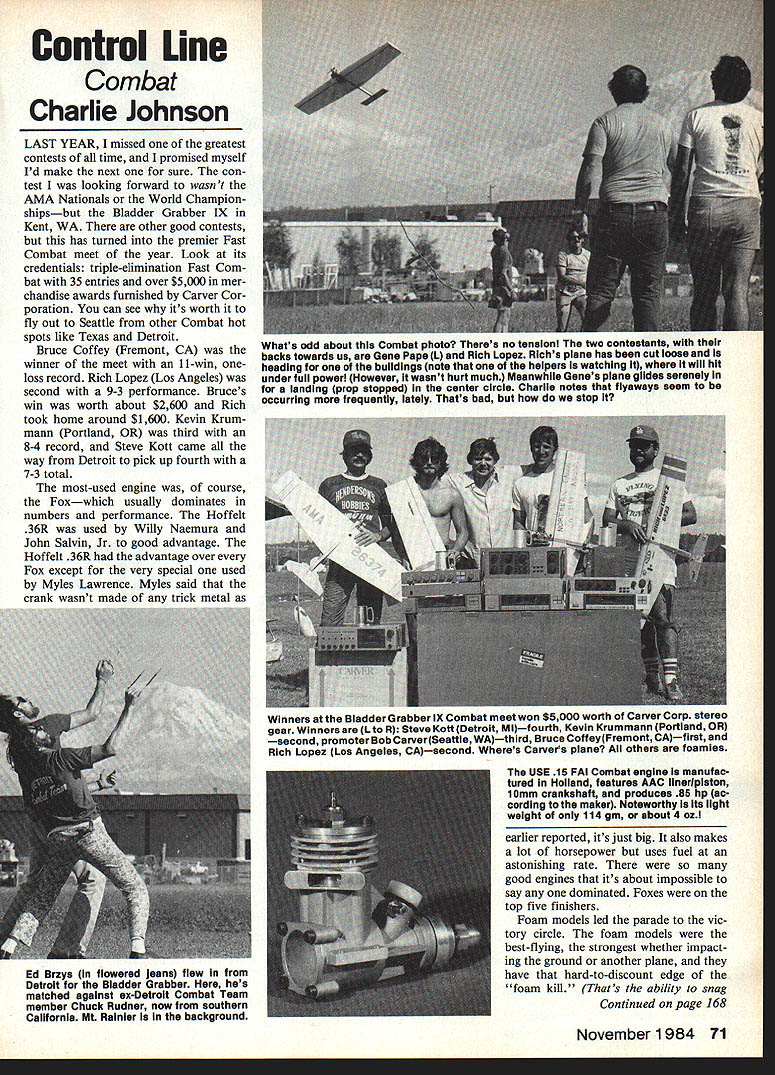
Bruce Coffey (Fremont, CA) was the winner of the meet with an 11-win, one-loss record. Rich Lopez (Los Angeles) was second with a 9-3 performance. Bruce's win was worth about $2,600 and Rich took home around $1,600. Kevin Krummann (Portland, OR) was third with an 8-4 record, and Steve Kott came all the way from Detroit to pick up fourth with a 7-3 total.
- 1st: Bruce Coffey (11-1)
- 2nd: Rich Lopez (9-3)
- 3rd: Kevin Krummann (8-4)
- 4th: Steve Kott (7-3)
Engines and performance
The most-used engine was, of course, the Fox—which usually dominates in numbers and performance. The Hoffelt .36R was used by Willy Naemura and John Salvin, Jr., to good advantage. The Hoffelt .36R had the advantage over every Fox except for the very special one used by Myles Lawrence. Myles said that the crank wasn't made of any trick metal; as earlier reported, it's just big. It also makes a lot of horsepower but uses fuel at an astonishing rate. There were so many good engines that it's about impossible to say any one dominated. Foxes were on the top five finishers.
As often happens at important contests, the usual fuel is discarded in favor of some nasty medicine. The result is more power for part of the flight—but often a blown engine or meltdown. Chuck Rudner had one of his go the meltdown route, where it limped around making strange pops and bangs. This usually means there's a hole in the piston—but in this case, it was just a little sunken. Chuck told me he uses a depth micrometer to determine just how far down the top of the piston has caved in. His standard is to use a piston with .003 (or less) inch; anything approaching .005 is living on borrowed time. Your engine may hole a piston after one run, even though it had less than .003 compression. This is only a general guide that was arrived at after checking many engines. Obviously, it's not worth losing a match at the Bladder Grabber or Nationals because of a bad piston. The best solution is to replace the offending piston, although it is expensive and time-consuming to refit a new one.
Foam models and airframes
Foam models led the parade to the victory circle. The foam models were the best-flying, the strongest whether impacting the ground or another plane, and they have that hard-to-discount edge of the "foam kill"—that's the ability to snag a streamer or string with the foam leading edge of the wing. (R. McM.)
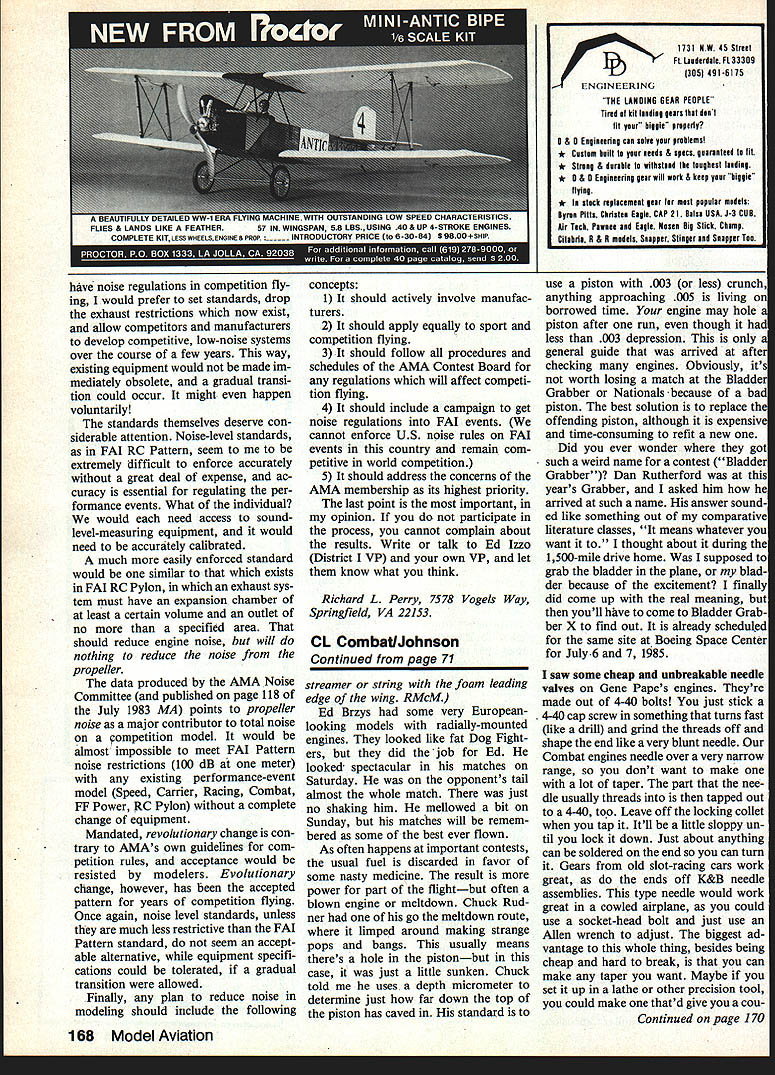
Ed Brzys had some very European-looking models with radially-mounted engines. They looked like fat Dog Fighters, but they did the job for Ed. He looked spectacular in his matches on Saturday. He was on the opponent's tail almost the whole match. There was just no shaking him. He mellowed a bit on Sunday, but his matches will be remembered as some of the best ever flown.
Needles and needle valves
I saw some cheap and unbreakable needle valves on Gene Pape's engines. They're made out of 4-40 bolts. You just stick a 4-40 cap screw in something that turns fast (like a drill) and grind the threads off and shape the end like a very blunt needle. Our Combat engines need only a very narrow orifice, so you don't want to make one that is a lot of taper. The part that needs to be is usually threaded into its body, then tapped out to a 4-40, too. Leave off the locking collar when you tap it. It'll be a little sloppy until you lock it down. Just about anything can be soldered on the end so you can turn it. Gears from old slot-car racing cars work great, as do the ends of K&B needle assemblies. This type of needle would work great in a beveled airplane, as you could use a socket-head bolt and just use an Allen wrench to adjust. The biggest advantage of doing it this way is that you can make any taper you want. Maybe if you set it up in a lathe or other precision tool, you could make one that'd give you a couple of turns rich-lean, rather than the usual one-eighth turn.
Suggested steps to make a simple 4-40 needle valve:
- Insert a 4-40 cap screw in a drill or similar turning tool.
- Grind the threads off the tip and shape it into a blunt needle with the desired taper.
- Thread the valve body and tap it to 4-40, leaving the locking collar off while tapping.
- Solder a turning knob or gear onto the head for adjustment.
Repairs, epoxy injector, and pit tactics
During the Saturday night repairing of the one model I used (it made six matches), I had a chance to use the epoxy injector Chuck Rudner and Myles Lawrence made. It's just a regular syringe with some brass tubing stuck in it and the tip is sharpened so it will slice into soft wood and foam. It's easy to mix the epoxy in equal amounts, because you have the ounce and cc graduations on the side. We also found that the microwave is superior to the old hot-water trick when it comes to warming epoxy so it'll set faster. I put the whole thing in Howard Rush's oven, and it worked fine.
Cleanup was pretty easy, because the epoxy we used didn't stick to the plastic syringe or to the rubber plunger. Make sure the brass tube is clear of epoxy before it sets! I can see a revolution in model repair during matches. Envision a pit crew with premixed portions of epoxy kept in a cooler. The model hits the ground, and a 100-cc portion is rushed to the microwave which is being run by a generator. Not much time left in the match, so the mechanic sets the control to Roast, and 10 seconds later the epoxy is ready to go, and 25 seconds later the "5-minute" epoxy has dried as the engine is being started.
Well, the above may not work too well; but I do have a Howard Rush story for everyone. Howard will be representing the U.S.A. on the Combat team this year, and, besides some exotic FAI stuff, he has some equally exotic Fast Combat material. His choice of propeller was the Y&O cast in carbon fiber. Mind you, this is no thinned-down Y&O, but the real McCoy which you measure with a ruler rather than calipers. Just to confound everyone, his models are very fast using this rather Fifties-appearing prop.
Howard crashed in one of his matches, and Rich Lopez and I couldn't get the prop off. We couldn't get it off during the match, after the match, or for the rest of the day! We theorized that the heat in the crank must have glued it and the prop together. Lopez suggested using a chisel—or maybe just sticking the whole thing in the microwave and seeing what would happen. Just after midnight, Rich succeeded in getting the remains of the prop off using a gear puller.
The same thing can happen with some of the plastic-type props when they break off cleanly with the thrust washer. Nothing short of a miracle would have saved us, but a good water-pump pliers might help you. Something we did think about after the match was lost was leaving the hub in place and just putting on another prop, since the engine had a Brasher crank and there would have been enough room for a second prop if the washer was left off.
New .15 engine from USE
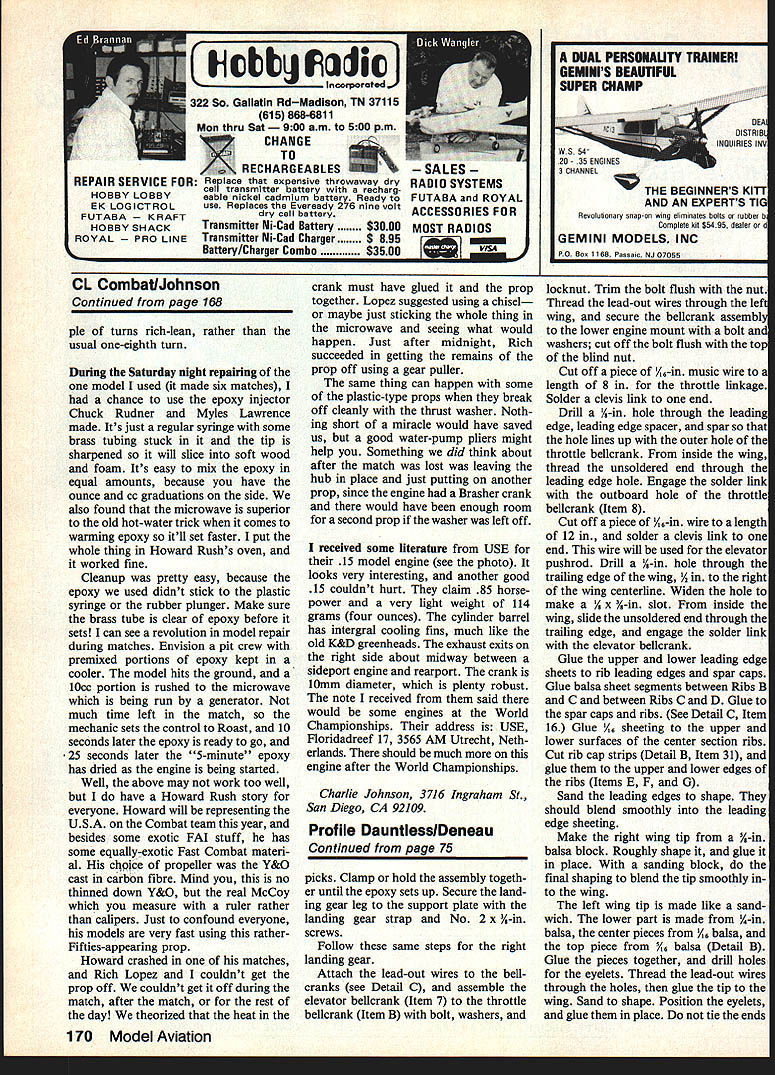
I received some literature from USE for their .15 model engine. It looks very interesting, and another good .15 couldn't hurt. They claim .85 horsepower and a very light weight of 114 grams (four ounces). The cylinder barrel has integral cooling fins, much like the old K&D greenheads. The exhaust exits on the right side about midway between a sideport engine and rearport. The crank is 10 mm diameter, which is plenty robust. The note I received from them said there would be some engines at the World Championships. Their address is:
- USE, Floridadreef 17, 3565 AM Utrecht, Netherlands
There should be much more on this engine after the World Championships.
Charlie Johnson, 3716 Ingraham St., San Diego, CA 92109.
Transcribed from original scans by AI. Minor OCR errors may remain.

