

Control Line: Combat
Charlie Johnson
How Come?
By now most readers who have seen the World Championship results have discovered that the U.S. Combat team didn't dominate. In a full double-elimination contest with one winner, there are at least two reasons for each of the other 41 contestants to be eliminated. Spectators at the Championships noticed some contestants were simply outclassed or using substandard equipment. A number of pilots treated Combat flying as a hobby and were subjected to early retirement at WC level.
The main reason many people lost matches, including most of the Americans, was over-eagerness — taking too big a cut. U.S. fliers' background in Fast Combat seemed to work against them; they tried to finish matches quickly. That tendency wasn't as obvious at Team Trials and Nationals because contestants' flying styles there are fairly similar. Success against other Americans at trials doesn't necessarily predict success at the World Championships. Fast-Combat aggressiveness often hindered rather than helped.
European Models and Tactics
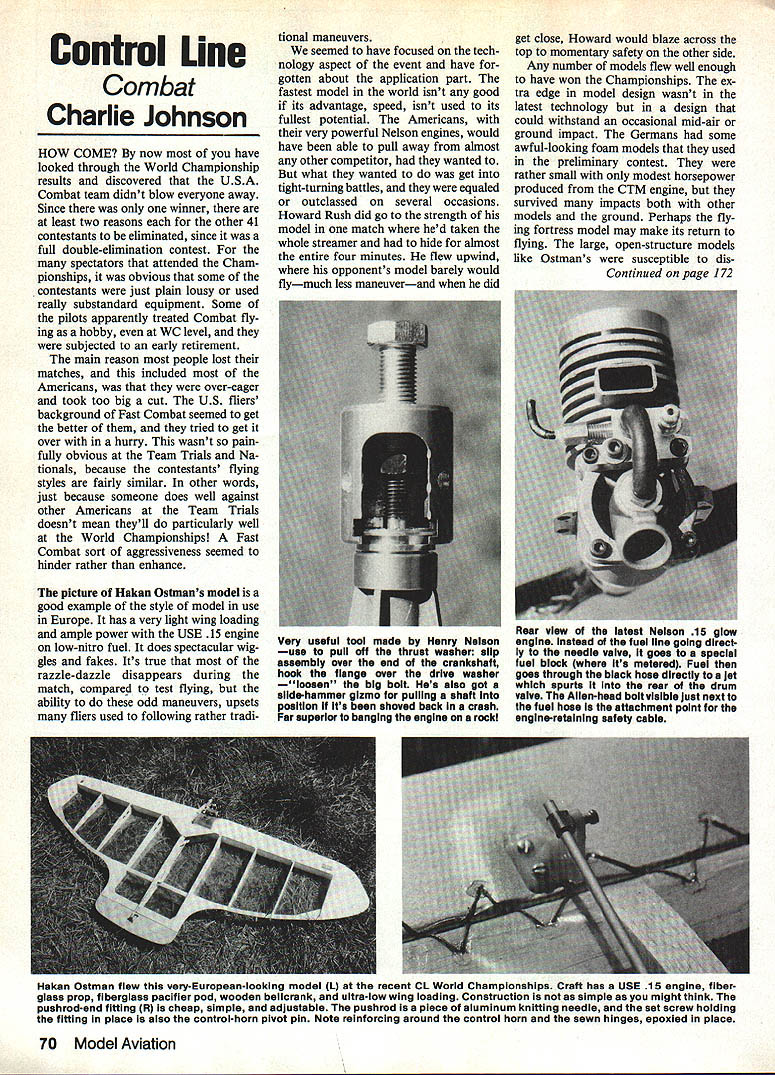
Hakan Östman's model is a good example of the European style: very light wing loading and ample power (a USE .15 on low-nitro fuel), capable of spectacular wiggles and fakes. Much of the razzle-dazzle disappears during a match compared with test flying, but those odd maneuvers upset fliers used to more traditional patterns. Many teams focused on technology and forgot about application: the fastest model is useless if its speed advantage isn't used to full effect.
Americans with powerful Nelson engines could often have pulled away from most competitors, but many wanted tight-turning battles and were equaled or outclassed on several occasions. Howard Rush used his model's strengths in one match: after taking a whole streamer he hid for almost the entire four minutes, flying upwind where his opponent barely flew. When his opponent did get close, Howard would blaze across to momentary safety.
Model Design and Survivability
Many models were capable of winning. The extra edge wasn't always the latest technology but rather a design able to withstand occasional midair or ground impacts. The Germans used some austere foam models in prelims — small, modest horsepower from CTM engines — that survived many impacts. Perhaps "flying fortress" models will make a comeback. Large open-structure designs like Östman's were susceptible to disabling midair damage; compact models with their mass concentrated at the center often survived first midairs and stayed up long enough to strip an opponent's streamer.
Defensive Tactics
These tactics and styles don't apply to Fast Combat but can be very effective in Slow Combat. I often wondered how many matches could be won using only defensive tactics. John Jo used this approach to win many matches at the Nationals, letting opponents' maneuvers defeat themselves. You may scoff at fake-and-wiggle tactics if you haven't seen them done properly, but the results speak for themselves.
Team Trials Suggestion
Paul Smith suggested holding U.S. Team Trials in the Bahamas. No one would have a home-field advantage, the weather is pleasant, and package deals for a week can be cheaper than a mainland flight. A Bahamas venue might attract more entrants — and their families — by combining trials with a vacation.
Nelson Engine, Rear Intake and Fuel
Much of our time before and during the WC was spent fiddling with the new Nelson rear-intake setup Howard Rush was using. In my experience this is the best engine I've seen for trouble-free performance and dependability. The preferred setup is the AAC version (aluminum piston in a chromed-aluminum liner) with rear intake to avoid dirt on impact and with a button-insert head.
The button inserts started life as GlowBee YA plugs and are held in the head by a threaded collar similar to the SuperTiger X-40. Only the element of the plug is actually in the combustion chamber. The performance gain is nearly 1,000 rpm over the conventional head with a screw-in plug. We destroyed a pocketful of these relatively expensive plugs ($2.50 each) before discovering the problem wasn't the 40% nitro but the oil choice. Howard had tried a mix using soybean oil (about 10% soybean oil with 2% lubricin) to improve mileage. We then tried a 40% nitro mix using Tom Fluker's recipe (which used Ucon oil), and the problem disappeared.
The real cause of the low mileage turned out to be fuel leaking around the needle. Wrapping Teflon tape around the needle before screwing it into the body sealed the leak. Mileage improved to less than an ounce per minute, and the plugs survived, even with 40% nitro and Ucon lubricant.
Mounting and Safety
As more fliers use these potent engines, remember they won't perform well unless mounted securely. A friend's "dog" engine suddenly found another 3,000 rpm when mounted on Howard's model because of an extremely rigid motor-mount assembly made of carbon fiber and wood. The Nelson mounting point for the safety cable should attach to the engine (fuel block) rather than motor-mount bolts, since bolts often come loose and the fuselage can fly off.
If you use the "noose" method, put tubing over the wire where it wraps around the engine to prevent wear or case damage if the motor comes out of the plane. At the WC I saw one engine damaged by the cable and another with gouges in the case.
Other Engines and Props
The USE .15 I reported on previously was in wide use at the Championships. They appeared well made and produced adequate horsepower — not as much as the Nelson — and weigh about 125 grams versus the Nelson's 160 grams. They are also cheaper (at least in Holland). I was warned about piston troubles, but the engines I saw performed well. If I had to choose one engine, it would be the Nelson AAC rear-inlet.
There were also some new Grish props reminiscent of the old Tornado 7-4, which used to stretch at the hubs. A bunch of these new props were distributed as samples and used during the contest.
Transcribed from original scans by AI. Minor OCR errors may remain.

