
Control Line: Combat
Charlie Johnson
Traveling and Logistics
The World Championships were more than hot rod airplanes and interesting flying styles — they were an exercise in logistics: getting a dozen or more fragile models many thousands of miles through airport terminals, cargo holds, inspectors, and automobiles. The days of sticking a couple of models in a raincoat are over. Giant, special-purpose boxes were the order of the day. Unfortunately, the excess baggage charge was so great that many competitors sold their models rather than take them home.
Cardboard boxes make wonderful containers. They're cheap, light, and very nearly as strong as some plywood containers. Bicycle-size boxes are marginal because of their dimensions. Avoiding excess baggage charges is becoming impossible. Other smaller, appropriately shaped boxes are available from bicycle shops, motorcycle dealers, furniture stores, etc. You have to go shopping the back alleys. Use lots of reinforcing tape to hold things together, and pour Styrofoam balls in the box after the models are put in. If the model is foam, then just leave the outer cores on the wing. You can integrate your pit box into the container, but the more weight you add, the more chance it will break up from its own mass.
A box that will hold four models will usually get by the gate at most airports. Two boxes with four models each are preferable to one very large box. Often you can save a large excess-baggage fee by giving the porter a generous tip. Make sure he's going to take the bags all the way through for you and not just the few additional steps to the check-in desk where you might be ambushed. There are limits to the size of the boxes, but rarely does anyone check unless it looks too big. It's really hard to pin any airline people down to just what they will allow, so plan for the worst and have additional money, just in case.
For the convenience of both yourself and those who handle your bags, install a handle of some sort. Printing "Fragile" on your box seems to be a waste of time; better to put a bullseye in the middle! Baggage handlers have their own records for height and distance, so I'd recommend having only the models in the box, minus engines.
Air Travel Tips
- Direct airline flights are always best. It takes at least a 20-minute overlap between connecting flights to get the baggage shuffled around.
- If you have to scramble from one flight to the next and there's less than 20 minutes, be prepared for the worst.
- If your bag doesn't arrive at the destination with you, go to the appropriate baggage problem desk and raise Cain.
- If you must leave the terminal for a hotel or a friend's house, make sure the airline delivers the bags to you. They may not offer, but they'll usually send the stuff out in a taxi.
Travel in the U.S.A. is nothing compared to overseas flights. Try to stay a day or two at your arrival city, just in case your bags are one flight behind. Customs inspectors don't know anything about models — it's better to let them think they are toys with no commercial value. I have a friend who's going to Australia for their Nationals this winter. When he applied for his visa, he made the mistake of saying he was going to fly in their National Championships. New forms and tons of paperwork followed. Apparently, they thought he might win and take vast sums of money out of the country as his prize. Many countries won't even let you in unless you have a certain amount of money. Charm and flying skill don't count; they want to see the greenbacks!
With more of us flying around the country and the world to meets, it's important to check into air fares. I've been able to fly to Boston from San Diego the last three times for $332–$378, which is less than half what other people pay to fly the same place on the same plane. There's almost always a cheaper way to go than most travel agents will tell you. They start off with first class and move down until they've hit a charter flight or apex fare. If there isn't a cheap fare, then I don't go!
MACA and Organization News
I suppose I should have flown up to the MACA (Miniature Aircraft Combat Association) Nationals, but it was the weekend after the World Championships. I only have the results of Fast Combat, but I heard the meet was a success. We'll have the MACA Top Twenty the next time around. The organization and newsletter are doing pretty well. I was looking through a newsletter from 10 years ago, and unlike most organizations, they met their original goals. They've promoted FAI Combat and helped select and send several teams to World Championships. They've kept up the newsletter and run a Combat at the Nationals. The Combat Advisory Committee, promoted by MACA, has done a lot to improve communication between Combat fliers and the CLCB (Control Line Contest Board).
I have to admit I was a little tardy in renewing my membership, but you can join, too, by sending $9.00 to MACA c/o Gary Frost at 1012 Bedford Lane, Ballwin, MO 63011. By the way, Chuck Rudner was the number one person on the Top Twenty list in 1974!
Engines and Equipment
Henry Borra from USE Engines sent along some more information on a diesel version of their fine-running glow. The diesel is currently available from the factory for HFL 350 plus HFL 18 air mail. You can check with a bank that deals in foreign currency to find out how much that is; I suspect around $80–$100, American. Write directly to Henry Borra, Director, at the World Champs at Floradreef 17, 3565 AM Utrecht, Holland. The glow USE .15 was used at the World Champs by both Meyer and Wakkerman for a one-two punch, plus by many other Europeans. It's hard to argue with the results.
Under close observation lately has been the Hoffelt .36R and the Myles Lawrence Fox .36 with ABC liner/piston and an outrageously giant crankshaft. Myles turned 140 mph at the Whittier Narrows Speed/Racing meet and backed it up with 138 mph. The Hoffelt engine was in the same bracket a few weeks earlier. The secret supplier of the Fox parts may make them available if there is a demand. I'm going back to my 10-year-old newsletters.
Marvin Denny and Slow Combat
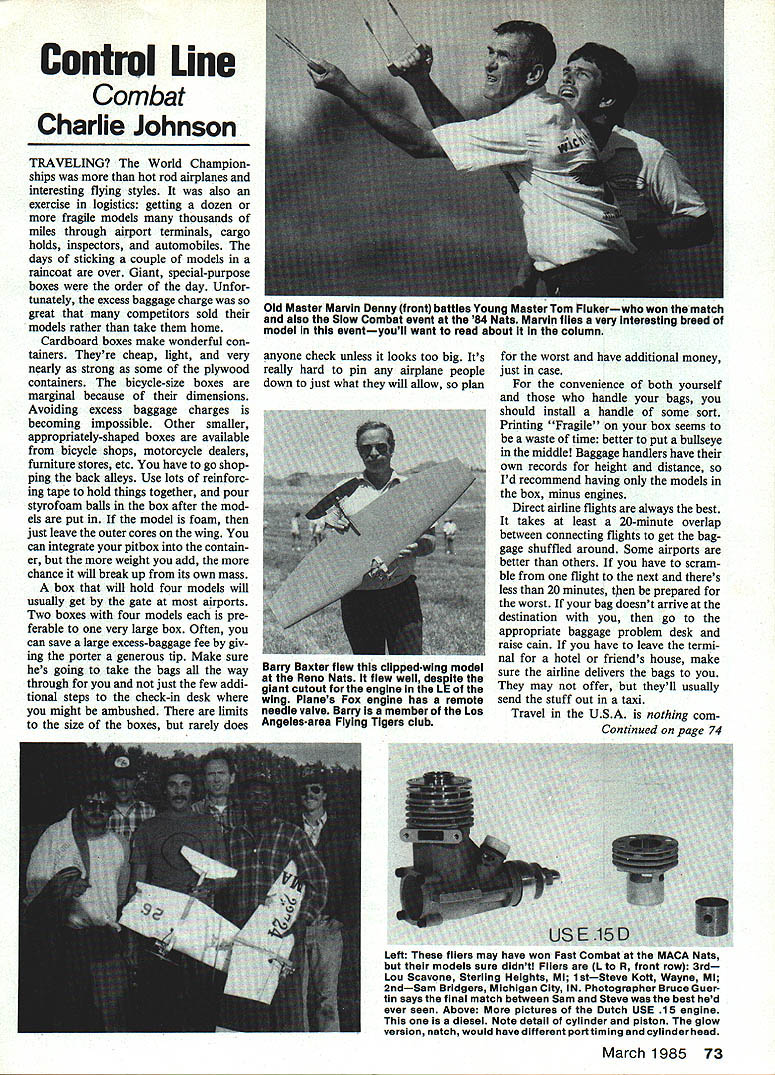
I had a long conversation with Marvin Denny from Wichita just before the Nationals last summer. A lot of the conversation was about the procedures to be used at the Nationals, but many of his thoughts on Slow Combat also came out. Marvin is a very competitive Combat flier. His real love is Slow, but he also flies the others. His models feature a fairly thin aerofoil for fast level speeds and flaps for tight turns. Nothing really exotic, but the system is pretty well worked out.
He purposefully uses a flexible wire between the two flaps: the inboard flap gets full deflection (because the control horn is hooked up to it), but the outboard flap doesn't get the full impact because the connecting link bends a little. This is another variation of differential flaps that were all the rage back in the days of the Thunderbird Stunter. One warning Marvin gave concerning launching a flapped model is not to launch it with a lot of wind blowing from the back, because it will push the model directly into the ground.
If there's one skill Marvin has perfected over the years, it's patience. He has very smooth-running and consistent models and he uses the full five minutes to work over an opponent. Marvin will hate me for this, but he has a very European flair to his flying, as we observed with the Dutch and others at the World Champs. There've been many matches where his opponent got a cut or two on Marvin, but five minutes is a long time, and except for an occasional upset by Tom Fluker, he usually returns the favor.
Season Notes
Combat has really slowed down around the country this time of year. The King Orange meet and the Buckeye Regionals (magic carpet time) are about the only things going. The Chicago area crazies do have their Frozen Finger meet, but anything under 75° is just too cold for us laid-back Californians.
Charlie Johnson 3716 Ingraham St., San Diego, CA 92109.
Transcribed from original scans by AI. Minor OCR errors may remain.

