
Control Line: Combat
Charlie Johnson
MACA Top Twenty
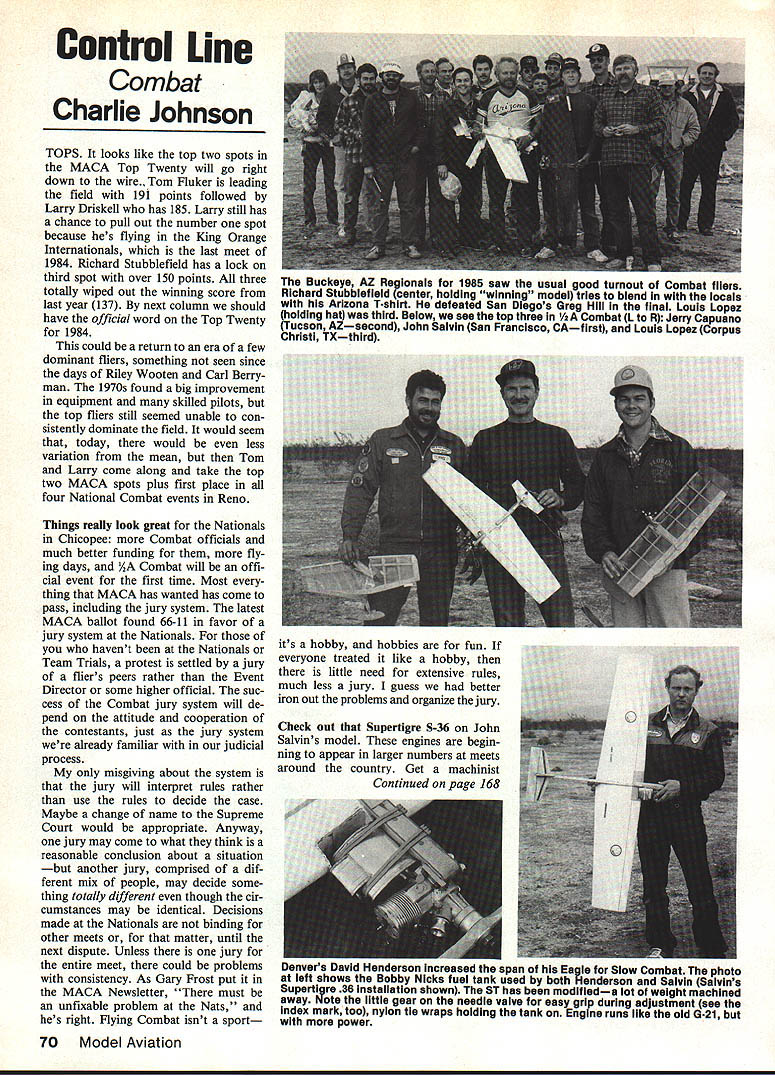
TOPS. It looks like the top two spots in the MACA Top Twenty will go right down to the wire. Tom Fluker is leading the field with 191 points followed by Larry Driskell with 185. Larry still has a chance to pull out the number one spot because he's flying in the King Orange Internationals, which is the last meet of 1984. Richard Stubblefield has a lock on third spot with over 150 points. All three totally wiped out the winning score from last year (137). By next column we should have the official word on the Top Twenty for 1984.
This could be a return to an era of a few dominant fliers, something not seen since the days of Riley Wooten and Carl Berryman. The 1970s found a big improvement in equipment and many skilled pilots, but the top fliers still seemed unable to consistently dominate the field. It would seem that, today, there would be even less variation from the mean, but then Tom and Larry come along and take the top two MACA spots plus first place in all four National Combat events in Reno.
Nationals and the Jury System
Things really look great for the Nationals in Chicopee: more Combat officials and much better funding for them, more flying days, and 'A' Combat will be an official event for the first time. Most everything that MACA has wanted has come to pass, including the jury system. The latest MACA ballot found 66-11 in favor of a jury system at the Nationals. For those of you who haven't been at the Nationals or Team Trials, a protest is settled by a jury of a flier's peers rather than the Event Director or some higher official.
The success of the Combat jury system will depend on the attitude and cooperation of the contestants, just as the jury system we're already familiar with in our judicial process.
My only misgiving about the system is that the jury will interpret rules rather than use the rules to decide the case. Maybe a change of name to the Supreme Court would be appropriate. Anyway, one jury may come to what they think is a reasonable conclusion about a situation — but another jury, comprised of a different mix of people, may decide something totally different even though the circumstances may be identical. Decisions made at the Nationals are not binding for other meets or, for that matter, until the next dispute. Unless there is one jury for the entire meet, there could be problems with consistency. As Gary Frost put it in the MACA Newsletter, "There must be an unfixable problem at the Nats," and he's right.
Flying Combat isn't a sport—it's a hobby, and hobbies are for fun. If everyone treated it like a hobby, then there is little need for extensive rules, much less a jury. I guess we had better iron out the problems and organize the jury.
Engines and Equipment
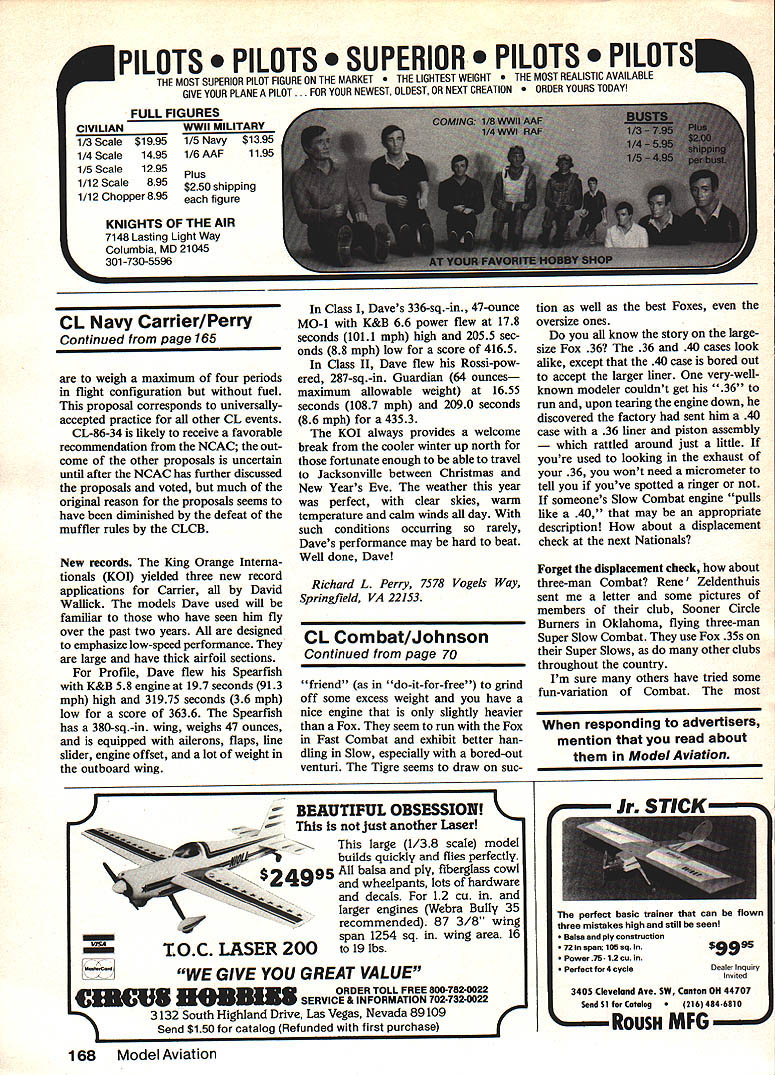
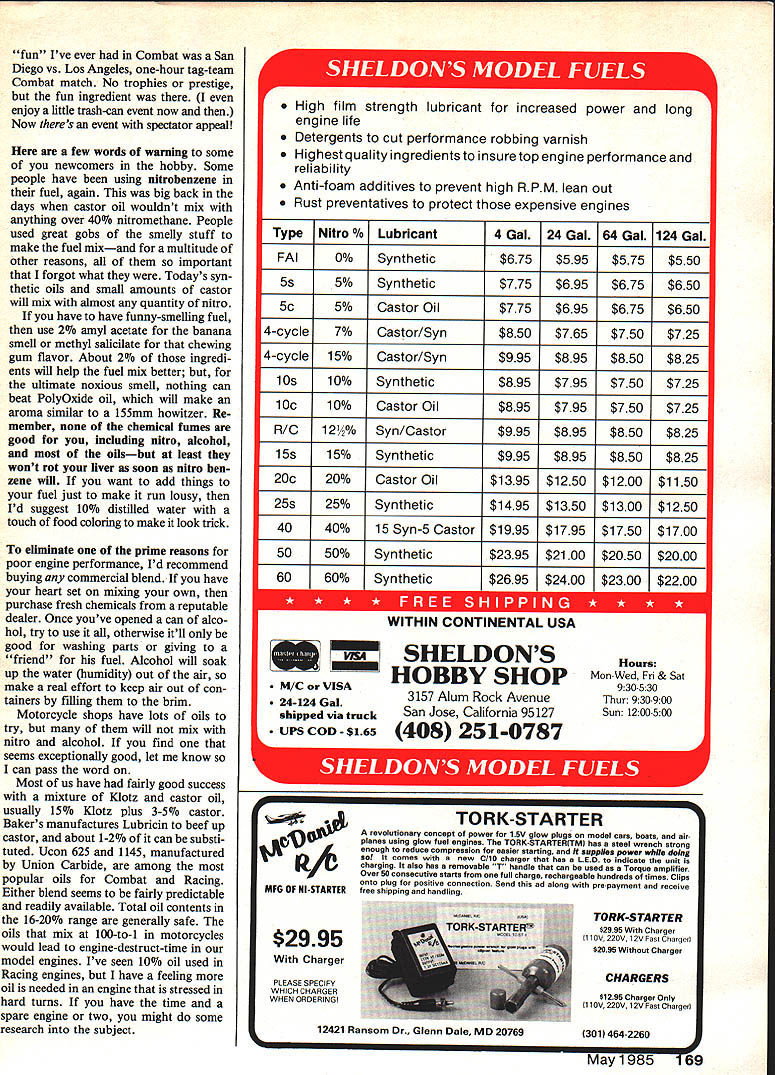
Check out that Supertigre S-36 on John Salvin's model. These engines are beginning to appear in larger numbers at meets around the country. Get a machinist friend (as in "do-it-for-free") to grind off some excess weight and you have a nice engine that is only slightly heavier than a Fox. They seem to run with the Fox in Fast Combat and exhibit better handling in Slow, especially with a bored-out venturi. The Tigre seems to draw on suction as well as the best Foxes, even the oversize ones.
Do you all know the story on the large-size Fox .36? The .36 and .40 cases look alike, except that the .40 case is bored out to accept the larger liner. One very well-known modeler couldn't get his ".36" to run and, upon tearing the engine down, he discovered the factory had sent him a .40 case with a .36 liner and piston assembly — which ran only marginally. If you're used to looking in the exhaust of your .36, you won't need a micrometer to tell you if you've spotted a ringer or not. If someone's Slow Combat engine "pulls like a .40," that may be an appropriate description! How about a displacement check at the next Nationals?
Events and Club Activities
Forget the displacement check — how about three-man Combat? Rene Zeldenhuis sent me a letter and some pictures of members of their club, Sooner Circle Burners in Oklahoma, flying three-man Super Slow Combat. They use Fox .35s on their Super Slows, as do many other clubs throughout the country.
The most fun I've ever had in Combat was a San Diego vs. Los Angeles, one-hour tag-team Combat match. No trophies or prestige, but the fun ingredient was there. (I even enjoy a little trash-can event now and then.) Now there's an event with spectator appeal!
Fuel, Oils, and Mixing Advice
A few words of warning to some of you newcomers in the hobby. Some people have been using nitrobenzene in their fuel, again. This was big back in the days when castor oil wouldn't mix with anything over 40% nitromethane. People used great gobs of the smelly stuff to make the fuel mix — and for a multitude of other reasons, all of them so important that I forgot what they were. Today's synthetic oils and small amounts of castor will mix with almost any quantity of nitro.
If you have to have funny-smelling fuel, then use 2% amyl acetate for the banana smell or methyl salicylate for that chewing-gum flavor. About 2% of those ingredients will help the fuel mix better; but, for the ultimate noxious smell, nothing can beat PolyOxide oil, which will make an aroma similar to a 155mm howitzer. Remember, none of the chemical fumes are good for you, including nitro, alcohol, and most of the oils — but at least they won't rot your liver as soon as nitrobenzene will. If you want to add things to your fuel just to make it run lousy, then I'd suggest 10% distilled water with a touch of food coloring to make it look trick.
To eliminate one of the prime reasons for poor engine performance, I'd recommend buying any commercial blend. If you have your heart set on mixing your own, then purchase fresh chemicals from a reputable dealer. Once you've opened a can of alcohol, try to use it all; otherwise it'll only be good for washing parts or giving to a friend for his fuel. Alcohol will soak up the water (humidity) out of the air, so make a real effort to keep air out of containers by filling them to the brim.
Motorcycle oils have lots of additives to try, but many of them will not mix with nitro and alcohol. If you find one that seems exceptionally good, let me know so I can pass the word on.
Most of us have had fairly good success with a mixture of Klotz and castor oil, usually 15% Klotz plus 3–5% castor. Baker's manufactures Lubricin to beef up castor, and about 1–2% of it can be substituted. Ucon 625 and 1145, manufactured by Union Carbide, are among the most popular oils for Combat and Racing. Either blend seems to be fairly predictable and readily available. Total oil contents in the 16–20% range are generally safe. The oils that mix at 100-to-1 in motorcycles would lead to engine-destruct-time in our model engines. I've seen 10% oil used in Racing engines, but I have a feeling more oil is needed in an engine that is stressed in hard turns. If you have the time and a spare engine or two, you might do some research into the subject.
Recommended starting points:
- 15% Klotz + 3–5% castor (with 1–2% Lubricin optional)
- Total oil content: 16–20% for Combat use
- Use fresh chemicals and keep containers full to avoid moisture pickup
Slow Combat Tanks and Supplies
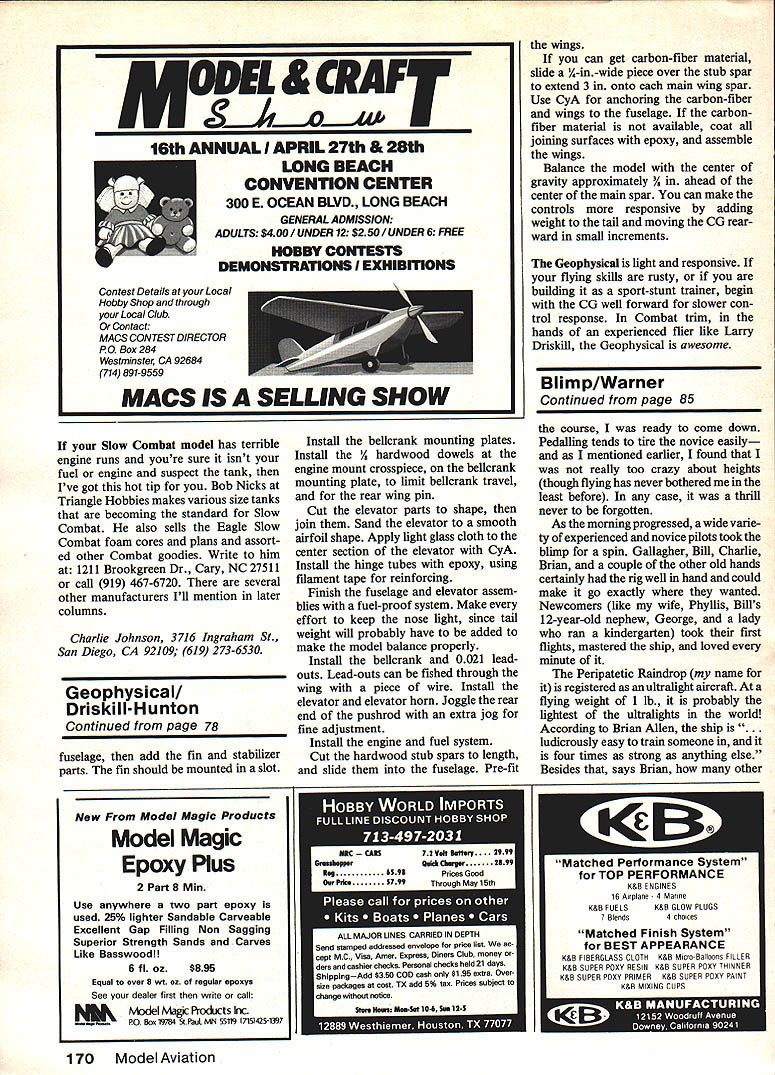
If your Slow Combat model has terrible engine runs and you're sure it isn't your fuel or engine and suspect the tank, then I've got this hot tip for you. Bob Nicks at Triangle Hobbies makes various size tanks that are becoming the standard for Slow Combat. He also sells the Eagle Slow Combat foam cores and plans and assorted other Combat goodies.
Write to: Bob Nicks, Triangle Hobbies 1211 Brookgreen Dr. Cary, NC 27511 Phone: (919) 467-6720
There are several other manufacturers I'll mention in later columns.
Contact
Charlie Johnson 3716 Ingraham St. San Diego, CA 92109 Phone: (619) 273-6530
Transcribed from original scans by AI. Minor OCR errors may remain.

