
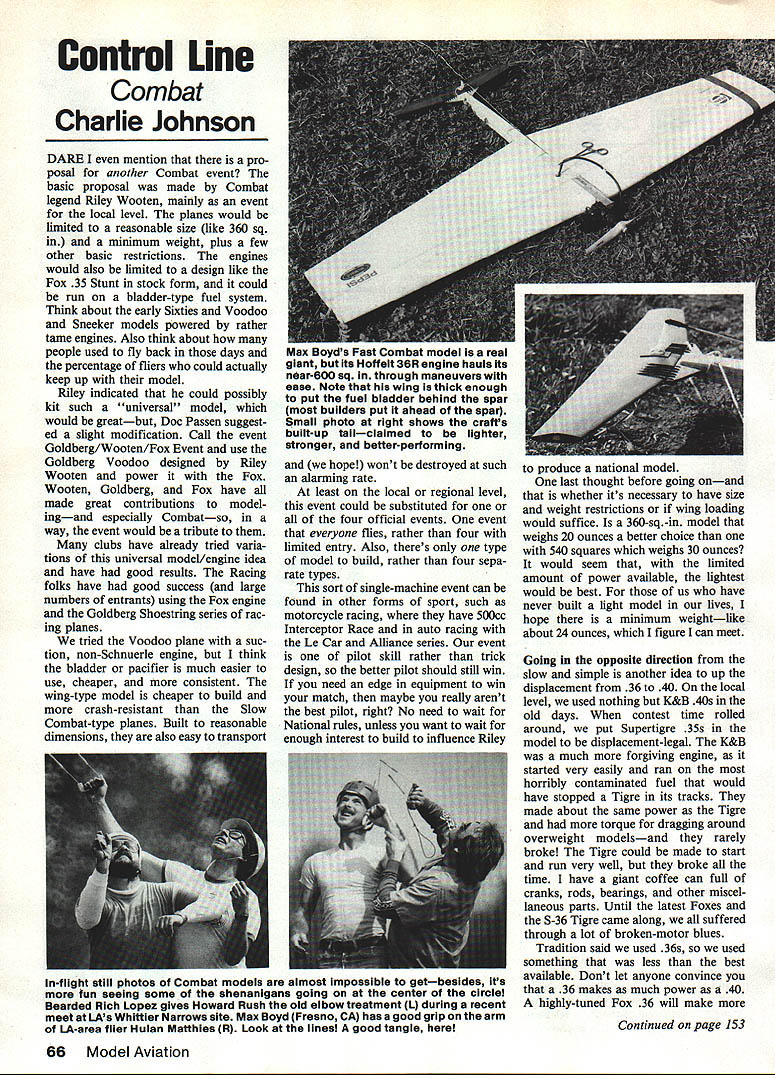
Control Line: Combat
Charlie Johnson
Dare I even mention that there is a proposal for another Combat event? The basic proposal was made by Combat legend Riley Wooten, mainly as an event for the local level. The planes would be limited to a reasonable size (like 360 sq. in.) and a minimum weight, plus a few other basic restrictions. The engines would also be limited to a design like the Fox .35 Stunt in stock form, and it could be run on a bladder-type fuel system. Think about the early Sixties Voodoo and Sneeker models powered by rather tame engines. Also think about how many people used to fly back in those days and the percentage of fliers who could actually keep up with their model.
Riley indicated that he could possibly kit such a "universal" model, which would be great — but Doc Passen suggested a slight modification. Call the event the Goldberg/Wooten/Fox Event and use the Goldberg Voodoo designed by Riley Wooten and power it with the Fox. Wooten, Goldberg, and Fox have all made great contributions to modeling — and especially Combat — so, in a way, the event would be a tribute to them.
Many clubs have already tried variations of this universal model/engine idea and have had good results. The racing folks have had good success (and large numbers of entrants) using the Fox engine and the Goldberg Shoestring series of racing planes.
We tried the Voodoo plane with a suction, non-Schnuerle engine, but I think the bladder or pacifier is much easier to use, cheaper, and more consistent. The wing-type model is cheaper to build and more crash-resistant than the Slow Combat–type planes. Built to reasonable dimensions, they are also easy to transport, and (we hope!) won't be destroyed at such an alarming rate.
At least on the local or regional level, one of them could be substituted for one or all of the four official events — one event that everyone flies, rather than four with limited entry. Also, there's only one type of model to build, rather than four separate types.
This sort of single-machine event can be found in other forms of sport, such as motorcycle racing, where they have the 500cc Interceptor race, and in auto racing with the Le Car and Alliance series. Our event is one of pilot skill rather than trick design, so the better pilot should still win. If you need an edge in equipment to win your match, then maybe you really aren't the best pilot, right? No need to wait for national rules, unless you want to wait for enough interest to build to influence Riley to produce a national model.
One last thought before going on — is it necessary to have size and weight restrictions or would wing loading suffice? A 360-sq.-in. model that weighs 20 ounces is a better choice than one with 540 sq. in. which weighs 30 ounces. It would seem that, with the limited amount of power available, the lightest would be best. For those of us who have never built a light model in our lives, I hope there is a minimum weight — like about 24 ounces, which I figure I can meet.
Going in the opposite direction from the slow and simple is another idea: up the displacement from .36 to .40. On the local level, we used nothing but K&B .40s in the old days. When contest time rolled around, we put Supertigre .35s in the model to be displacement-legal. The K&B was a much more forgiving engine, as it started very easily and ran on the most horribly contaminated fuel that would have stopped a Tigre in its tracks. They made about the same power as the Tigre and had more torque for dragging around overweight models — and they rarely broke! The Tigre could be made to start and run very well, but they broke all the time. I have a giant coffee can full of cranks, rods, bearings, and other miscellaneous parts. Until the latest Foxes and the S-36 Tigre came along, we all suffered through a lot of broken-motor blues.
Tradition said we used .36s, so we used something that was less than the best available. Don't let anyone convince you that a .36 makes as much power as a .40. A highly tuned Fox .36 will make more power than an old-style K&B .40, but a design equal to the Fox except for having .40 displacement will make proportionally greater power than the .36. Now, with all the incredible speeds being obtained by some of the top tuners using .36 engines, one would wonder why anyone would want to go faster. The only argument I can think of is that more of us could go faster more easily. What's the difference between 120 mph and 130 mph when you're having fun? There may be an engine-availability problem in the future with some of the more desirable engines, but there are still a lot of .36s left.
Another alternative to the increase in displacement would be to decrease it to the 3.5 cc (or .21 cu. in.) size. Where the .36 could compete against the .40 at a slight disadvantage, this proposal would obsolete the .36 as far as competition use goes. Availability, lighter weight, and less power (for slowing down the models) are usually cited as reasons for such a change. Any of the engine/model changes really only affect less than a hundred national and regional competitors, so no need to worry. Those of you on the local level can do anything you want (as long as two of you can agree).
I talked with Jed Kusik the other day before he left for his new job working with Henry Nelson. Henry's engine business has really turned into the big time. Don't wait until a week before the Nationals or Team Trials to order your engines! Even though they have orders for hundreds of them from the Chinese and other people all around the world, Henry won't sneer at your two-engine order. He will put it in line with the rest. Jed said he's spent most of the time doing work on engines that had been sent in for repair, so that backlog should have been cleared long before you read this. He's also assembling and testing every unit. They must meet a very high standard before they are shipped, or they're closely scrutinized to find out why they're not performing. Jed said that positioning of the liner in the case is very critical. Even a tiny amount of misalignment causes a large drop in power. If you're into engine disassembly at every opportunity, then you should be careful about liner positioning. Head clearance is the other major factor. Most people run the head down tighter until they start popping plugs and then run it up a few thousandths. Overcompressing seems to be one of the major problems with engines that don't run up to par.
Before you complain about any engine, be sure to test-run it on a very strong test bench and see how it performs. Loose mounts (or ones that distort the case when tightened) will kill the performance of any engine, regardless of the care taken in manufacture. You can take it from several people at the World Championships that I've seen their engines pick up a couple of thousand rpm when run on Henry's test bench.
Besides the usual 140 mph models to report on, the only other useful item is the Zinger 8-1/2 by 6 prop, which many of you think is too small for a Fast or Slow Combat model. It works great in the turns and at full steam, and that's really the measure of any good prop. These props are widely available and cheaper than a lot of other ones on the market. Remember, test your props using a full competition streamer before you trim them and put them through a series of maneuvers.
MACA Top Twenty — 1984
- Larry Driskill — 195
- Tom Fluker — 191
- Richard Stubblefield — 164
- Paul Smith — 121
- Chris Gay — 120
- Steve Kott — 114
- Pete Athans — 99
- Jerry Sabin — 93
- Don Cranfill — 72
- Bud Bodzioch — 66
- Al Jorgensen — 61
- Gary Byerley — 55
- Joe McKenzie — 55
- Phil Cartier — 54
- Bill Lajack — 50
- Ron Malcolm — 47
- Jeff Johnson — 46
- John Salvin III — 45
- Ed Brzys — 43
- Don Holbrook — 42
Charlie Johnson 3716 Ingraham St. San Diego, CA 92109
Transcribed from original scans by AI. Minor OCR errors may remain.

