
Control Line: Combat
By Charlie Johnson
Team News
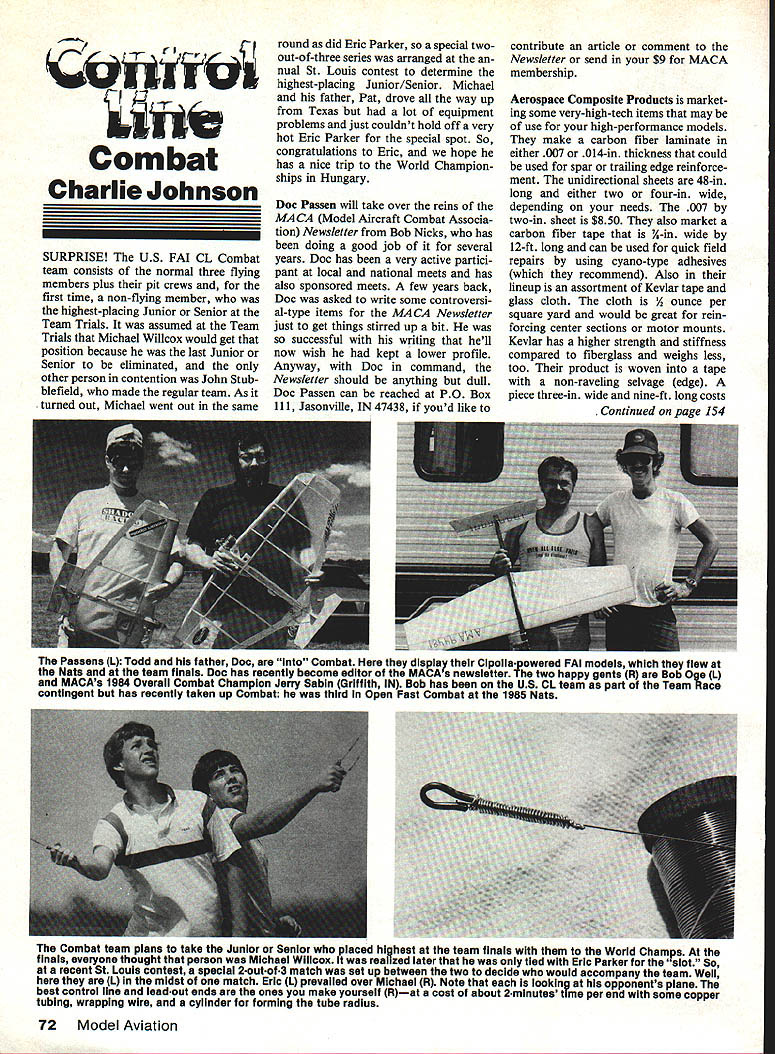
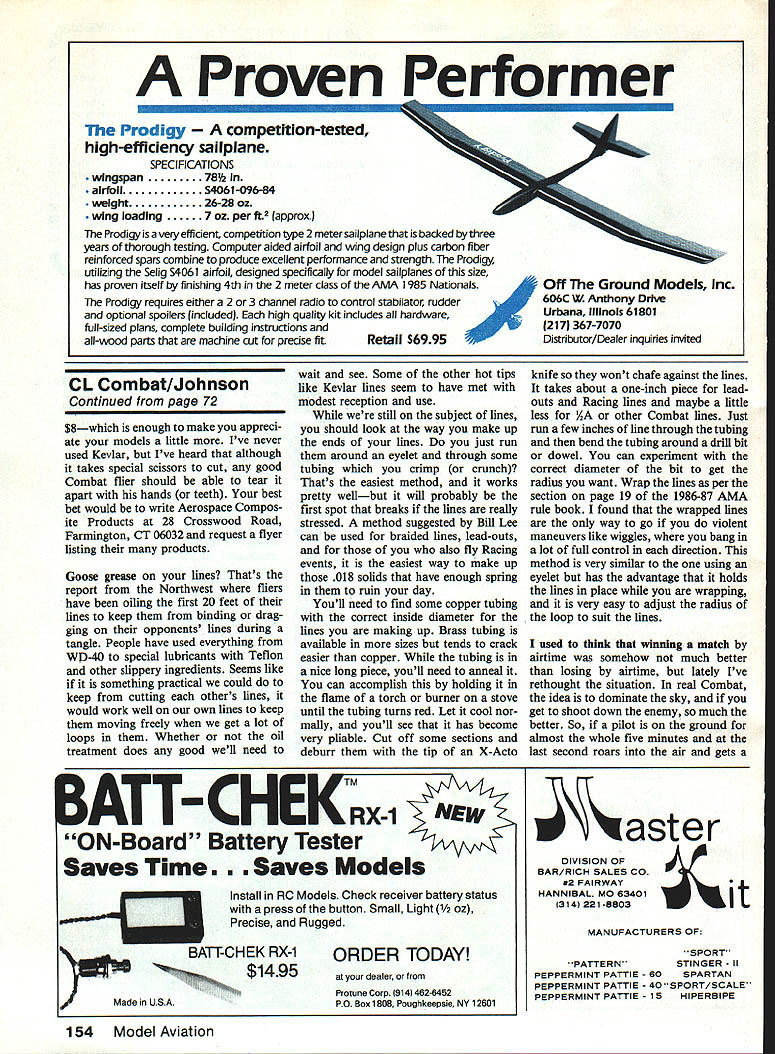
SURPRISE! The U.S. FAI CL Combat team consists of the normal three flying members plus their pit crews and, for the first time, a non-flying member who was the highest-placing Junior or Senior at the Team Trials. It was assumed at the Team Trials that Michael Willcox would get that position because he was the last Junior or Senior to be eliminated, and the only other person in contention was John Stubblefield, who made the regular team.
As it turned out, Michael went out the same round as Eric Parker, so a special two-out-of-three series was arranged at the annual St. Louis contest to determine the highest-placing Junior/Senior. Michael and his father, Pat, drove all the way up from Texas but had a lot of equipment problems and just couldn’t hold off a very hot Eric Parker for the special spot. Congratulations to Eric, and we hope he has a nice trip to the World Championships in Hungary.
MACA Newsletter
Doc Passen will take over the reins of the MACA (Model Aircraft Combat Association) Newsletter from Bob Nicks, who has been doing a good job of it for several years. Doc has been a very active participant at local and national meets and has also sponsored meets a few years back. Doc was asked to write some controversial-type items for the MACA Newsletter just to get things stirred up a bit. He was so successful with his writing that he’ll now wish he had kept a lower profile. With Doc in command, the Newsletter should be anything but dull.
Doc Passen can be reached at:
- P.O. Box 111, Jasonville, IN 47438
If you’d like to contribute an article or comment to the Newsletter or send in your $9 for MACA membership, contact him at that address.
Materials and Suppliers
Aerospace Composite Products is marketing some very high-tech items that may be of use for your high-performance models. They make a carbon fiber laminate in either .007 or .014-inch thickness that could be used for spar or trailing edge reinforcement. The unidirectional sheets are 48 inches long and either two or four inches wide, depending on your needs. The .007 two-inch sheet is $8.50.
They also market a carbon fiber tape that is 3/8 inch wide by 12 feet long and can be used for quick field repairs using cyano-type adhesives (which they recommend). Also in their lineup is an assortment of Kevlar tape and glass cloth. The cloth is 1/2 ounce per square yard and would be great for reinforcing center sections or motor mounts. Kevlar has higher strength and stiffness compared to fiberglass and weighs less, too. Their Kevlar product is woven into a tape with a non-raveling selvage (edge). A piece three inches wide and nine feet long costs $8 — which is enough to make you appreciate your models a little more.
I've never used Kevlar, but I've heard that although it takes special scissors to cut, any good Combat flier should be able to tear it apart with his hands (or teeth). Your best bet would be to write Aerospace Composite Products at:
- 28 Crosswood Road, Farmington, CT 06032
and request a flyer listing their many products.
Line Lubrication
Goose grease on your lines? That's the report from the Northwest where fliers have been oiling the first 20 feet of their lines to keep them from binding or dragging on their opponents' lines during a tangle. People have used everything from WD-40 to special lubricants with Teflon and other slippery ingredients. If it's something practical we could do to keep from cutting each other's lines, it would also work well on our own lines to keep them moving freely when we get a lot of loops in them. Whether or not the oil treatment does any good we'll need to wait and see. Some of the other hot tips like Kevlar lines seem to have met with only modest reception and use.
Making Up Line Ends
While we're still on the subject of lines, you should look at the way you make up the ends of your lines. Do you just run them around an eyelet and through some tubing which you crimp? That's the easiest method, and it works pretty well—but it will probably be the first spot that breaks if the lines are really stressed.
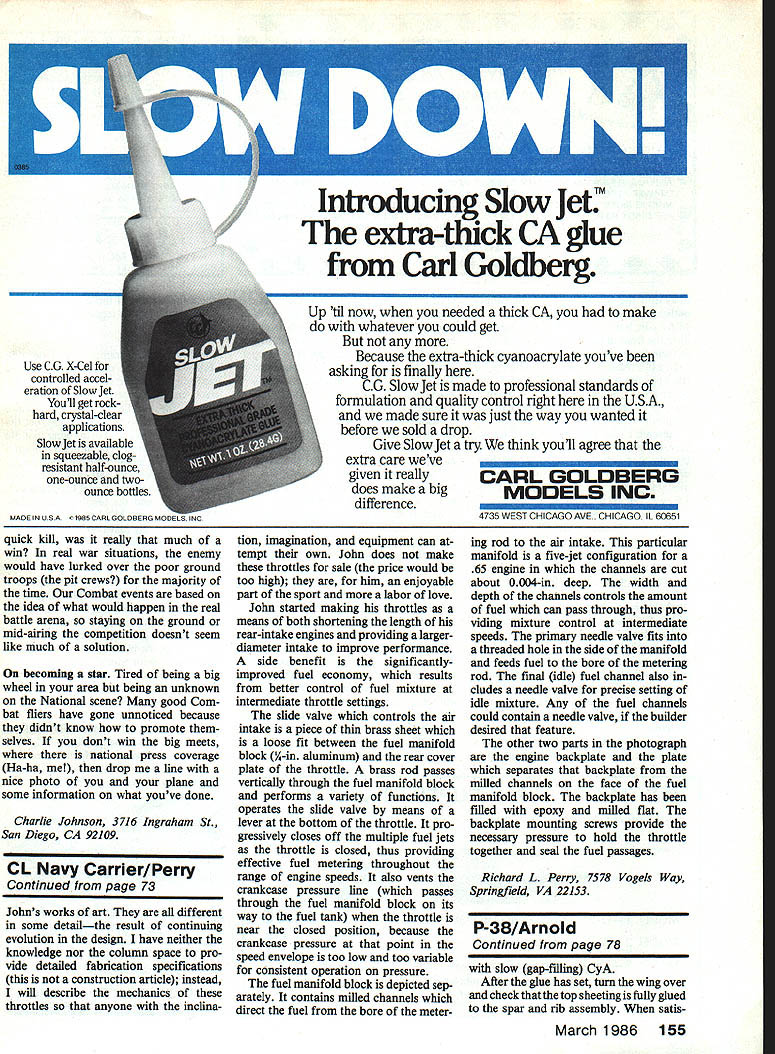
A method suggested by Bill Lee can be used for braided lines, lead-outs, and for those of you who also fly Racing events; it is the easiest way to make up those .018 solids that have enough spring in them to ruin your day. You'll need to find some copper tubing with the correct inside diameter for the lines you are making up. Brass tubing is available in more sizes but tends to crack easier than copper.
Steps:
- While the tubing is a nice long piece, anneal it by holding it in the flame of a torch or the burner on a stove until the tubing turns red.
- Let it cool normally; you'll see that it has become very pliable.
- Cut off some sections and deburr them with the tip of an X-Acto knife so they won't chafe against the lines.
- It takes about a one-inch piece for lead-outs and Racing lines and maybe a little less for .020 or other Combat lines. Run a few inches of the line through the tubing and then bend the tubing around a drill bit or dowel. Experiment with the correct diameter to get the radius you want.
- Wrap the lines as per the section on page 19 of the 1986–87 AMA rule book.
I found that the wrapped lines are the only way to go if you do violent maneuvers like wiggles, where you bang in and pull out in each direction. The movement is very similar to the one using an eyelet but has the advantage that it holds the lines in place while you are wrapping, and it is very easy to adjust the radius of the loop to suit the lines.
Thoughts on Winning by Airtime
I used to think that winning a match by airtime was somehow not much better than losing by airtime, but lately I've changed my mind about the situation. In real Combat, the idea is to dominate the sky, and if you get to shoot down the enemy, so much the better. So, if a pilot is on the ground for almost the whole five minutes and at the last second roars into the air and gets a kill, he has dominated the match.
Quick kill — was it really that much of a win? In real war situations, the enemy would have lurked over the poor ground troops (the pit crews?) for the majority of the time. Our Combat events are based on the idea of what would happen in the real battle arena, so staying on the ground or mid-airing the competition doesn't seem like much of a solution.
On Becoming a Star
Tired of being a big wheel in your area but being an unknown on the National scene? Many good Combat fliers have gone unnoticed because they didn't know how to promote themselves. If you don't win the big meets, where there is national press coverage (ha-ha), then drop me a line with a nice photo of you and your plane and some information on what you've done.
Charlie Johnson 3716 Ingraham St. San Diego, CA 92109
Transcribed from original scans by AI. Minor OCR errors may remain.

