
Control Line: Combat
Charlie Johnson
THE Miniature Aircraft Combat Assoc. recently named the Top Twenty combat fliers for 1975. The results were based on placings in AMA and WAM Fast Combat, Slow Combat and FAI combat.
- Mike Guthamson, Kingsbury, TX.
- Howard Rush, Hampton, VA.
- Charlie Johnson, San Diego, CA.
- Paul Smith, Wichita, KS.
- Ross Melhuish, Ontario, Can.
- Drew Lance, Saratoga, CA.
- Bob Burch, Cicero, IL.
- Jay Morway, Detroit, MI.
- Mike Strieter, Laurel, MD.
- Victor Radisli, Houston, TX.
- Larry Driskill, Big Springs, TX.
- Jordan Segal, Niles, IL.
- Chuck Rudner, Gainesville, FL.
- Jim Phillips, Oklahoma City, OK.
- Mike Tallman, Wichita, KS.
- Warren Sanders, College Park, MD.
- Marvin Denny, Wichita, KS.
- Ed Bridant, Petaluma, CA.
- Rich "Von" Lopez, Daly City, CA.
- Lorna Samuel, San Diego, CA.
There were 108 AMA Slow Combat events held in 1975, 98 Fast Combat and 18 FAI events. The average Slow contest was larger than the average Fast meet. Points were awarded on the basis of 3X the total number of entrants for first, 2X for second and 1X for third.
The Top Twenty fliers were asked to send in their advice and comments on what put them on top. There were no surprises. Most used Supertigre or Fox engines, although I've always used K&B. All recommended lots of practice and good equipment. In order to gain enough points to make the list for 1976 you're going to have to travel to some out of town contests. If you don't have the time or money to travel around then your chances of making the Top Twenty aren't very good. Here's a short list of the items most often mentioned:
- Know your equipment. Make sure you or your pit crew can start your engine when it is hot.
- Try to have good equipment. One good engine is better than two poor ones.
- Don't jump from one design to another during the contest season.
- Watch your opponents fly and capitalize on their mistakes when you fly them. If you notice that their engine goes rich during outsides or gets "loose" on upwind turns then lead them into such maneuvers provided your plane doesn't do the same thing.
Fast Stuff: Tired of breaking cranks? Had enough instant wear-out? Stop running with the animals—be a hunter! So reads the flyer from Henry Nelson advertising his HP 36 front intake de-stroked version of the HP 40 especially modified for Slow Rat, Slow Combat and Fast Combat. Features include: Schneurle porting, ringed aluminum piston, twin ball bearings. All engines are properly set-up and test run, also immediate parts service. If you want the fastest thing on your block send $90.00 to: Nelson Competition Engines, 729 Valemont Dr., Verbena, PA 15147, or call Henry at (412) 793-8062.
While on the subject of ferocious motors I might mention the new Fox 1976 Combat Special. This engine features Schneurle porting, a giant half-inch crank made of 8620 steel with twin ball bearings. List price for this engine is $39.95 but Duke is offering a special deal to owners of earlier model Fox combat engines. For $15.00 Duke will upgrade your 1975 engine and for $25.00 he'll update the older models. Fox is also offering cash prizes for the top place in various combat events at the Nationals if you use his engine, fuel and plug.
K&B may go ahead with a 1000-engine run of their .35 version of the ABC .40.
Rich Brasher and myself have been testing K&B and Fox; they work well and are expected to be real high-performance this summer. Good news — plug blowers: Taylor Plugs will be distributed in the USA. A well-known kit manufacturer recently received some test samples which proved a bit good; samples were received directly from Charlie Taylor. I must admit today's plugs aren't the greatest — a plug blowing per flight doesn't make the day. Consistently blowing plugs may mean you should back off compression or nitro. Other things that knock out plugs rather quickly are heavy planes being bogged, tight turns, or too much vibration for the pitch the engine can handle. Something real deadly to plugs is a radical change in fuel mixture; the engine goes rich during outside maneuvers. The trickiest item I've ever seen is an insert-type glow plug element nonconduc... tive type glow plug element on a nonconductive plate similar to a printed circuit board. The element took up most of the combustion chamber and required a small battery to start and power the unit but there's no way it could blow out or distort. Maybe some smart engineer will make a compact spark ignition system that weighs a couple grams.
Goodies in the mail: A couple months ago I received a large package from Dan Rutherford. Inside was a complete WAM combat ship with engine, lines, bladder tank and handle! Instructions were very simple, just fuel with 60% and fly. Dan is one of the masters of 1/2A airplanes and I learned enough from his design and suggestions to do a 180-degree turnabout on 1/2A airplanes. The two biggest things I'd been doing wrong were in fuel metering and control systems. I found that .018 line is plenty big enough for leadouts and control-handle wire; the little planes don't have enough pull to straighten out anything bigger. The Kirkraft fine-thread needle is absolutely necessary on a bladder system; the TD needle either being a click lean or rich, never right on. Dan really likes to let the TD wind up, uses only 3 to 3-1/2 pitch with around 5-in. diameter. The more revs you feed in the easier it is to set the needle up to a point, around 24,000 rpm where engine life is limited. If you've had the urge to get "wild" with a combat ship but don't want to risk a full-size combat ship then give one of these 1/2A monsters a try. Add lots of power, keep it lightweight and a bit trail heavy and try something you've never done before. Even the "Wilkens Wiggle" is a cinch.
Woodard Rush suggests a good starting event for the newcomer in combat might be FAI class. Most people, myself included, thought that FAI would be for the real pro fliers but after a little rethinking on the subject I think the Colonel is right. Breaking in to FAI wouldn't be nearly as hard as Fast or Slow because there are no established hot dogs. FAI requires a different way of thinking, cuts not kills, and different strategies since you are allowed two models and sets of lines per match. Dave Clarkson reports that the pit work in FAI combat in England is really astounding. Both the primary model and spare are started at the five-minute warning, and of course enough fuel is carried on board to last the entire match. If anything happens to the primary plane (crash, sick engine, etc.) the streamer is transferred to the backup. Four engines running at once, frantic pit action, lots of noise, truly a sight to see!
The typical FAI model as used in England is around 350 sq. in., uses a Tiger 15 either G-15 or G-20 (Oliver diesels are now in the minority) and has a top speed of around 90 mph. Fuel blends are a mild side compared to AMA Fast, with 10% nitro being favored because it is cheap and dependable and provides plenty of revs during those tight turns.
Over a half dozen Americans were expected to attend the Dutch International July 3-4 in Holland. I'd be surprised if the British didn't win but this will be the first time they've come up against a bunch of Americans. For predictions I'll say that the British will win the Dutch International (and hope for an American upset), the Americans will win Aerobatics the following weekend at the World Champs, the Italians will win Speed with times in the mid 170-mph bracket without ground-start, and the Dutch will win Team Race with a mid-8-minute final.
Slow Combat: Much heated discussion about this event in the MACA Newsletter and elsewhere. Most would like to keep the event Slow, some would do away with it, others want to give it a flavor of its own, a different "feel" to it at Fast Combat. Dan Rutherford was right when he said that keeping the "sport" in an event once it reaches the National level is almost impossible to do. If you have strong feelings on Slow Combat or any combat event please write to MACA. Membership is available to everyone by sending $5.00 to MACA Treasurer Tom Southern, 2207 Longview, TX 75601. MACA also has a combat design of the year contest going on right now; send along your favorite design and you might win something.
Last minute results from the Northeast Regionals in Eugene in Fast Combat was Norm McFadden and runnerup was Rich Brasher. Both fliers are from the San Francisco Bay area and fly SuperTiger-powered "Death Rays." Third place finishers were our Combat Advisory Chairman, Ron Scoones from Bothell, WA. Dirty Dan Rutherford took all the marbles in Slow Combat. Contest Director Gene Paper reported that the best match of the day was between Phil Gunderson, using a very old style Fox, and Rich Lopez using the late SuperTiger. A full five-minute match with cuts and a kill by Tyrantula Man Granderson. A new 1976 Fox Combat Special was used by one contestant but because it was the first time out no one could say what the potential could be.
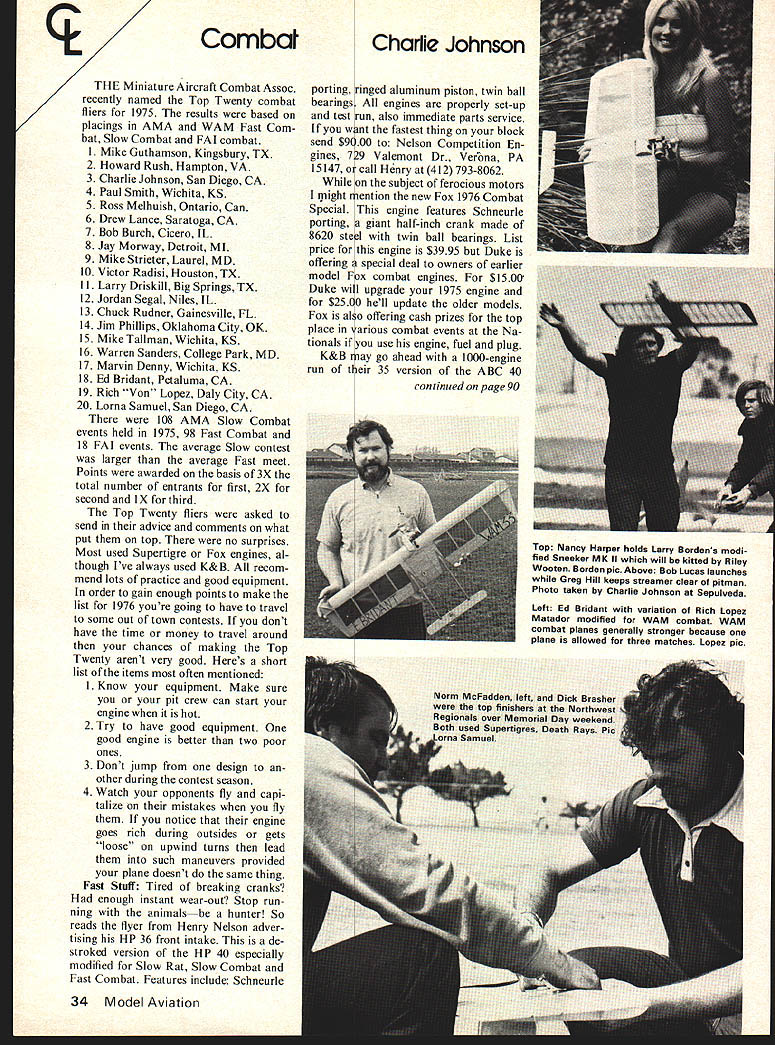
I received some nice pictures and comments from Larry Borden concerning the new MKII Sneaker which is being kitted by Riley Wooten. The airframe is lightened by using cut out ribs, cut-off motor mount like a Nemesis, long 4-1/2 in. booms, and the engine is canted back into the leading edge. A plywood stiffer runs from the motor mount out six in. along the leading edge for strength and the LE is sanded to a blunt shape to allow for smoother airflow.
By the time my next column hits we'll know if I was right or wrong about who will win in Europe; we sure have the potential to do it. If you have comments please write or call me at: Charlie Johnson, 3716 Ingraham St., San Diego, CA, 92109, (714) 273-6530.
Transcribed from original scans by AI. Minor OCR errors may remain.

