
Control Line: Combat
By Charlie Johnson
LOTS of time remains for you to make plans to attend the one and only Bladder Grabber XI. This is the triple-elimination Fast Combat meet held in the suburbs of Seattle that you've been reading about for years. As you and the other 40 competitors go for the gold and glory and the $5,000 worth of prizes, you'll be a part of history. The winners will even get their pictures in Model Aviation and a bunch of MACA points (Miniature Aircraft Combat Association — a special-interest group) to help them toward the MACA Championship for 1986.
There will be more information elsewhere in this issue, but here's a rundown of what you can expect. The festivities start off with a free breakfast for contestants at 9:00 a.m. on June 28, at which time everyone registers and tries to psych out the competition. It takes about 120 matches to determine the winner; with 40 entries, the rest of Saturday and most of Sunday is spent flying. Combat has always been well-paced, and since it is a two-day affair, the course of battle will change as people get hot on the second day and others lose their touch. The meet has the elements of the first U.S. Combat team trial in St. Louis where no one knew what was going to happen. It's also like the good old Nationals where we flew for days and Riley Wooten always came out on top.
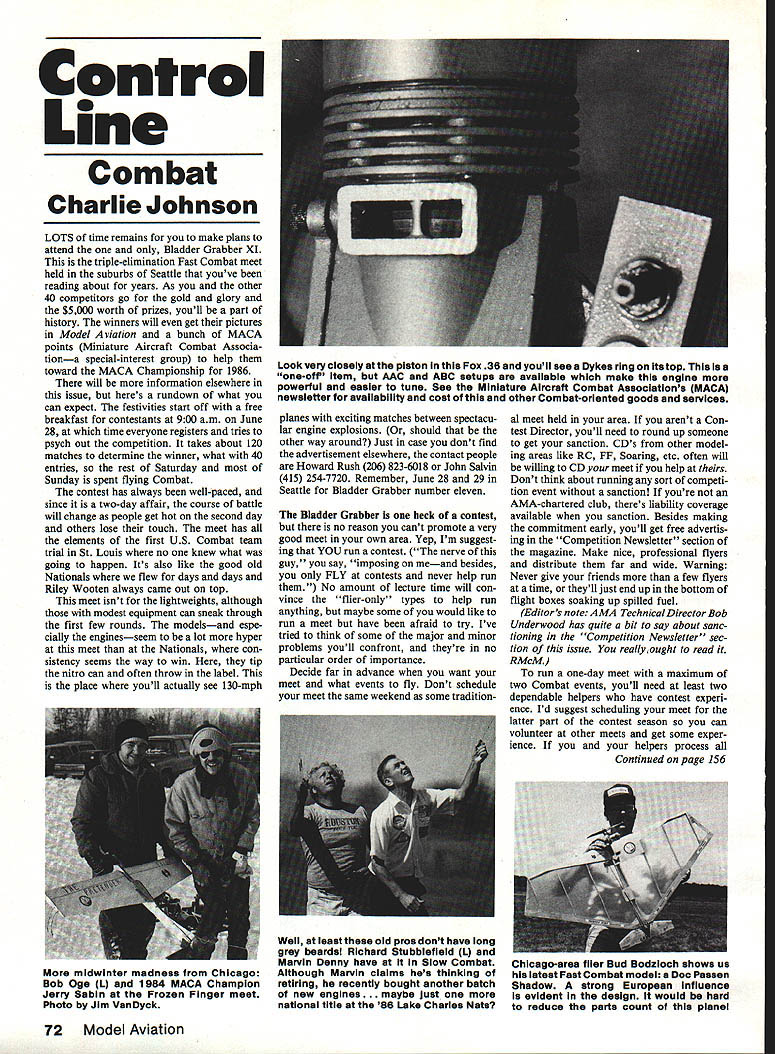
This meet isn't for the lightweights, although those with modest equipment can sneak through the first few rounds. The models — and especially the engines — seem to play the major role. This is the place where you'll actually see 130-mph planes, with exciting matches between spectacular engine explosions. (Or, should that be the other way around?) Just in case you don't find the advertisement elsewhere, the contact people are Howard Rush (206) 823-6018 or John Salvin (415) 254-7720. Remember, June 28 and 29 in Seattle for Bladder Grabber number eleven.
Running Your Own Meet
The Bladder Grabber is one heck of a contest, but there is no reason you can't promote a very good meet in your own area. Yep, I'm suggesting that YOU run a contest. No amount of lecture time will convince the "flier-only" types to help run anything, but maybe some of you would like to run a meet and have been afraid to try. I've tried to think of some of the major and minor problems you'll confront; they're in no particular order of importance.
Plan early and sanctioning
- Decide far in advance when you want your meet and what events to fly.
- Don't schedule your meet the same weekend as some traditional meet held in your area.
- If you aren't a Contest Director (CD), you'll need to round up someone to get your sanction. CDs from other modeling areas like RC, FF, Soaring, etc., often will be willing to CD your meet if you help at theirs.
- Don't think about running a contest if you aren't sure you want to sanction. If you're not an AMA-chartered club, there's liability coverage available when you sanction.
- Besides making the commitment early, you'll get free advertising in the "Competition Newsletter" section of Model Aviation.
- Make nice, professional flyers and distribute them far and wide. Warning: never give your friends more than a few flyers at a time or they'll just end up in the bottom of flight boxes soaking up spilled fuel.
(Editor's note: AMA Technical Director Bob Underwood has quite a bit to say about sanctioning in the "Competition Newsletter" section in this issue. You really ought to read it. — RMcM.)
Staffing and match flow
- To run a one-day meet with a maximum of two Combat events, you'll need at least two dependable helpers who have contest experience.
- I'd suggest scheduling your meet for the latter part of the contest season so you can volunteer at other meets and get some experience.
- If you and your helpers process all models as a group just before a round starts, you'll be free to judge and run matches and not need a pit boss.
- Put the pits upwind from the circle, and have two judges near the pits to call out the next match while the third person roams the center circle.
- If you have lots of space, provide a "run-off" area where pilots of models still flying after the match time has ended can move. There's nothing worse than watching a model orbit in the circle for five minutes while the next pair waits to enter.
Events, fees, and trophies
- Don't worry about attracting all the big names or try to run too many events. If some won't come to your meet unless you run K/A biplane Combat, then you'll just have to do without them.
- If you run a double-elimination meet, consider only one event if you expect over 20 people to enter.
- Keep the entry fee low and acquire some modest trophies. If you spend too much for the gold you'll be tempted to raise the entry fee and worry a lot about making your money back.
- If you can't afford to invest a few dollars in the meet, chances are you won't be able to help much. Promotion costs money — one local promoter regularly invested several hundreds of his own dollars to help make the meet successful.
- A very respectable meet could be run for around $150 including trophies, sanction, and streamer cost.
Streamers and equipment
- Buy the streamer material far in advance and make up some samples to test behind the hottest models around. Streamer material is getting expensive and only crepe paper like Dennison's will work well; the rolled paper generally sheds after a few hot laps.
- The AMA rule specifies streamer length and width for combat — check the rulebook for exact size.
- Also have clear rules about starting and flying in the pits and circle.
Local contacts and lodging
- If you are the contact person listed on the flyer or in Model Aviation, expect calls from out-of-towners looking for a cheap place to stay (your place, preferably) or additional meet information.
- Local tourist groups sometimes have information about motels and sites that you can send out with the meet information.
- If there is an inexpensive motel near the flying site, talk to the manager about a special rate for modelers. Don't be generous and put your money up for a deposit or you'll be sorry.
Field setup and equipment
- Have circles and pit areas marked well in advance of the first arrivals. There's something tacky about having the field set up around you.
- Don't forget an accurate line-length-checking area, stopwatches, and a bull horn for dealing with difficult pilots.
- Sacrifice and get out there at the crack of dawn unless you can get the local Park & Rec people to do it — but then, you might get some strange circles!
Scheduling and running rounds
- Schedule a realistic starting time: something like 10:00 a.m. for a two-event meet or 11:00 a.m. for one event.
- Start when you say you will. The fliers will grump, but you've got to set the pace right or you'll be flying the second round at dark.
- Run the first three or four rounds as fast as you can. Some people will use as much time as you give them. Experience will guide you as to when to wait or when to push.
- I prefer running the rounds as fast as possible and then taking a break between rounds so everyone can regroup.
- Fast Combat generally runs quicker than the five-minute match thanks to some 10-second kills and midairs. Slow Combat can drag because contestants often refuel and fly to the eight- or nine-minute mark. VA Combat tends to take even more time than FAI with its multiple everything.
- If you want a golden rule: never fly FAI at your first meet.
Rules and preparation
- Before helping at your first meet, be sure to read the AMA rulebook a few dozen times. If you think you've got everything down pat, just wait until about the fifth match when something out of the ordinary happens.
- Discuss contest procedures at the pilots' meeting, but make other decisions without the help of a dozen fliers.
Good luck.
Charlie Johnson 3716 Ingraham St. San Diego, CA 92109
Transcribed from original scans by AI. Minor OCR errors may remain.

