
Control Line: Combat
Charlie Johnson
AVAILABLE now — the long-awaited Cipolla .36 Combat engine is now available in the U.S.A. through Doc Passen:
- Doc Passen, 608 W. Main, P.O. Box 111, Jasonville, IN 47438
- Phone: (812) 665-3723
- Introductory price: $69.95 (will go to full price $89.95 if reception is successful)
Engine description and recommended setup
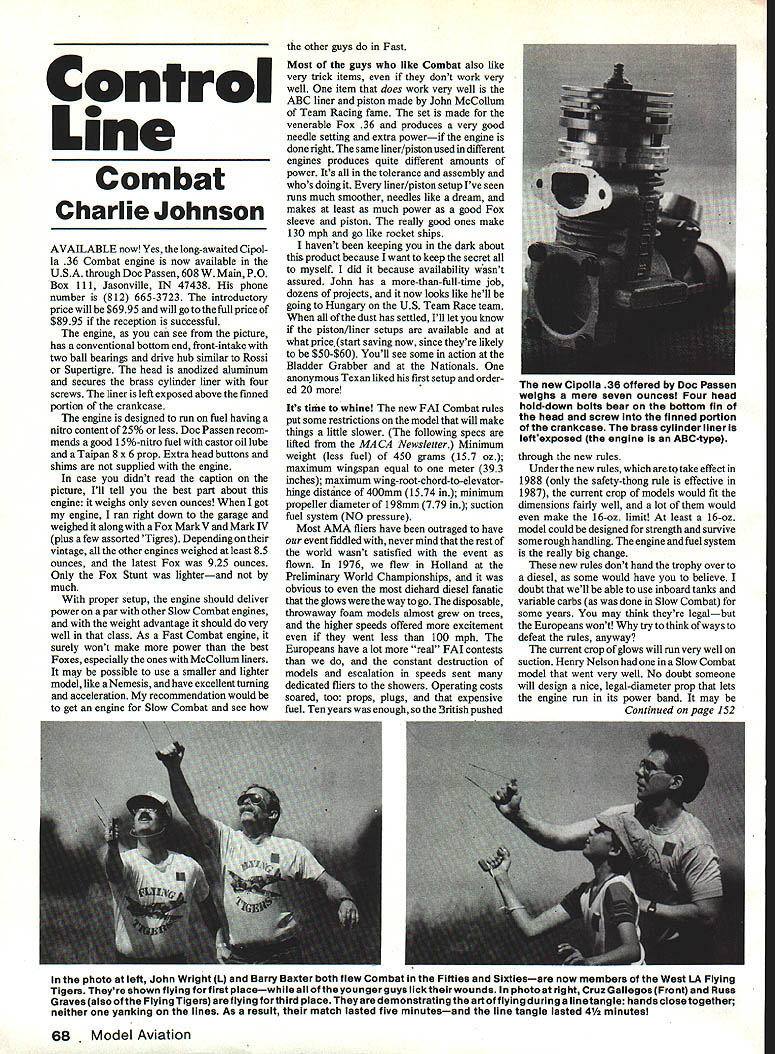
You can see the engine in the picture: it has a conventional bottom end with a front intake, two ball bearings, and a drive hub similar to Rossi or SuperTigre. The head is anodized aluminum and secures a brass cylinder liner with four screws. The liner is left exposed above the finned portion of the crankcase.
- Designed for fuel with nitro content of 25% or less.
- Recommended fuel: ~15% nitro with castor oil lubrication.
- Recommended prop: Taipan 8 x 6.
- Extra head buttons and shims are not supplied with the engine.
Best part: the engine weighs only seven ounces. I weighed it alongside a Fox Mark V, a Mark II (and a few Tigres); depending on vintage, the others were at least 8.5 ounces, and the latest Fox was about 9.25 ounces. Only the Fox Stunt was lighter (and not by much).
Performance and recommendations
With a proper setup the Cipolla should deliver power on a par with other Slow Combat engines. The weight advantage should make it very competitive in Slow Combat.
As a Fast Combat engine it probably won't out-pull the best Foxes—especially those fitted with McCollum ABC liners—but it may allow use of smaller, lighter models (for example a Nemesis) that would yield excellent turning and acceleration. My recommendation: get a Cipolla for Slow Combat and see how others do in Fast.
McCollum ABC liner/piston note
John McCollum (Team Racing fame) makes an ABC liner and piston set for the venerable Fox .36 that can produce excellent needle settings and extra power when installed and assembled correctly. The same liner/piston in different engines can yield widely different results — it's all in tolerances, fit, and the builder's skill. The really good setups run much smoother, needle easily, and can produce performance comparable to the best Fox sleeve/piston combinations (some Fox-based setups have reached ~130 mph).
Availability has been uncertain because John is very busy and has many projects (and may be going to Hungary with the U.S. Team Race team). When availability is clear I'll report price and supply; expect roughly $50–$60. You'll see some setups in action at upcoming contests — one anonymous Texan liked his first setup enough to order 20 more.
FAI / MACA rule changes and implications
The new FAI Combat rules (specs lifted from the MACA Newsletter) introduce restrictions that will tend to slow the event. Key specs:
- Minimum weight (less fuel): 450 grams (15.7 oz)
- Maximum wingspan: 1 meter (39.3 in)
- Maximum wing-root-chord-to-elevator-hinge distance: 400 mm (15.74 in)
- Minimum propeller diameter: 198 mm (7.79 in)
- Fuel system: suction (NO pressure)
These changes are intended to curb the escalating speeds, model destruction, and operating costs that developed over the past decade — particularly with disposable foam models and very high-speed setups in Europe. The new rules are to take effect in 1988 (the safety-thong rule is effective in 1987).
Most AMA fliers were unhappy about the rule changes, but the Europeans had pushed them because constant destruction, higher costs (props, plugs, fuel), and growing speeds were driving fliers away. Under the new rules many current models will fit the dimensions and many could be designed to meet the 16‑oz limit (450 g) with adequate strength.
These rules do not hand the trophy to diesels. I doubt inboard tanks and variable carbs (as used in some Slow Combat setups) will be acceptable to Europeans for some years. Expect attempts to find legal workarounds, but also expect glow engines to adapt: suction-fed glows can run very well. Henry Nelson had a Slow Combat model that ran fine on suction, and I'm sure someone will design a legal-diameter prop that lets engines operate in their power band.
Closing
The Cipolla .36 is a lightweight, promising option for Slow Combat. Keep an eye out for McCollum liners if you want more power, and plan model and prop choices around the new FAI/MACA dimensions and suction-fuel restriction.
Transcribed from original scans by AI. Minor OCR errors may remain.

