
Control Line: Combat
Charlie Johnson
Nationals and Volunteering
THE NATIONALS will be held this summer in Lincoln, NE. The site is very nice, with Combat having "center stage" next to AMA HQ and all incoming traffic. After the rather dismal turnout of entrants at the last Nats we should all look at this as a must-attend event. Everyone in Combat needs to either enter or help.
Judy Curtis will be the Event Director this year and has asked for as much help as she can get in order to make things run smoothly. How about flying three Combat events and helping with the fourth? Check with Judy or AMA about volunteer work.
Celebrity Combat and Fun Events
Doc Passen and I will be sponsoring several other fun events to be held during Combat Week. The most serious undertaking will be the Celebrity Combat event, which allows someone to challenge the "star" of his choice. Both pilots use Slow Combat models powered by Cipollas furnished by Doc Passen. For a small entry fee (probably around $5, to be donated to the AMA Museum or Building Fund) you get first choice of models and also a celebrity pit crew to keep you in the air. This will be lots of fun for the celebrities, too, as they only have to walk out and get the handle. If someone doesn't like the Slow models furnished, he is welcome to bring two identical models for himself and the star. We already have quite a few sponsors and should have some nice little prizes to give out. Don't think that the stars are going to give you any breaks, though!
Other fun events will include:
- Speed Pattern
- Loops per Minute
- Top Speed Event (includes Fast, Slow, FAI, and VZ)
Get your official times at the Nationals and have bragging rights for a whole year! Does anyone think he'll see 140 mph at the Nats?
Johnson's Rules Event
The most fun event (for me, anyway) will be the infamous Johnson's Rules Event, which will be a 20-question quiz of the most often-violated rules. This event will take place either on a rainy day or possibly at the MACA meeting.
Want a hint as to what will be on the test? OK: what's the suggested pull test for the string used in Fast and Slow Combat streamers? Write the answer down before you look in the rule book.
Stealth Combat, Mufflers, and Plans
Tom Dixon was one of many who responded to the idea of Stealth Combat and the general use of mufflers when necessary. Tom is a very experienced aerobatics pilot and model designer with extensive knowledge of engine reworking. He suggested using the Enya .35 and SST muffler either off the shelf or modified by him. He also has a great many plans for Stunt and Combat models. Among the more interesting models available were the Super Whatzit, Quicker, Half-Fast, Orbit, Ace, Lancer, and many more.
Tom Dixon has a wonderful catalog listing all the plans, props, and engines available; he can be reached at: 1938 Peachtree Road, Suite 401, Atlanta, GA 30309. Send along a large, legal-size stamped envelope to speed the process.
Props and Suppliers
Another product that may interest competition- or performance-oriented fliers is the line of made-in-Australia Bolly props. Constructed of glass or carbon, they come in sizes that would work on most Combat ships. The Bolly props are some of the nicest I've ever seen and are worth it for a little extra performance.
Line Terminations and Lead-Outs
For line terminations, Sig suggests looping the line around the outside of the sleeve before running it through the sleeve a third time. This method provides an additional mechanical lock similar to that achieved with a wrapped line termination.
The best method is the wrapped construction shown in the photo and described in the AMA rule book. The fine copper wire in lamp cord produces a small-diameter line termination which is neat and strong and avoids the possibility of damaging the line in the crimping process, a potential problem on smaller lines. A light coating of epoxy glue will ensure that the line wrapping remains secure.
I do not solder multi-strand lines or lead-outs, and I discourage others from soldering them. Although soldering can be done safely, there are potential pitfalls:
- Excessive heat can weaken the line.
- Solder can flow down the cable and stiffen a short length, concentrating flexing stress where the solder ends.
- Corrosive flux can travel along the interior of the cable and is difficult to neutralize; resulting internal corrosion can be hard to detect.
The use of eyelets or thimbles to reduce line wear is recommended by the rules but is not very practical at the bellcrank end of the lead-out. The increased wear at the bellcrank can be compensated for by using significantly larger cable for the lead-outs, but I prefer to use hard brass tubing sleeves as shown in the photos. A 1/16-in.-diameter brass tube is placed around the lead-out and bent in a U-shape with round-nose pliers or a drill bit. The line with the sleeve in place is routed through the bellcrank hole, which has been enlarged to 5/64 in. or 3/32 in. to allow free movement. The line is then finished using one of the AMA-approved methods from the rule book.
Engines, Pit Crew, and Spare Engines
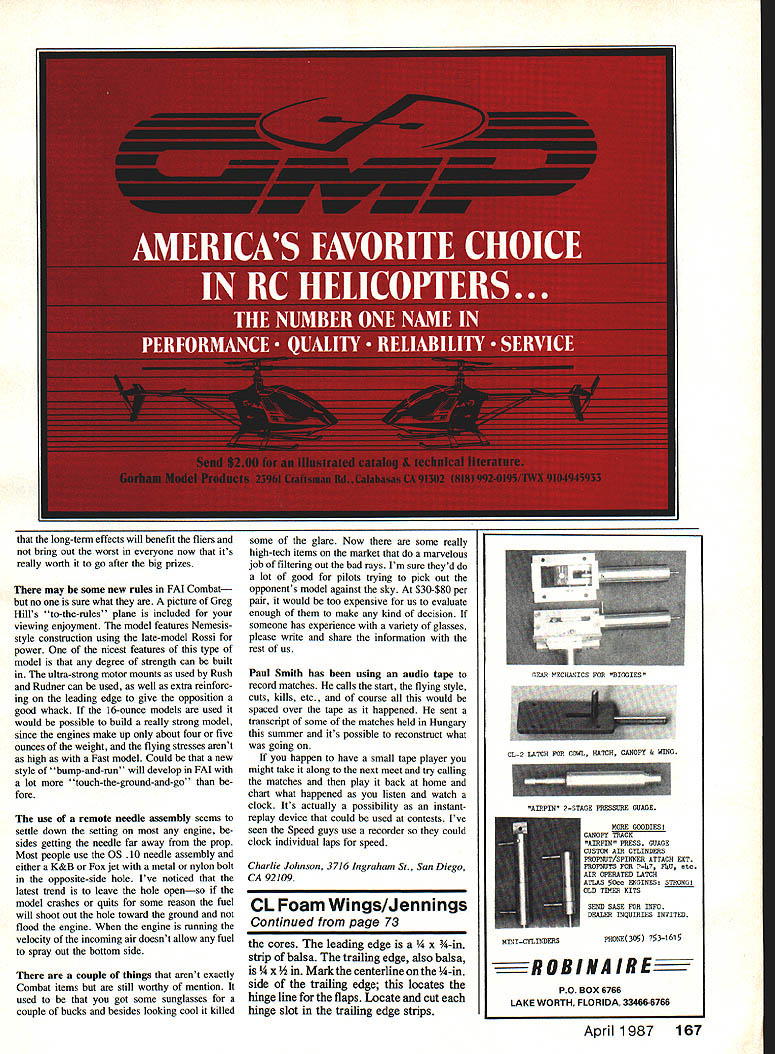
The picture of the K&B shows blind-mounting nuts in the engine case. This style works well on the newer planes with 1/4-in. motor mounts and obviously won't work if the plane has a nacelle. I've seen the pit crew struggle with a dirty or melted-down engine when they should have just changed it. You should keep a spare engine in the pit but not ready to go. That means it should have a prop, have the needle set properly, and have a bladder attached. If it's generally quicker to pull the engine when it's stuffed with dirt or has a broken part (like a needle valve assembly), then a quick engine change is the way to go if the engine has locked up.
We can have another unofficial event for pit crews where they're timed for 10 laps with an engine change minus a normal 10 laps of the model. A ballpark figure would be one minute to pull the engine, fit the new bladder, and get the engine going. Most often that's plenty of time to get airborne and win the match.
Bladder Grabber and Prizes
The Southern California version of the Bladder Grabber will be held on April 4–5, 1987 in Los Angeles. The three-club division will feature:
- $1,000 cash for first
- A Carver Corporation stereo for second
- A Hoffelt .30F for third
(The tax man may be waiting for the first-place winner!)
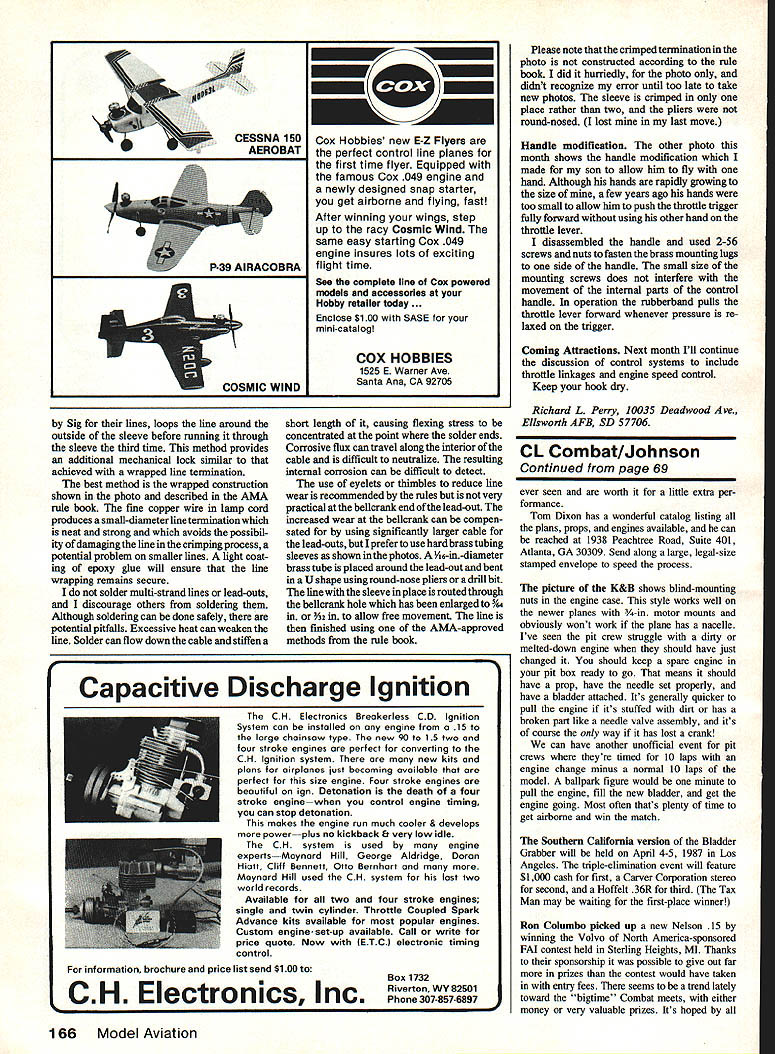
Ron Columbo picked up a new Nelson .15 by winning the Volvo of North America–sponsored FAI contest held in Sterling Heights, MI. Thanks to sponsors, it was possible to give out far more in prizes than the contest would have taken in with entry fees. There seems to be a trend lately toward the "bigtime" Combat meets, with either money or very valuable prizes. It's hoped by all that the long-term effects will benefit the fliers and not bring out the worst in everyone now that it's really worth it to go after the big prizes.
FAI Combat and Model Construction
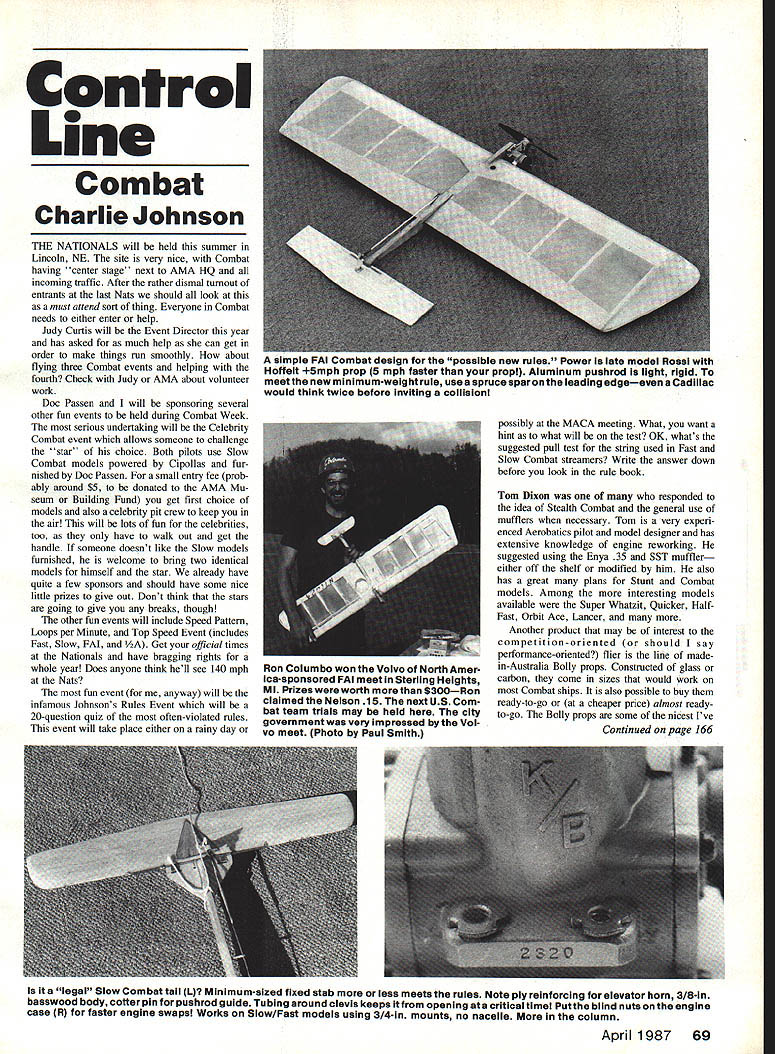
There may be some new rules in FAI Combat — but no one is sure what they are. A picture of Greg Hill's "to-the-rules" plane is included for your viewing enjoyment. The model features no-nonsense construction using the late-model Rossi for power. One of the nicest features of this type of model is that any degree of strength can be built in. The ultra-strong motor mounts as used by Rush and Rudner can be employed, as well as extra reinforcing on the leading edge to give the opposition a good whack.
If the 16-ounce models are used it would be possible to build a really strong model, since the engines make up only about four or five ounces of the weight, and the flying stresses aren't as high as with a fast model. It could be that a new style of 'bump-and-run' will develop in FAI with a lot more 'touch-the-ground-and-go' than before.
Needle Assembly and Fuel Drain Hole
The use of a remote needle assembly seems to settle down the setting on most any engine, besides getting the needle far away from the prop. Most people use the OS .10 needle assembly and either a K&B or Fox jet with a metal or nylon bolt in the opposite-side hole. I've noticed that the latest trend is to leave the hole open — so if the model crashes or quits for some reason the fuel will shoot out the hole toward the ground and not flood the engine. When the engine is running the velocity of the incoming air prevents fuel from spraying out the bottom side.
Accessories and Match Recording
There are a couple of things that aren't exactly Combat items but are still worthy of mention. It used to be that you got some sunglasses for a couple of bucks and—besides looking cool—they killed some of the glare. Now there are some really high-tech items on the market that do a marvelous job of filtering out the bad rays. I'm sure they'd do a lot of good for pilots trying to pick out the opponent's model against the sky. At $30–$80 per pair, it would be too expensive for us to evaluate enough of them to make any kind of decision. If someone has experience with a variety of glasses, please write and share the information with the rest of us.
Paul Smith has been using an audio tape to record matches. He calls the start, the flying style, the cuts, kills, etc., and of course all this would be spaced over the tape as it happened. He sent a transcript of some of the matches held in Hungary this summer and it's possible to reconstruct what was going on.
If you happen to have a small tape player you might take it along to the next meet and try calling the matches and then play it back at home and chart what happened as you listen and watch a clock. It's actually a possibility as an instant replay device that could be used at contests. I've seen the Speed guys use a recorder as they could clock individual laps for speed.
Charlie Johnson 3716 Ingraham St. San Diego, CA 92109
Transcribed from original scans by AI. Minor OCR errors may remain.

