
Control Line: Combat
Charlie Johnson
TOPS
The MACA Top Twenty was recently announced for the 1986 competition year. Tom Fluker, Sr. compiled the results of 157 competitors who placed in the 68 contests that reported results.
Top 20 Overall Points Standings
- Richard Stubblefield — Texas — 147 pt
- Michael Wilcox — Texas — 126 pt
- Don Cranfill — Texas — 125 pt
Richard Stubblefield topped the Fast and Slow Combat categories, and Don Cranfill took FAI. Jerry Sabin was tops in 1/2A Combat.
MACA comeback and membership
It looks as though MACA (Miniature Aircraft Combat Association) may be back in business after a fairly rocky period. Phil Cartier was elected the new president of MACA, receiving almost 93% of the votes cast. If you are interested in joining MACA, send $10 to Phil Cartier, 760 Waltonville Rd., Hummelstown, PA 17036. His telephone number is (717) 566-3810. Be sure to include your full name, address, AMA number, and home phone.
More money meets
The United States Slow Combat Championships will be held in Gainesville, TX, June 6–7, 1987. It will be a triple-elimination Slow Combat meet with a first prize of $500 cash. Team North Texas (TNT) is sponsoring the meet. The entry fee will be $35 — which includes a banquet at the local country club. For information call Joe McKinzie at (817) 838-3458 or Tom Fluker at (817) 668-7918. Gainesville is about 60 miles north of Dallas, so airline connections should be no problem.
Fox Mark VI problems
Remember the early Fox Mark I? It rarely blew up in the air because it usually broke on the test stand. Engines with intact cranks could easily be spotted in the air because they usually quit on the first outside loop. Fortunately the Mark III followed and was subsequently replaced by the improved Mark IV, which is by far the most popular and successful Fast Combat engine in use. Then came the Mark V with its single ball bearing, more weight, and a ho-hum reception.
Fox Mfg. has been advertising the new Mark VI for over a year now, and the first batches have hit the marketplace. It was reported that the first few engines leaked a lot of fuel out the front bearing, but the problem was quickly solved by cutting a spiral groove in the crank. The prop-mounting stud on the crankshaft broke on some others, making for a great-sounding shaft run sans propeller. The worst problem is with the piston coming apart.
The engine features a brass cylinder liner with an aluminum piston that is undercut at the top and has an iron ring pressed on (presumably to reduce wear). Just flipping the prop may make the iron ring stick in the top of the bore. If you've bought one you'd best look at the piston and see if there's a gap. I'm sure Fox will make all the engines good, and eventually the performance will be as promised, but it appears that quality control missed the boat on this one. The bugs should be worked out before the engines hit the market. We're Combat fliers, not the government!
Field fix story and wrist-pin issues
One of the locals had his piston come apart during midweek practice and replaced the aluminum piston with a regular iron piston from an earlier-series engine. It sounds like a fairly dumb idea, but he got the last laugh because the engine ran better than before. The engine should have been a loose goose once it warmed up, but the piston apparently expanded as much as the brass liner and made good power without freewheeling at the end of the run.
Of course going back to the old-style piston/liner isn't the answer, because then you have the wrist-pin-keeper problem that seems to show up just when your engine is at its best. People have solved that problem by machining the grooves deeper and using Rossi clips.
Tucson Regionals and pictures
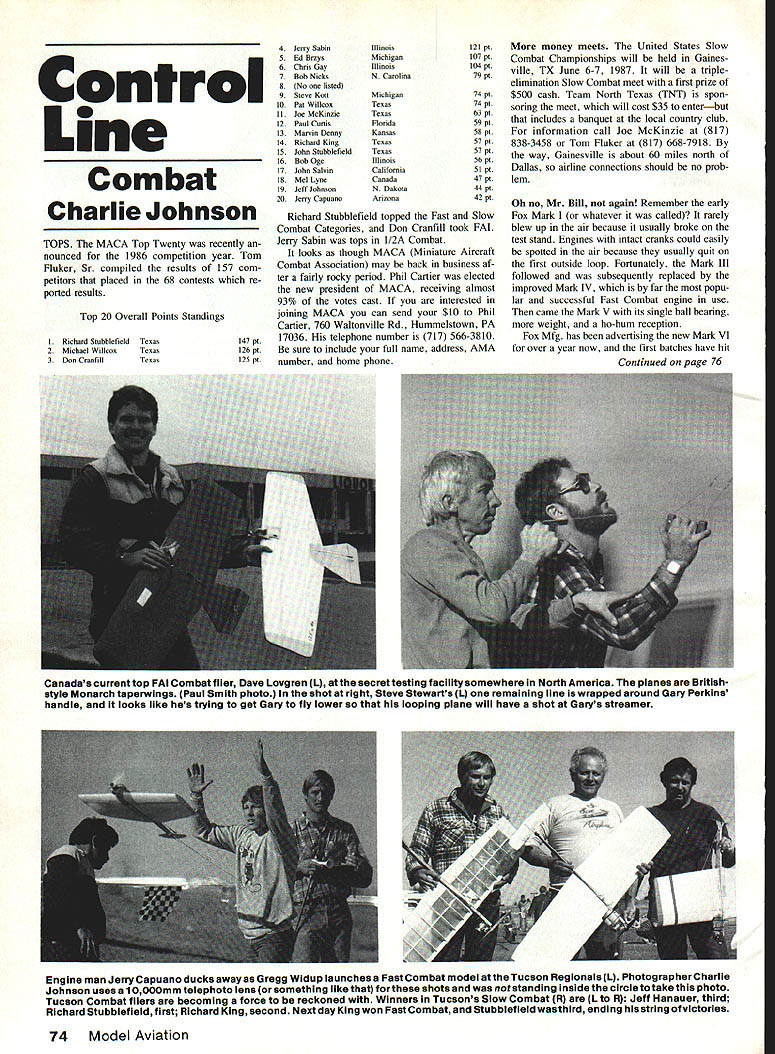
Several of this month's pictures are from the 1987 Tucson Regionals. I thought we were at the Chicago Frozen Finger meet for a while, as it snowed in Tucson on the Friday before the meet, and the field was frozen Saturday morning. The site was moved from Buckeye (goodbye to the carpet circles!), and the Tucson facilities were super even if we hit the one time in 15 years that it snowed there. The Tucson club has a strong core of Combat fliers who are really getting their acts together. I wouldn't be surprised if one or more of them do well at the upcoming money meets. Tucson should be proud of new MACA number 20, Jerry Capuano.
Los Angeles $1,000 meet and the trend toward major meets
The Los Angeles $1,000 meet took off like no one could have expected. Entries may exceed 60, which will make it difficult to run triple-elimination in two days. The thought of $1,000 cash is too tempting to pass up. There are very few competitive events with a thousand up for first that are open to ordinary people; in most sports, only top professionals get a chance at that kind of money.
It looks like a trend toward a number of major meets such as:
- LA Money Meet
- Bladder Grabber
- U.S. Slow Combat Championships
- AMA Nationals
- FAI Team Selection
If you seriously flew at all five of those meets you'd be busy the whole year preparing, even if you didn't fly at any local meets as tune-ups.
Personal recollections
In my early years of Combat flying, we flew at a meet or two almost every weekend: local club meets, regionals, Nationals — there was always a contest to go to. The person who won Open Fast Combat at the Nats was truly the National Champion! Winning one of the Nats events is still a real accomplishment, but these other major meets with giant prizes have changed the sport. As to whether the trend is good or bad, I'll let you know if I win something at the big show.
Nationals — Celebrity Combat and fun events
Fun at the Nationals? You bet! The Celebrity Combat event that Doc Passan and I are running will feature many-time National Champion Riley Wooten along with Richard Stubblefield as the two most popular opponents. For $5 you'll be able to "choose off" one of those two master fliers (or any number of other well-known pilots). Also, just for fun we're flying for Top Speed in an FAI class, Speed Pattern, Loops per Minute, and Johnson's "Infamous Rules Test."
Here's a sample rules question to study for the written test. If, while both models are airborne and under power during a match, a model cuts its own streamer off (a kill), it is scored as:
- a) A kill for the other guy.
- b) Streamer-handling error.
- c) End of match; whoever is ahead wins on points only.
- d) None of the above.
They know at the Nats this summer is "fun." Complainers will have to take the written test and have the results posted for all to scoff at.
A return to low-tech
The Slow Combat model that Richard Stubblefield is holding in the Tucson Regionals picture is his latest venture into simple models. It features an external bellcrank with the lines coupled directly to it — no lead-outs. Both lines exit through a common wire lead-out guide that can be moved to the outboard wing should the inboard wing be demolished. The idea might get you enough air points to win a match.
The wings aren't secured in the usual fashion; holes are cut in to help lighten the structure. Aluminum motor mounts can be used over and over. Richard seemed to think that he didn't give away anything as far as performance, and first place in Slow seems to bear this out. Let's hope that MACA Number One has started a trend toward simple and cheap designs rather than the space-age projectiles that seem to be in favor.
Charlie Johnson 3716 Ingraham St., San Diego, CA 92109.
Transcribed from original scans by AI. Minor OCR errors may remain.

