
Control Line: Combat
Charlie Johnson
Money Nats recap
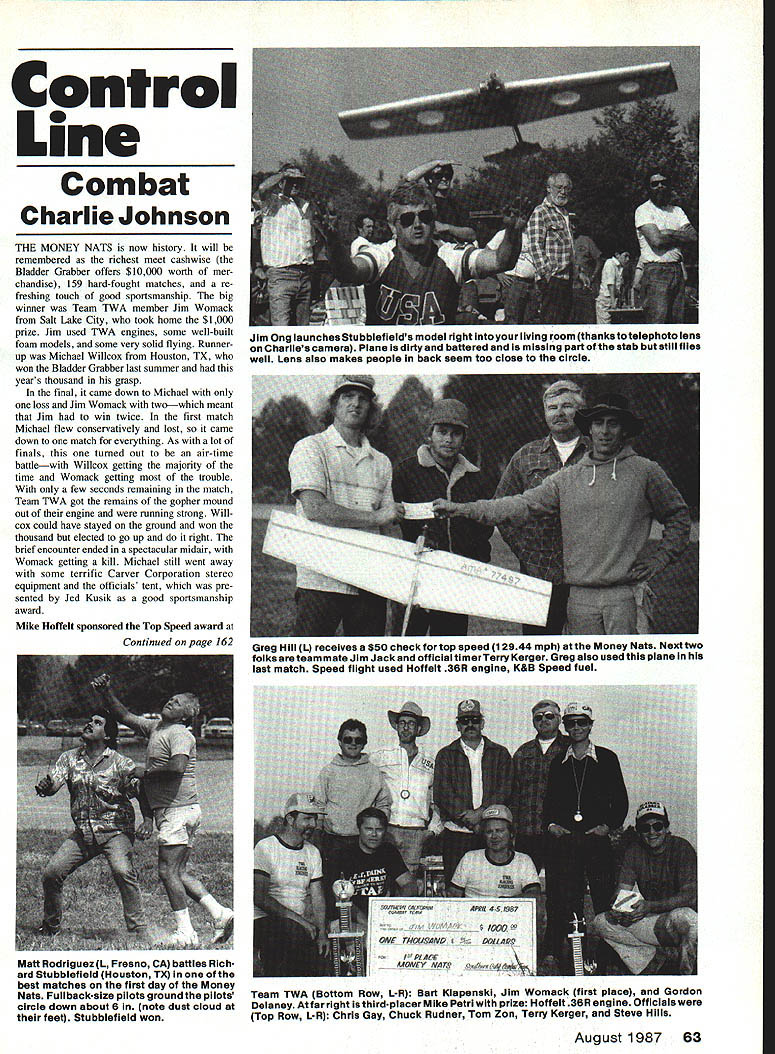
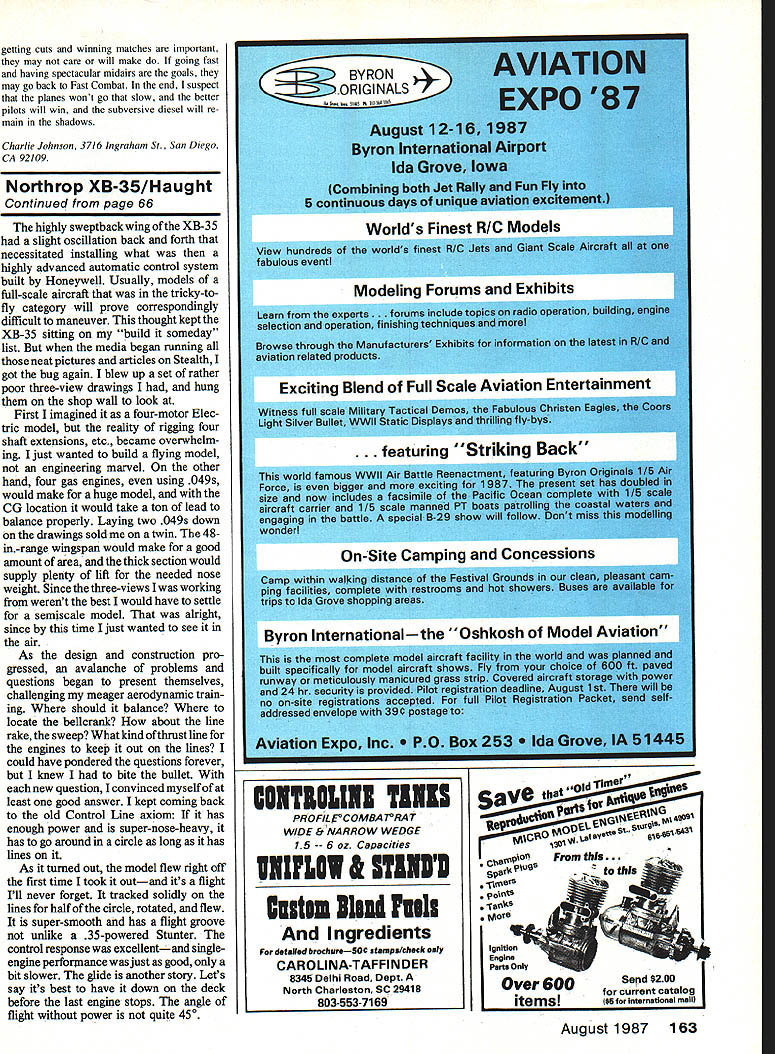
The Money Nats is now history. It will be remembered as the richest meet cashwise (the Bladder Grabber offers $10,000 worth of merchandise), 159 hard-fought matches, and a refreshing touch of good sportsmanship. The big winner was Team TWA member Jim Womack from Salt Lake City, who took home the $1,000 prize. Jim used TWA engines, some well-built foam models, and very solid flying. Runner-up was Michael Willcox from Houston, TX, who won the Bladder Grabber last summer and had this year's thousand in his grasp.
In the final it came down to Michael with only one loss and Jim Womack with two—which meant Jim had to win twice. In the first match Michael flew conservatively and lost, so it came down to one match for everything. As with a lot of finals, this one turned out to be an air-time battle—with Willcox getting the majority of the time, and Womack setting most of the trouble. With only a few seconds remaining in the match, Team TWA got the remains of the gopher mound out of their engine and were running strong. Willcox could have stayed on the ground and won the thousand but elected to go up and do it right. The brief encounter ended in a spectacular midair, with Womack getting a kill. Michael still went away with some terrific Carver Corporation stereo equipment and the officials' tent, which was presented by Jed Kusik as a good sportsmanship award.
Mike Hoffelt sponsored the Top Speed award at the Money Nats.
Top Speed award
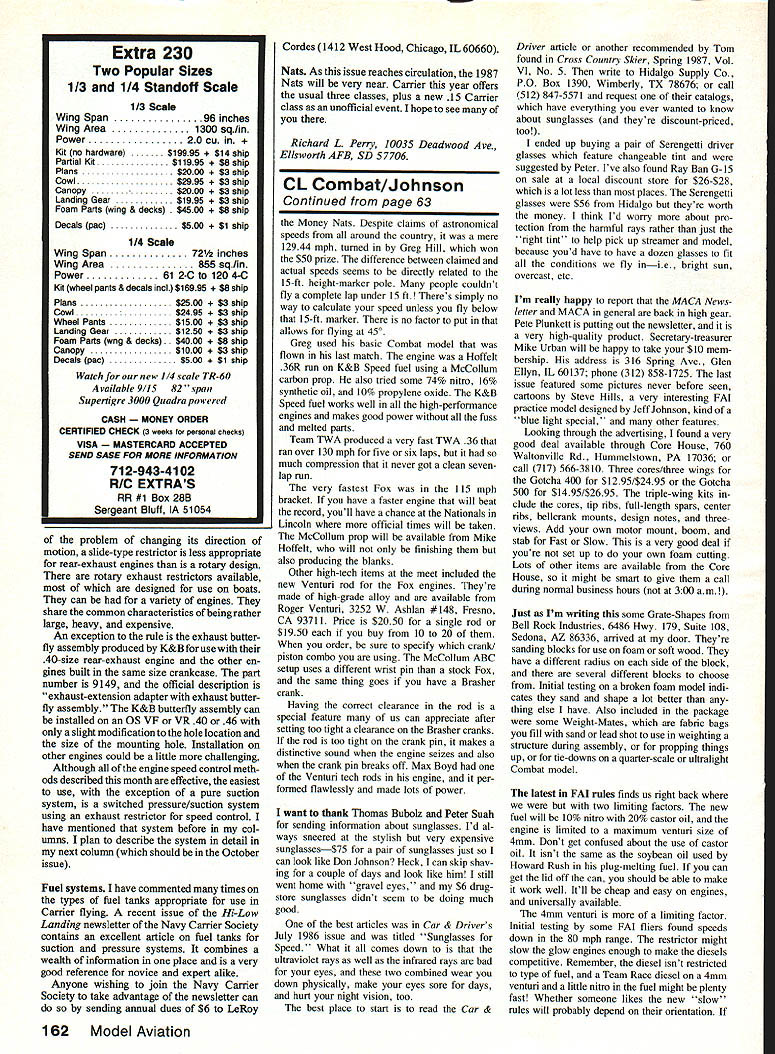
Despite claims of astronomical speeds from around the country, the winning speed was a mere 129.44 mph, turned in by Greg Hill, which won the $50 prize. The difference between claimed and actual speeds seems directly related to the 15-ft. height-marker pole. Many people couldn't fly a complete lap under 15 ft.! There's simply no way to calculate your speed unless you fly below the 15-ft. marker. There is no factor to adjust for flying at 45°.
Greg used his basic Combat model that he had flown in his last match. The engine was a Hoffelt .36R run on K&B Speed fuel using a McCollum carbon prop. He also tried some 74% nitro, 16% synthetic oil, and 10% propylene oxide. The K&B Speed fuel works well in all the high-performance engines and makes good power without all the fuss and melted parts.
A Team TWA produced a very fast TWA .36 that ran over 130 mph for five or six laps, but it had so much compression that it never got a clean seven-lap run.
The very fastest Fox was in the 115 mph bracket. If you have a faster engine that will beat a Fox, you will have a chance at the Nationals in Lincoln where more official times will be taken. The McCollum prop will be available from Mike Hoffelt, who will not only be finishing them but also producing the blanks.
Parts and high-tech items
Other high-tech items at the meet included the new Venturi rod for Fox engines. They're made of high-grade alloy and are available from Roger Venturi:
- Roger Venturi, 3232 W. Ashlan #148, Fresno, CA 93711.
- Price: $2.50 for a single rod or $19.50 each if you buy 10 to 20.
- When you order, be sure to specify which crank spin position you are using.
The McCollum ABC set-up will cost less if you use a McCollum ABC set-up instead of the stock Fox, and the same thing goes if you have a Brasher crank.
Having the correct clearance in the rod is a special feature many of us can appreciate after the engine has been run for a time on the bench. It will save you time and frustration when the engine breaks down on this ragged racetrack.
Sunglasses and eye protection
I want to thank Thomas Bubolz and Peter Suah for sending information about sunglasses. I'd always sneered at the stylish but very expensive sunglasses—$75 for a pair just so I can look like Don Johnson? Heck, I can skip that for a couple of days and look like him! I still went home with "gravel eyes," and my $6 drugstore sunglasses didn't seem to be doing much good.
One of the best articles was in Car & Driver's July 1986 issue and was titled "Sunglasses for Racing." What it all comes down to is that ultraviolet rays as well as infrared rays are bad for your eyes. These combined wear you down physically, make your eyes sore for days, and hurt your night vision.
The best place to start is to read the Car & Driver article or another recommended by Tom found in Cross Country Skier, Spring 1987, Vol. VI, No. 5. Then write to Hidalgo Supply Co. or call and request one of their catalogs, which have everything you ever wanted to know about sunglasses and their "eye discount" price:
- Hidalgo Supply Co., P.O. Box 1309, Wimberley, TX 78676
- Phone: (512) 847-5571
I ended up buying a pair of Serengeti driver glasses which feature changeable tint and were suggested by Peter. I've also found Ray-Ban G-15 at a local discount store for $26–$28, which is a lot less than most places. The Serengeti lenses were $56 from Hidalgo but they're worth it. I think I'd worry more about protection from harmful rays rather than just the "right tint" to help pick up streamers and model.
Pete Plunkitt is putting out the newsletter, and it is a very high-quality product. Secretary-treasurer Mike Urban will be happy to take your $10 membership:
- Mike Urban, 316 Spring Ave., Glen Ellyn, IL 60137
- Phone: (312) 858-1725
The last issue featured some pictures never before seen, courtesy of Steve Hill—they were very interesting.
Grate-Shapes sanding blocks
Just as I'm writing this, some Grate-Shapes from Bell Rock Industries arrived at my door. They're sanding blocks for use on formers, and they have a different radius on each side that fits the block. There are several different blocks to choose from.
- Bell Rock Industries, 26346 Hwy. 179, Suite 108, Sedona, AZ 86336
FAI rule changes
The latest in FAI rules finds us right back where we were but with two limiting factors. The new fuel will be 40% nitro with 20% castor oil, and the engine is limited to a maximum venturi size. (Don't get confused about castor oil; it isn't the same as soybean oil used by some people. Castor oil is still the most widely used and universally available oil.) The other limiting factor is that the prop will be limited to the same diameter as before but with a maximum pitch.
The restrictor ring will be used to limit the venturi, and a Team Race disc on a 4 mm venturi and a little nitro in the fuel might be plenty fast! Whether someone likes the new "slow" rules will probably depend on their orientation.
A problem in changing its direction of motion is that a slide-type restrictor is less appropriate for rear-exhaust engines. Rotary-design exhaust restrictors, available and designed for use in boats, can be used. A variety of engines share common characteristics, being rather large, heavy, and expensive. An exception to the rule is the exhaust-butterfly assembly produced by K&B to use on 40-size rear-exhaust engines and other engines built with the same size crankcase.
- Part number: 9149
- Official description: "exhaust-extension adapter, exhaust-butterfly assembly, K&B."
The butterfly assembly can be installed on OS, VF, YR 40–46 with slight modification — hole location and size of the mounting hole vary. Installation on other engines could be a little challenging.
Speed control and exhaust restrictors
Although the engine speed-control methods described here are effective, the easiest to use, with the exception of a pure suction system, is a switched pressure/suction system using an exhaust restrictor. Speed control has been mentioned in these columns before; I plan to describe the system in detail in the next column — should be the October issue.
Fuel systems
I have commented many times on the types of fuel tanks and their appropriate use. For carrier flying, the recent issue of Hi-Low Landing, the newsletter of the Navy Carrier Society, contains an excellent article on fuel tanks and suction/pressure systems. It combines a wealth of information and is a very good reference for the novice and the expert alike.
Anyone wishing to join the Navy Carrier Society and take advantage of the newsletter can send annual dues of $6 to:
- LeRoy Cordes, 1412 West Hood, Chicago, IL 60660
Nats information
As this issue reaches circulation, the 1987 Nats will be very near. The Carrier year offers the usual three classes plus a new .15 Carrier class as an unofficial event. For information write:
- Richard L. Perry, 10035 Deadwood Ave., Ellsworth AFB, SD 57706
Transcribed from original scans by AI. Minor OCR errors may remain.

