
Control Line: Combat
Charlie Johnson
Exotic Parts Availability
COMPLAINTS! One that is most often heard is that mere mortals are unable to obtain the really exotic stuff that the pros are able to use to their advantage. If you weren't able to get one of the 20 McCollum piston/liner sets or possibly a Brasher crank, there's still hope. Cipolla made 200 ABC piston/liner sets for the Fox which can be used either as replacements for early iron versions or for the Mark VI. The sets cost $39.95 plus $1 for P&H and are available from Doc Passen, P.O. Box 111, Jasonville, IN 47438.
Early reports from Chicago indicate that the Cipolla (or "Foxolla") is fast, needles well, and shakes less than the iron-piston setups. The Cipolla piston is of very robust design and features a single "circlip" holding the wrist pin in place. If you get one, you'll have to grind down one end of your Fox wrist pin to fit this new piston; the sample I received needed a little X-Acto work to deburr the ports. Reports on reliability and performance will follow in a later column.
In fairness to Fox, the latest piston in the Mark VI is all-aluminum and seems to have solved the problem that existed with early-production engines. If you have a Mark VI that has destroyed its piston or are afraid to run your engine because of the bad press it has received, send the engine back to the Fox factory and they'll take care of it. As far as the McCollum setup is concerned, it has set the standard for this type of combination. It would be difficult for even Nelson to do a lot better.
FAI Rule Changes and Performance
As all the FAI fliers know, the new rules mandate fuel with 10% nitro and 20% castor oil, plus a 4-mm-diameter venturi on the .15-cu.in. engine. Early reports in the MACA Newsletter had models going less than 80 mph and falling from the sky. Prophets of doom claimed models would be too slow and would lack appeal because of the 4-mm venturi and around 1,000 rpm loss if the engine had been set up to run on 40% nitro.
To competitors and spectators: it's true that some models only go about 80 mph with the new rules—but the Nelson .15 will still break 100 mph. Henry Nelson reported in the July MACA Newsletter that his engine lost about 1,500 rpm because of the 4-mm venturi and around 1,000 rpm if the engine had been set up to run on 40% nitro. Most Nelson users were using nitro in the 10% range anyway, so they should see an airspeed drop of only about five miles per hour.
Henry also reports no trouble running on the castor-oil-based fuel, but recommends using UCON oil (or a comparable synthetic oil) for test flying to retard buildup of carbon in the engine. Nelson's last line says it all: "F2D remains the same event and is, for Nelson users at least, FAST." Henry Nelson may be reached at RD 2, Box 233 Ramsey Rd., Zelenople, PA 16063.
Nelson Engines and Ordering
I believe the current price of a Nelson F2D Combat Special, including the legal 4-mm venturi, is around $175. Every engine is hand-fitted by Henry Nelson and test-run to make sure it is up to standard. Henry's state-of-the-art machinery allows him to hold such close tolerances that rarely does anything need to be done to an engine.
If you decide to order an engine (or engines), be sure he knows:
- Exactly what purpose it will be used for.
- What percentage of nitro you will be using.
- If you will be using the 4-mm venturi or just flying exhibition-type stunts for the crowd.
And please use the prop he recommends — not a wide-bladed 10 x 6.
CL Combat — Continued from page 66
I wish I had a picture from the recent Bladder Grabber meet, but that'll have to wait until next time. Mike Petri, who placed third at the Mooney Meet, was undefeated through 11 rounds of flying—until he met the meet's CD, Chuck Rudner. Somehow, Chuck beat the red-hot Petri three straight and took over $5,000 in prize money. The big-time contests have really taken off recently, and we can thank people like Heather, Jim, Howard and Mary Lou Rush—and especially Bob Carver (who donated over $10,000 worth of stereo equipment), just because he loves Combat. Those people have done more than the rest of us could have dreamed of years ago. Thank you!
Fuel System and Needle-Valve Tips
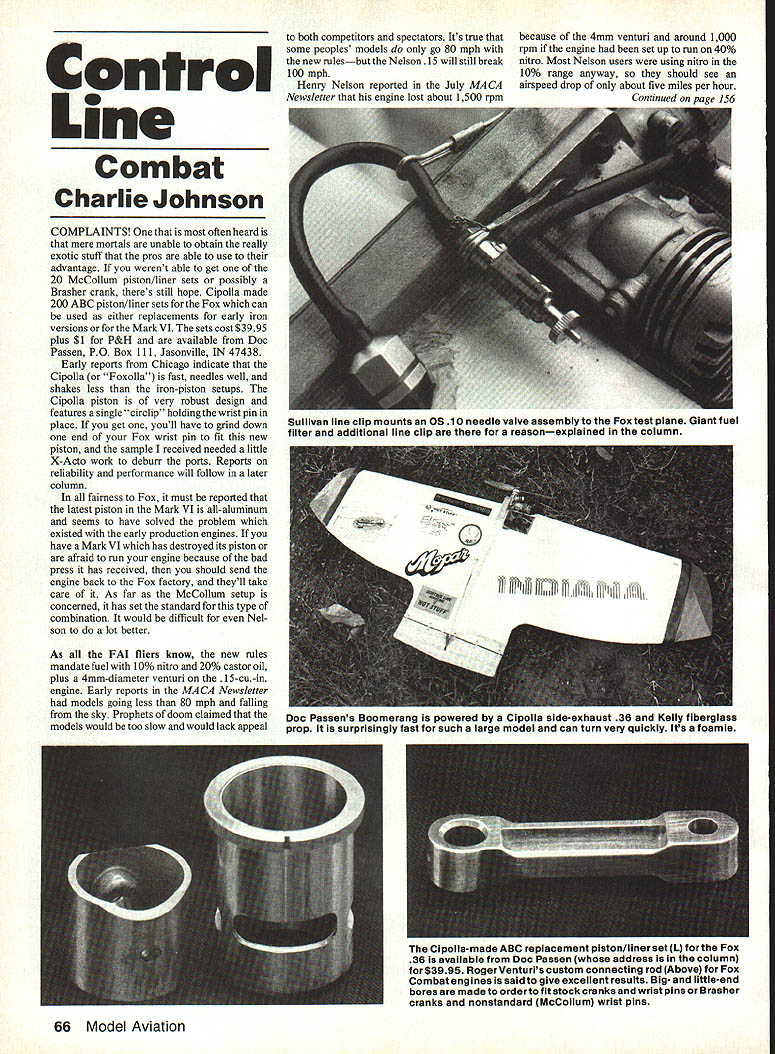
One of the pictures shows a Fox .15 with lots of extra plumbing hooked on. It was the subject of a test to see what would happen if the fuel line was routed differently and a giant fuel filter stuck in its middle.
If the line and filter are run far enough to the inboard side of the model, this will cause the engine to "sag" in tight maneuvers. Even though the addition of a filter to a plane's fuel system will smooth out the needle-valve setting a little bit, a filter with large capacity lets the engine merely "bleed down" rather than stop quickly. Such a situation could cause agonizing moments in the middle of a match, since the engine would have time to pick up again because it was still running—although at a very low power level.
Removing the large filter produced quick engine stops instead of "bleed-down." The moral: keep as small a quantity of fuel in the line between the needle valve and the engine's pressure tank as possible. This admonition includes the size and placement of the fuel filter and points to the use of a small inside-diameter fuel line.
The biggest improvement you can make to your engine, if you are still using either a conventional spray bar or a two-piece body-and-metering-jet setup on the venturi, is the addition of a remotely mounted OS .10 needle-valve assembly to the venturi. In the Fox .15 picture a Sullivan Products control-line clip was used to mount the OS needle-valve assembly; this has proved to be as effective a mounting method as any of the other cuts I have seen—and it's inexpensive.
Adding the OS .10 needle-valve assembly is the best thing you can do for any engine run with a bladder tank—just be sure to use a filter between the bladder and the needle valve (never between the needle valve and the venturi). You'll need to remove the engine's standard spray bar and replace it with a Fox or K&B jet. Jim Jack doesn't even use a jet in his system—he knocks the fuel tube (coming from the inside needle-valve assembly) into the hole in the side of the venturi where the jet would normally be screwed in.
Before you screw the needle valve into the body of the remote-needle system, place a short length of fuel-line tubing over the threads so that, when you test for leaks, any leaks will be outside the engine. Check the system for leaks without the engine running—you'd be surprised how much fuel can leak past unsealed assemblies!
Charlie Johnson, 3716 Ingraham St., San Diego, CA 92109
Transcribed from original scans by AI. Minor OCR errors may remain.

