
Control Line: Combat
Charlie Johnson
Starting procedure (pit-crew drill)
Get to the circle early and prepare the model:
- Run the engine to check settings and lock the needle.
- Shut the engine off and refill the bladder if necessary.
- Turn the model upside down and put four drops of fuel in the exhaust.
- Turn the crankshaft in the normal direction of rotation until the piston is at top dead center on its compression stroke.
- Keep the exhaust port closed. Do not flip the prop or put on the starting battery yet.
- You can leave the model like this for a minute or two, but it’s better to rehearse the drill about 30 seconds before match start.
At T minus 5 seconds:
- Connect the battery.
- On "Go!" hit the prop backwards (a back flip). A tight-fitting baseball batting glove protects fingers—better than a loose work glove—especially with carbon-fiber props.
If the engine starts but doesn’t run cleanly, try three drops of fuel in the exhaust next time. There’s a combination of these factors that will start an engine almost every time. Still, nothing is guaranteed—at the unofficial Pit Crew Contest at the Nats, not one of the 12 competitors got a perfectly clean start.
Flipping techniques and tips
- I usually prefer to "blast" over compression for worn or loose engines; that can start engines others won't.
- Sometimes an engine won’t start with a prop flip in one direction but will with a flip or tap in the other direction.
- Back-flipping also saves fingers when dealing with tight props or old G-21 Supertigres and cold ABC engines.
- Good engine men "know" the engine will catch and move out of the way as they follow through with their flip—be aware they may be out of position if the engine fails to start on the first flip.
Launch timing and release technique
Many matches are lost because pilots launch using different release styles. The judge starts the clock when the launcher opens his hands to release the model. If your pit crew guides the model a few feet before letting go, your official airtime may start later even though both models are the same distance from the starting point.
Tips to make the release obvious:
- Have the pit crew kneel.
- Aim the model upward about a 45° angle for release so the judge can clearly see the launch point.
- Ensure the starter clears the area quickly after the flip.
I timed differences of over one second between the two release styles—sometimes more if the pit crew takes a step. Making the release point obvious (e.g., a steep climb) helps judges and avoids losing time.
Top-speed timing and notes
- Reported top speeds at recent events seemed lower than some claims: Greg Hill ran 129 mph at the Monocry Nats and Jim Jack ran 121 mph at the unofficial Top Speed event at the AMA Nats.
- Official timing is limited to runs flown at or below 15 ft. altitude; higher runs produce uncertain "estimates" since there’s no agreed correction factor.
- The Superior X-40 conversion might be timed more consistently when driven by a Slow Rat; a K&B 5.8 also won and can handle some high-nitro runs.
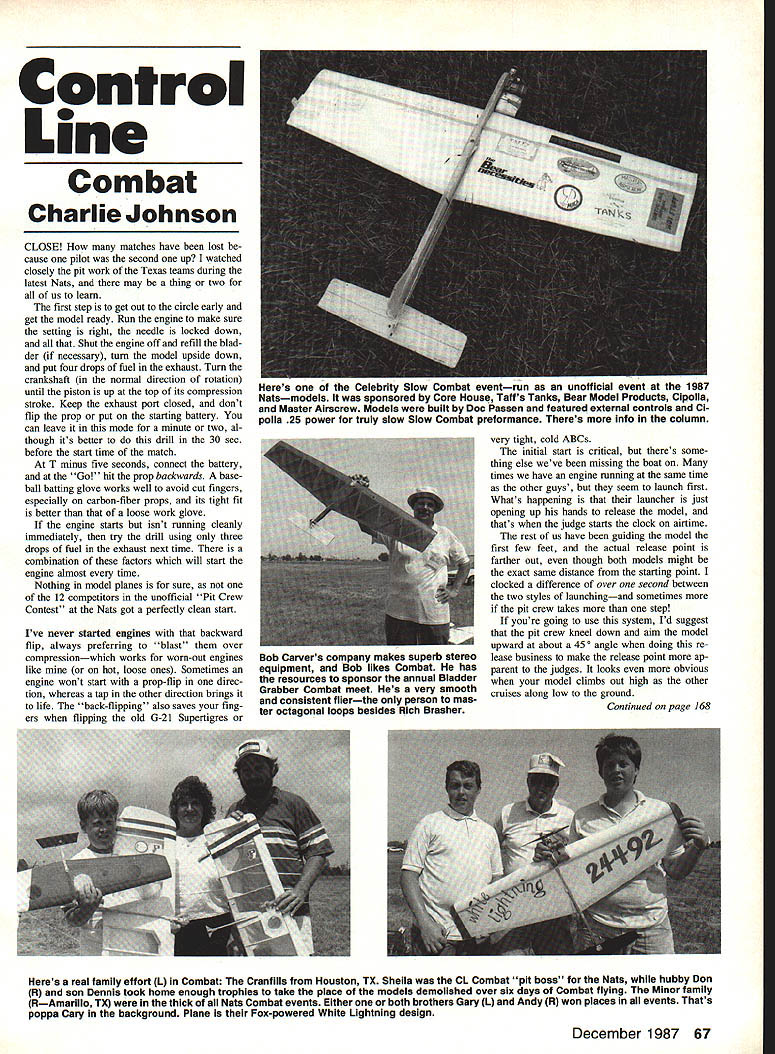
Celebrity Fun-Fly
The concept was sound but the execution at the Nats was substandard for a number of reasons.
Rushed prep and a mechanical lesson
We weren’t planning to fly Wednesday and rushed planes. One Cipolla .25 had been used in RC cars; we swapped in aircraft-style cylinder heads. One crankcase bolt hole wasn’t tapped deep enough for the aircraft head bolts, so a bolt bottomed out before clamping the head properly. The distortion and compression loss made the engine almost impossible to start, and when it ran it was only about 3,000 rpm.
One engine with the correct head bolts ran perfectly and pulled the model in true Slow Combat fashion. The cause was obvious after closer inspection. Windy weather on Thursday and Friday prevented further test hops.
Diesels for combat
- Al Kelly is planning diesel conversions (Rossi and Cipolla) for the FAI team trials.
- A 4 mm venturi is large for a .15 diesel, but speeds around 100 mph may be possible.
- Diesels can carry less fuel (weight savings), require no battery, have no glow plug to burn out, and offer a broader torque curve than an aggressive glow engine.
- My memory of high-performance diesels from the 1976 Combat World Champs is that they were cranky and hard to tune; Al claims the 1987 versions are much better. If diesels dominate, expect the new battle cry: "Think stink!"
Safety thong and engine restraint
A safety thong and possibly an engine restraint may be required in all Combat events. These rules are a slight inconvenience but can prevent injury and DQs.
(Note: The safety-thong requirement was approved by the Control Line Contest Board for immediate implementation. This was reported in October’s "Competition Newsletter," page 123. Charlie Johnson could not have been aware of this when he wrote this column. — RCM)
Engine restraint advice:
- Best attachment point: a backplate bolt. Use an eyelet around the wire and a slightly longer bolt.
- A "noose" arrangement (wire encircling the engine) works well when you need to change engines, though it can leave wear marks on the crankcase.
- Avoid attaching the restraint to the engine’s mounting bolts—they are the parts most likely to loosen or fail if a prop blade is damaged.
Circle size, tactics, and sportsmanship
- The AMA pilots' circle is smaller than the FAI circle, but both leave too much room for wandering and tactical use of the circle.
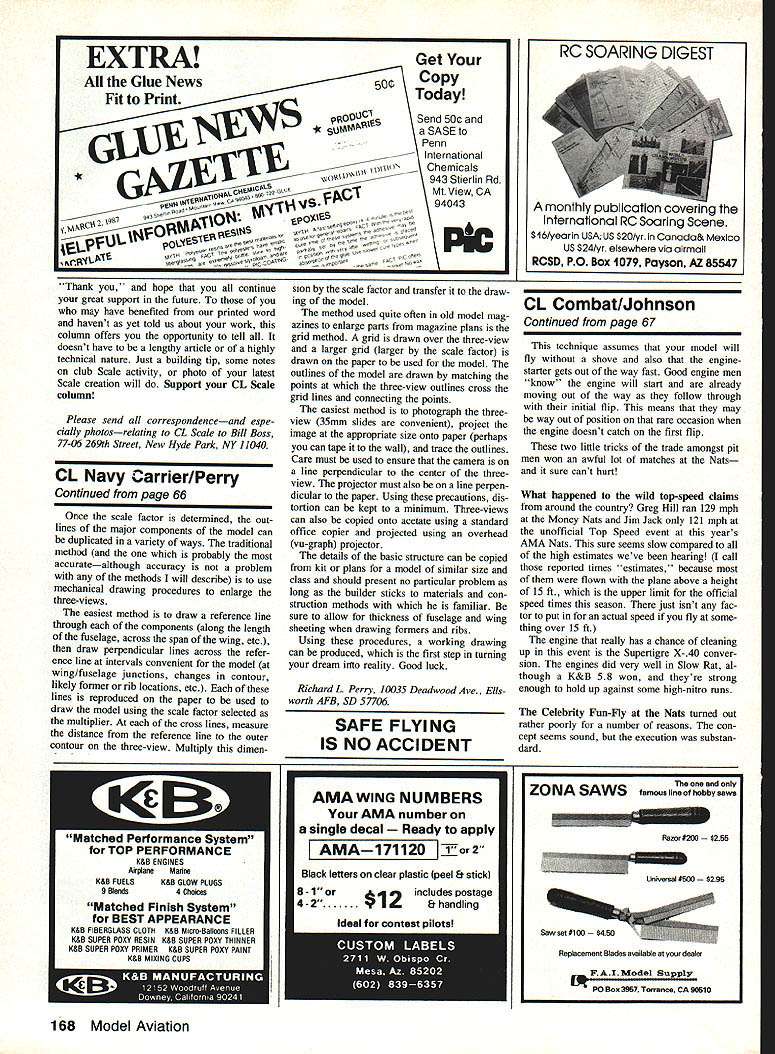
- During eliminations, Howard Rush used the FAI circle to run from one side to the other to avoid an opponent lining up on him. Many AMA fliers found this entertaining and saw it as a potential tactic in AMA events.
- Problems with running around the circle:
- Multiple pilots lining up increases the chance of engines cutting into an opponent’s lines rather than the streamer or model.
- Extra fly-aways and line cuts become more likely.
- A tighter pilots' circle would minimize cutaways. Some suggest penalizing contestants who avoid engagement by running around the circle rather than flying their airplanes away—this would be controversial, but Combat is not a track meet.
Circle marshal (center judge) duties
The circle marshal’s responsibilities are not clearly defined in the rule book. One useful duty would be to signal pit crews to either stay outside the 50-ft line or come into the circle.
At the Nats there were at least three incidents where pit crew members ran in to retrieve a downed model while an opposing model was still under power and looping overhead with its lines wrapped around the downed airplane. That creates a serious hazard: the model under power could hit a pit man or pull the flying model into the ground.
A simple wave from the circle marshal to control pit-crew movement is acceptable and advisable.
Closing
These small techniques and attentions to detail among pit crews won a lot of matches at the Nats—and they certainly can’t hurt.
Transcribed from original scans by AI. Minor OCR errors may remain.

