
Control Line: Combat
Charlie Johnson
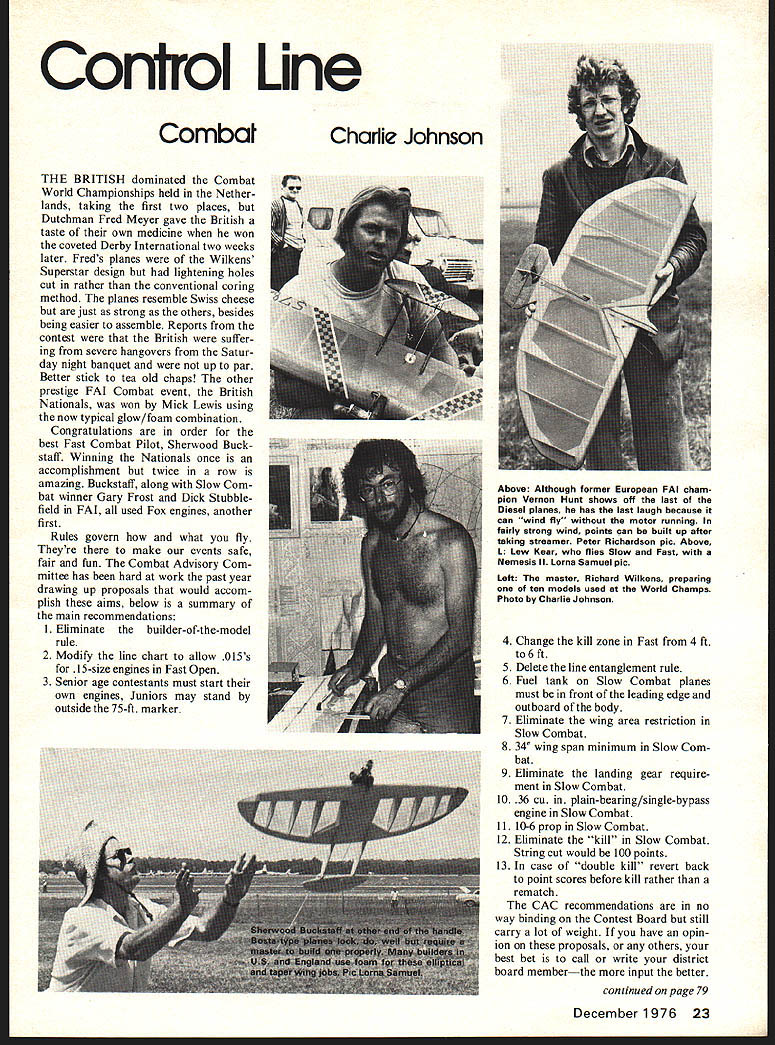
THE BRITISH dominated the Combat World Championships held in the Netherlands, taking the first two places, but Dutchman Fred Meyer gave the British a taste of their own medicine when he won the coveted Derby International two weeks later. Fred's planes were of the Wilkens' Superstar design but had lightening holes cut in rather than the conventional coring method. The planes resemble Swiss cheese but are just as strong as the others, besides being easier to assemble. Reports from the contest were that the British were suffering from severe hangovers from the Saturday night banquet and were not up to par. Better stick to tea old chaps! The other prestige FAI Combat event, the British Nationals, was won by Mick Lewis using the now typical glow/foam combination.
Congratulations are in order for the best Fast Combat Pilot, Sherwood Buckstaff. Winning the Nationals once is an accomplishment but twice in a row is amazing. Buckstaff, along with Slow Combat winner Gary Frost and Dick Stubblefield in FAI, all used Fox engines, another first.
Rules govern how and what you fly. They're there to make our events safe, fair and fun. The Combat Advisory Committee has been hard at work the past year drawing up proposals that would accomplish these aims; below is a summary of the main recommendations:
- Eliminate the builder-of-the-model rule.
- Modify the line chart to allow .015's for .15-size engines in Fast Open.
- Senior age contestants must start their own engines. Juniors may stand by outside the 75-ft. marker.
- Change the kill zone in Fast from 4 ft. to 6 ft.
- Delete the line entanglement rule.
- Fuel tank on Slow Combat planes must be in front of the leading edge and outboard of the body.
- Eliminate the wing area restriction in Slow Combat.
- 34" wing span minimum in Slow Combat.
- Eliminate the landing gear requirement in Slow Combat.
- .36 cu. in. plain-bearing/single-bypass engine in Slow Combat.
- 10-6 prop in Slow Combat.
- Eliminate the "kill" in Slow Combat. String cut would be 100 points.
- In case of "double kill" revert back to point scores before kill rather than a rematch.
The CAC recommendations are in no way binding on the Contest Board but still carry a lot of weight. If you have an opinion on these proposals, or any others, your best bet is to call or write your district board member — the more input the better.
At our annual contest we tried a new method of airplane/line processing — new to us anyway. We set up a pit area big enough for the planes for the first round. Planes for the next opposing flying order, according to the draw, were placed with tightly stretched string marked to point center models. Two strings marked a plus-or-minus 6-in. area. Length/thickness pull tests were easily accomplished. Passing out streamers tremendously speeds up the show; it also makes a safe place to park model lines while helping friends. Though contestants knew thorough processing, some tried to get away with long lines or two undersize .015s. A Fast Combat joker tried to tell us his .40 HP was really .36 because he put a short rod in. The Event Director asked him what size he thought he'd have put the rod out of a Chevy pickup.
Processing can be a real pain, but efficient organization can accomplish its goals, keeping everyone safe and honest. A no-kill rule tried in Slow Combat resulted in better overall matches. A new problem arising is that when a contestant cuts the string and gets credit for the cut but is unable to get points otherwise through air time, it can mean playing dodge-'em for the remainder of the match. As FAI Combat found, some guys take a couple quick cuts and then stay down for the rest of the match — ha, ha — won't start the engine. A variation is the trick of flying inverted about a foot off the ground as a purely defensive move; it makes for a very interesting inverted team race. The trailing plane cannot catch the other unless about 20 mph faster, since the leading pilot can whip block just like a real Team Race. has its equivalency in real air-to-air combat. It's called the coward's way out.
THE BIG NEWS in combat engines is the Fox 15 and 35. Very little is known about the 15 at this writing except that it comes in various styles, depending on whether plain or ball bearings are employed. Stubblefield used a ball-bearing rear exhaust version to win FAI at the Nationals (my spy failed to produce a picture of the engine). The 35 also won the Nationals in both Fast and Slow Combat and is holding up remarkably well in all hands. The hackers who could blow up any engine are having their success with this one, too, but for normal out-of-the-box use this engine is the best on the market. The sample we tested did everything asked of it, good starts and power plus. It was very easy on plugs — which your pocketbook will appreciate.
The one annoying thing is the need to send it off on the rich side, blubbering rich if you're running a lot of nitro, not quite rich on the lower nitro fuels. The problem is the tremendous amount of revs it picks up once unloaded in the air. Literature packed in the box recommends pinching the line to keep the engine cleaned out just before launch. This doesn't do much for accurate fuel metering, or when you want to be first up and the engine decides it's time for a pinch and tune shuffle. Engines that take the thrust on the rear bearing, such as Fox, seem to exhibit this unloading more than Tigres which take the thrust on the front bearing. An interesting experience for you machinists would be to set up a Fox with a Tigre-type front end. The square venturi on the Combat Special is also suspect by those who love round venturis; since shape is ultimately more important than mere size they claim a round venturi would solve some of the problems.
Next article I'll have the answer because I'm making a couple of venturi sets in order to plot size and shape in relation to power and fuel consumption. The smallest venturi that will let the engine reach its horsepower peak will also be the most efficient. Most often a larger venturi does nothing except make for erratic needle settings and waste fuel. Almost any current racing engine will flow more than enough air/fuel mixture with its standard venturi, or one quite a bit smaller. B-Team Race models go over 110 mph with .290 venturis and this would be considered small for a Slow Combat engine. The majority of top runners worry more about producing power consistently than flash horsepower over some part of the power curve.
MACA WILL be running the FAI Combat Team selection when we find out if the FAI will be going to a three-year cycle, and in what year combat will be held. If you're interested in world class competition then now is the time to get started. Besides the Tigre G-15 and G-20 the new side-port X-15 is a real strong performer, probably equal to Rossi and Cox when in combat trim and tune. Gordon Delaney had one of these in his FAI Challenger and consistently pulled a streamer at over 100 mph and through the turns just as strong.
Charlie Johnson, 3716 Ingraham St., San Diego, CA 92109 — Tel. 714-273-6530.
Transcribed from original scans by AI. Minor OCR errors may remain.

