
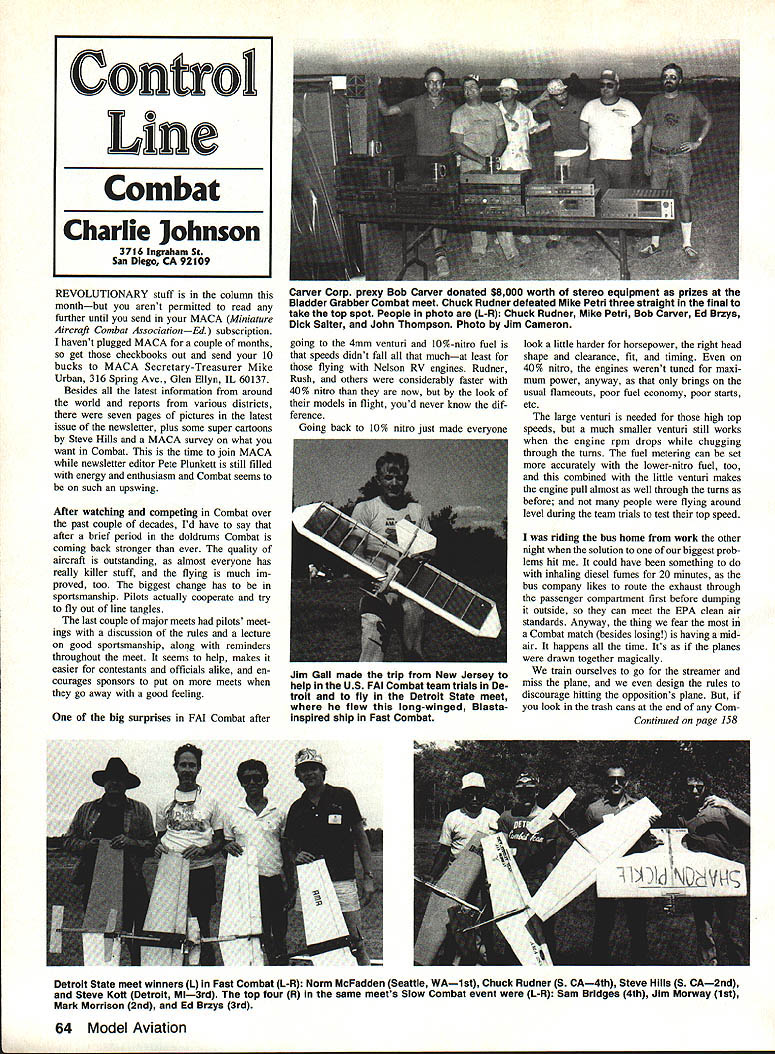


Control Line: Combat
Charlie Johnson
3716 Ingraham St. San Diego, CA 92109
REVOLUTIONARY stuff is in the column this month — but you aren't permitted to read any further until you send in your MACA (Miniature Aircraft Combat Association — Ed.) subscription. I haven't plugged MACA for a couple of months, so get those checkbooks out and send your $10 to MACA Secretary-Treasurer Mike Urban, 316 Spring Ave., Glen Ellyn, IL 60137.
Besides all the latest information from around the world and reports from various districts, there were seven pages of pictures in the latest issue of the newsletter, plus some great cartoons by Steve Hills and a MACA survey asking what you want in Combat. This is the time to join MACA while newsletter editor Pete Plunkett is still filled with energy and enthusiasm and Combat seems to be on such an upswing.
Combat is coming back
After watching and competing in Combat over the past couple of decades, I'd have to say that after a brief period in the doldrums, Combat is coming back stronger than ever. The quality of aircraft is outstanding — almost everyone has really killer stuff — and the flying is much improved, too. The biggest change has to be in sportsmanship. Pilots actually cooperate and try to avoid line tangles.
At the last couple of major meets there were pilots' meetings with discussions of the rules and lectures on good sportsmanship, along with reminders throughout the meet. It seems to help, makes it easier for contestants and officials alike, and encourages sponsors to put on more meets when they go away with a good feeling.
Fuel and performance (FAI Combat)
One of the big surprises in FAI Combat after going to the 4 mm venturi and 10% nitro fuel is that speeds didn't fall all that much — at least for those flying with Nelson RV engines. Rudner, Rush, and others were considerably faster with 40% nitro than they are now, but by the look of their models in flight, you'd never know the difference.
Going back to 10% nitro just made everyone look a little harder for horsepower: the right head shape and clearance, fit and timing. Even on 40% nitro, the engines weren't tuned for maximum power anyway, as that only brings on the usual flameouts, poor fuel economy, poor starts, etc. A large venturi is needed for those high top speeds, but a much smaller venturi still works when the engine rpm drops and the engine is chugging through turns. Fuel metering can be set more accurately with the lower-nitro fuel, too, and this combined with the smaller venturi makes the engine pull almost as well through the turns as before. Besides, not many people were flying around level during the team trials to test their top speed.
Key points:
- 10% nitro didn't dramatically reduce real-world speeds for many competitors.
- Lower nitro forces attention to engine setup: head shape, clearances, timing.
- Large venturis favor top speed; smaller venturis help mid-turn performance and more precise fuel metering.
- Tuning aggressively for maximum power usually worsens flameouts, starting, and fuel economy.
Dealing with midairs — "bump-and-run" Combat
I was riding the bus home from work one night when the solution to one of our biggest problems hit me. It could have been something to do with inhaling diesel fumes for 20 minutes, as the bus company seems to route the exhaust through the passenger compartment first before dumping it outside to meet EPA clean-air standards. Anyway, the thing we fear the most in a Combat match (besides losing) is having a midair. It happens all the time — it's as if the planes were drawn together magically.
We train ourselves to go for the streamer and miss the plane, and we even design the rules to discourage hitting the opponent's plane. But if you look in the trash cans at the end of any Combat meet, you see the results.
So, at a meet, you know that all the planning did little good. It seems inevitable that it's going to happen, so let's meet it head on.
Think in terms of flying B-17s instead of fighter pilots. Remember the Flying Fortress that returned from its WWII mission with half a wing missing, two engines out, and gaping holes all over? Yech — yet you get the idea. We'll call it "bump-and-run" Combat. No fleet of models needed — just patch up old paint between matches and fly another mission. Equipment not up to a little abuse? Guess you'll be out today!
The object would still be to score points by cutting the streamer (or by the kill in Fast Combat), but an occasional bounce off your opponent's model might soften him up just enough for you to get a few extra points later. It doesn't have to be dangerous to others:
- A tighter pilot's circle will avoid having props cut the lines.
- A safety wire from engine to leader should keep heavy pieces hooked to the leaders.
- Half-A Combat is already flown this way and brings more giggles from the crowd and contestants than any other event. The small planes are rarely damaged that much during a collision, so it's not a big deal to hit a few times during the contest.
Fast Combat models are really too fast and powerful for this type of flying, since they have a lot of mass and a slashing prop could tear up even the strongest structure. Slow Combat ships are better for the game, but .15s are the best because their little props do the least amount of damage. If you try to cut off Ron Colombo's magnesium tailboom, you'll probably just break your prop, anyway.
Current technology is aimed toward high-performance models that destroy upon impact with the ground or another model. They're built to go fast and turn tight. With only a slight loss in peak performance, a tremendous increase in impact resistance could be made. As with the FAI restrictions, performance might not drop all that much, and an extra benefit would be a more forgiving model in the event of operator error. That's the hardest thing about learning Control Line flying — any little error and the model is in the ground (or all over it). Imagine learning to drive and crashing the car every time you let the clutch out too roughly.
One more caution: your perception of how Combat is flown is based on what you've seen over the years. What happens if a very good pilot adopts this "tactical flying" — as they call it in Europe — and becomes very successful, to the point of dominating Combat? Most people who've tried this tactic have only succeeded in destroying both models and not in consistently gaining any advantage, while racking up a pretty poor image of themselves.
FAI World Championships and support
As all of you know, the next FAI Control Line World Championships will be in Kiev, Russia later this year. I'm sure a lot of us would like to go, but getting to Russia seems a little more difficult than, say, flying to England. In the past, the team supporters have often been treated like second-class citizens during visits to foreign lands. If any of you are interested in going to the Russian meet, I'd suggest that you make your intentions known to the folks at AMA HQ and encourage them to provide as good a supporter package as possible.
The wider the base of support for the FAI program, the better — and what better way than to get as many Combat fliers to attend the World Champs as possible to see it all for themselves. They'll do the selling of the FAI program for the AMA after that.
Political awareness and allies
Those of you who are members of the NRA (National Rifle Association) know of the constant pressure from antigun groups. Another AMA — the American Motorcyclist Association — recently went through a battle with a senator from Missouri who wanted to ban superbikes. Now, you may not care about guns or superbikes, but you can insert the words "Combat airplane" in their places, and a lot of the heat that has been coming out of the U.S. capital would have been the same.
Combat models are as exciting as superbikes and are as potentially dangerous as any gun, and once this "family" sport of ours comes under attack, too, the NRA was a great help to the motorcyclists in fighting against some really off-the-wall legislation. We should be looking for friends and possible coalitions should the government or a TV program like "60 Minutes" turn their sights on us.
Transcribed from original scans by AI. Minor OCR errors may remain.

