
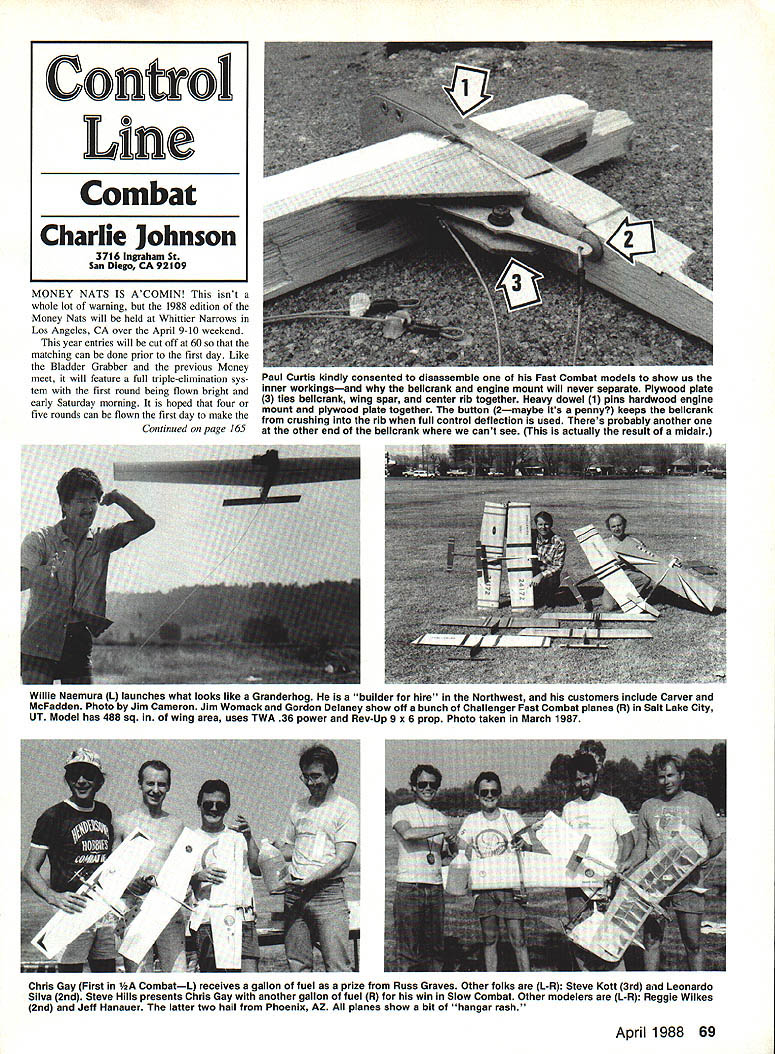
Control Line: Combat
Charlie Johnson 3716 Ingraham St. San Diego, CA 92109
Money Nats (1988)
MONEY NATS IS A-COMIN! The 1988 edition of the Money Nats will be held at Whittier Narrows in Los Angeles, CA over the April 9–10 weekend. This year entries will be cut off at 60 so that the matching can be done prior to the first day. Like the Bladder Grabber and the previous Money meet, it will feature a full triple-elimination system with the first round flown bright and early Saturday morning. It is hoped that four or five rounds can be flown the first day to keep the schedule on track.
As of this writing the only prize announced is $1,000 for first, but I expect other prizes for the top few finishers. Everyone surely gets enough Combat flying out of it to make it worthwhile, and the prestige in winning is in the same league as the Grabber. It looks like the airlines are going to have some pretty good prices through this time period, too.
Traveling with models
Once you've packed all your models for the flight out, mark the box in very large letters: MODEL AIRPLANES — PLEASE HANDLE WITH CARE. Several airline people I have met have commented that mentioning model airplanes might get more respect because most of the people who handle luggage are interested in models and might take it easy on your gear. I don't know what "fragile" means to most of those guys, but it would make for a funny comedy routine.
Carrier events
I enjoy the Carrier events because they are challenging — a balance of equipment and flying skill. Judging is done almost exclusively by stopwatch with little room for subjectivity. The event can be flown by individuals (a practiced team is not required), and a contestant can usually set his own schedule and contest rather than being timed to a rigid schedule of heats or rounds. The pace is more relaxed on Sunday (and this also helps avoid running out of daylight, as these contests tend to do). I hope those of you who decide to try Carrier flying find it as enjoyable as I have.
Doc Passen's Control Line kits and products
Ever the optimist, Doc Passen now offers a line of Control Line kits, called Doc's Generic. The kits contain no spars and have no fancy, fragile boxes to put them in. Those beautiful 48-in. spars don't do you much good when you receive the box bent in half! From Doc's flyer, it looks like you get everything else except for the usual glue and covering — you go to the hobby shop to buy the spars of your choice.
Of interest to Combat flyers:
- Pair-O-Docs Slow Combat model: double kit for Slow Combat, very light, can be used as a trainer with a smaller engine. Price: $29.95 for the double kit.
- Pair-O-Docs Fast-Combat kit: $19.95.
- Doc's Viper (modified from the earlier Bear kit) available in a foam version: $10.95 for a single.
- Metal engine mounts: $4.99.
- Control line handle with built-in safety: $5.95.
- Lots of other items listed in his flyer, including 11 more kits and various engines.
Doc Passen can be reached at (812) 665-3723, or write to: P.O. Box 111, Jasonville, IN 47438.
Engine weights (from Doc's scale)
Doc also sent a list of some commonly used engines which he weighed on his new scale:
- K&B .5 — 10.75 oz.
- Rossi .15 — 5.5 oz.
- K&B .72 series — 8.75 oz.
- ST C-35 — 7.87 oz.
- Cipolla .36SE — 6.75 oz.
- Enya .29 — 8.0 oz.
- ABC Mk-3 Fox — 8.24 oz.
I've noticed almost a half-ounce variation in different vintages of Super Tigre .35s which I still own. Some of the smaller-displacement Cipollas actually weigh more than the larger ones because they're both built using the same basic case, but the smaller engine has a much thicker cylinder liner. It's much easier to lose weight by using a light engine than by trying to get it out of the airframe. All the cutout sections on one large foamie amounted to only 1/2 oz., although it's still well worth the effort.
Rules and ideas to reduce collisions
You'll remember that in my last column I suggested a form of "bump-and-cut" Combat where flimsy airplanes wouldn't have much of a chance. This time let's go in the other direction and try to design Combat to avoid collisions at all costs.
It seems obvious that light, ultraperformance airplanes aren't going to be able to withstand the bumps, so people with that style of model have good reason to steer clear of the mass. The trouble is those planes are so quick they can't always keep clear of others.
Some local clubs fly with special rules to reduce midairs:
- Eliminate a flyer after his second midair of the day — regardless of fault.
- Limit the number of models processed for the day (say two models). Wreck them beyond repair, and you get to watch, regardless of the round.
- WAM (Western Associated Modelers) used to have a one-model rule where you had to get through at least three rounds with the same model to have any chance of winning the meet.
The limited-model idea appeals to guys with a small supply of models. If the limit is two and that's all you have, then you have just as good a chance as the guy with a dozen.
External bladder fuel systems
The introduction of the external bladder arrangement at the Bladder Grabber (perfect name!) set a lot of people to thinking. External controls save a lot of time. They are lighter, all control lines are the same length, etc.
External bladders eliminate building a pod and put the fuel mass in the center of the model so the wing doesn't hang low at the beginning of the flight with all the fuel outboard. Tie the surgical tubing in a knot at one end and attach it with a piece of wire or string to an anchor point near the back of the model. I suggest centering the fuel mass over the CG or having it a bit to the rear of the model at the start of the match where the streamer will stabilize the model. At the end of the flight, the CG will be more forward, which helps the landing.
The front part of the bladder can be made conventionally using an eyelet and wrapping with either wire, string, or (my favorite) the smallest size of S6 rubber bands. If you can find them in the hobby shop, they are the best thing going: they never rot or break, are easier to use than wire, and a bag lasts a lifetime. The front of the bladder needs to be secured to the center section or engine mount. Use a good filter in the line, and fill the bladder through the section of fuel line on the bladder side of the filter.
Greg Hill had a high-pressure bladder (originally on a Fast ship) strapped to the side of his 1/2A. His setup included a stock Cox needle valve assembly, which I gave no chance of working in the air. Even with a fairly new engine, though, he was able to get excellent air settings since the fuel mass was centralized. I was amazed. His model flew over five minutes on about an ounce of 50%-nitro fuel. As with any external bladder, the bladder is vulnerable to midairs and to hitting the ground inverted.
Simple, effective model design — Richard Stubblefield
About a year ago Richard Stubblefield went through the "what's really necessary?" process and came up with some really simple, easy-to-build models that don't sacrifice enough in performance to keep you from winning if you fly well.
Richard knew his designs would be at a minor performance disadvantage against sleeker models that could fly dazzling consecutive maneuvers. His solution was to use the model's lighter weight and better acceleration out of flatter turns to cut the other guy off at the pass (or at the knot). I've seen many matches where a rocket Combat model roared around Richard's and was unable to get into position to get a cut. The hot rod looked like it was about to eat his plane alive until the pilot made one mistake and gave Richard a shot at the streamer. The moral: adjust your flying style to what you have on the end of the strings.
Diesels and conversions
I received a lot of information from Davis Diesel Development about various conversion packages they offer. The only diesel experience I have is with an Oliver Tiger .15 that I got in England. That's a far cry from a dieselized .35! If any of you have recent experience with .35-size diesels in actual Combat against good-running glow engines, drop me a note and tell me about it.
Transcribed from original scans by AI. Minor OCR errors may remain.

