
Control Line: Combat
Charlie Johnson 3716 Ingraham St. San Diego, CA 92109
Fast engine-starting methods
Quick! One of the neatest special events at the 1987 Nationals was the pit-crew competition for preparing and starting engines. The clean-start winning crew was able to start an engine in about 0.6 seconds.
I thought about that when I watched a new flier at the field last Saturday having very little luck starting his Super Tigre G-21 Combat engine. He wore out his battery and patience; his fingers will take a week to recover. He'd have been thrilled to get the engine running in six minutes, much less 0.6 seconds.
Whether you're a sport flier or a Combat aficionado, here are two engine-starting methods that work with a little practice:
- Turn the prop until the engine is on the compression stroke, then hit the prop backwards. You strike the leading edge of the blade and force it downward. This causes very little resistance and avoids turning the engine past top dead center.
- Turn the prop against compression about a quarter-turn clockwise so the blade is roughly straight up/down, then hit the prop forward. Again, resistance is low and you don't push the piston through TDC.
Both methods use a sharp "hit" or "flick" of the prop rather than the full forward flip that pushes through compression. The bounce method may cause the engine to momentarily run backwards; most engines will burn off excess prime and be running forward quickly if done correctly.
A few practical notes:
- The bounce method requires some fuel in the exhaust port—try three or four drops placed directly into the port. Turn the engine through once to check for a good "bump." If the plug glows brightly but there's no bump, add a few more drops. Too much fuel will make the engine run backwards and sputter.
- If the engine sputters after too much prime, reprime it before trying again.
- Excess prime in high-compression ABC engines (Aluminum piston, Brass cylinder, Chrome-plated) is particularly hazardous when cold—avoid forward flipping unless the engine is very loose or very hot.
- Sometimes flipping forward is the only way to start; this can be aided by a small atomizer bottle filled with a 50/50 solution of fuel and Marvel Mystery Oil.
Common engine damage and inspection
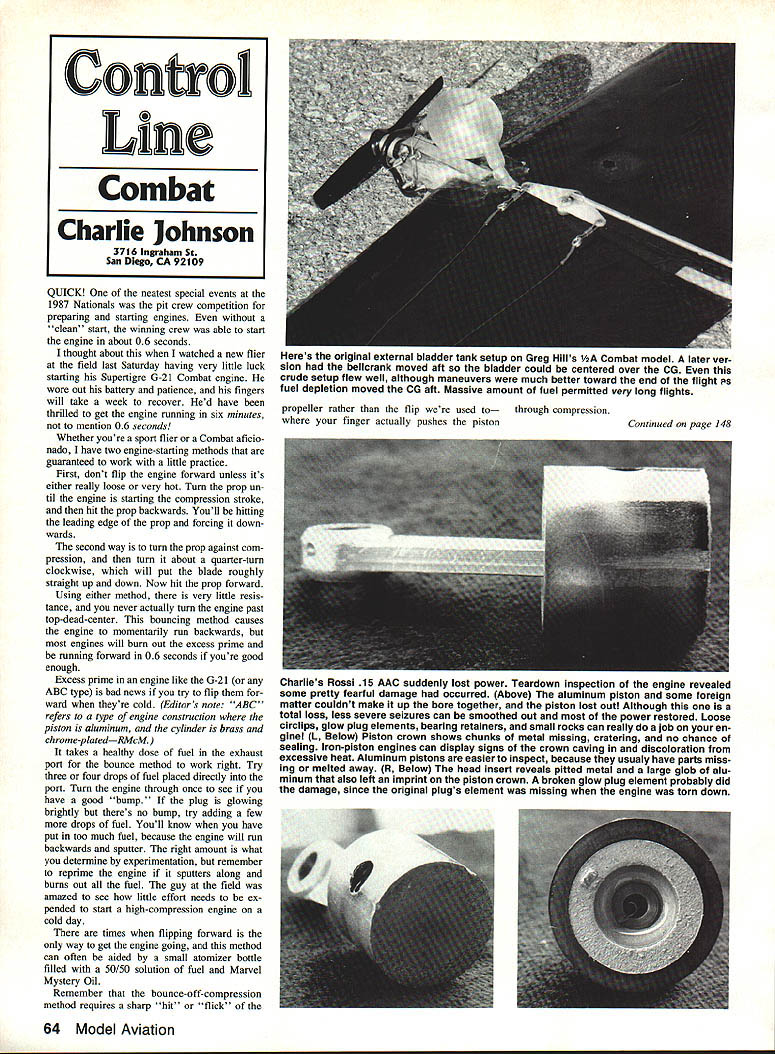
Charlie's Rossi .15 AAC suddenly lost power. Teardown revealed severe damage: the aluminum piston and foreign matter couldn't pass together up the bore, and the piston lost out—this one was a total loss. Less severe seizures can sometimes be smoothed out and much power restored.
Typical signs and causes:
- Piston crown with chunks missing, cratering, and no chance of sealing indicates catastrophic damage.
- Iron pistons may show crown caving and discoloration from excessive heat.
- Aluminum pistons often have parts missing or melted away, making inspection straightforward.
- Head inserts can show pitting and large globs of aluminum that have left imprints on the piston crown.
- Broken glow plug elements are notorious for battering piston crowns and squishbands; if the original plug element is missing at teardown, it's a likely culprit.
- Crimped-type bearing retainers often come apart, letting brass pass through the engine.
- Loose circlips, glow plug elements, bearing retainers, and small rocks can all wreak havoc.
- Excessive slop in the conrod or wrist-pin boss reduces power and accelerates destruction.
Before tearing an engine down, check the basics:
- Fuel system is clean and fuel is fresh.
- Bolts are tight and the engine is mounted securely.
- No air leaks at structural joints.
- Try a new glow plug before complete teardown if everything else looks OK.
- Fuel containing trapped water will cause persistent problems.
- If you feel grinding when turning the prop, inspect the internals.
When puzzled by a continuing problem, use a magnifying glass or X-10 loupe to examine:
- Piston for cracks, especially around the intake port on the crankcase.
- Crankpin for scoring.
- Piston and liner for overheating signs.
- Rod and wrist-pin areas for slop.
Safety and equipment tips
With events packed with people and many fliers using external controls and fuel systems, keep the following in mind:
- If a bladder tank breaks in the pits you may be blasted with fuel and there is a remote chance of fire. External bladders simplify construction and add strength, but bell-crank and bladder assemblies are vulnerable to impact.
- Since lines are often hooked directly to the bell-crank with lighter lead-outs, they can fray or break more easily than heavier lead-outs. Inspect lines more often than you normally would.
Diesel conversion and fuel recipe
Al Kelly offered advice on working with diesel engines. He finds diesels easy to work with and has even bored a Picco .21 to a .36. His starting tip: "flick" it over and use a soft stick to whack the prop like Racer Tim Gillott.
Al's recommended fuel mix (exercise caution with components):
- 35–40% ethyl ester/ether
- 20% oil (a mixture of castor and mineral oil works)
- 2–3% amyl or propyl nitrite
- Remainder kerosene
Notes:
- Ether and amyl nitrite are regulated/controlled in some places and may raise eyebrows at chemical suppliers.
- Al recommended Davis Diesel conversions and favored ABC engines; he suggested a Fox .36 MK IV as a good candidate. A big prop helps starting and can improve Slow Combat performance.
Building and repair tips
Dowel/skewer reinforcement for foam wings:
- Use inexpensive wooden skewers or dowels vertically between spars to lock them in place. The pointed end punches through foam easily.
- Add a little glue, push the skewer through the wing, and cut it off flush with the spar. This can be a quick field repair after covering.
- To strengthen the lead-out guide area, run skewers through the tip rib into the spars a few inches to keep the tip from flexing and "steering" the model—useful when there's a lot of line rake and the spars are forward.
- Drilling through the engine-mount block and cutting at a 45° angle into the wing can add rigidity.
Spar-notes and shimming:
- If spar notches are too big, rather than adding lots of glue, shim the spar using medium-weight silkspan:
- Cut a piece about 2 in. wide (for 3/8 x 1-in. spars) and as long as the wingspan.
- Saturate the silkspan with white glue and squeeze off excess.
- Put the spar in the middle of the tissue and press it down into the foam cores, overlapping the paper onto the foam.
- This tightens the joint and bonds the spar to the foam. Extra layers or small amounts of fiberglass cloth in the center section will add strength.
Events and contests
This season looks great for Combat fliers:
- The Money Nats will be history by the time you read this.
- Over Memorial Day weekend there will be a big regional meet in Eugene, Ore., featuring all Combat events and more. The contest is at the airport and is the first Regionals at a new state-of-the-art flying site.
- Also coming: the Bladder Grabber (with incredible prizes), the AMA Nationals, the Texas Slow Combat Championships, the CL World Championships, and other regionals.
Special announcement:
- A $1,000 first prize is offered for the V-4 Combat Internats triple-elimination meet to be held in Jonesville, Ind., over Labor Day weekend (September 3–4, 1988). AMA Sanction No. 584. Sponsor and Contest Director is Mr. Enger, Doc Pass.
Travel note:
- V-4 models can be packed into overhead compartments on many widebody airliners, but watch for heavy luggage and smaller aircraft with cramped storage.
Model Aviation Control Line: Combat
Editor's note: "ABC" refers to engine construction with an Aluminum piston, Brass cylinder, and Chrome-plated liner.
Transcribed from original scans by AI. Minor OCR errors may remain.

