
Control Line: Combat
Charlie Johnson 3716 Ingraham St. San Diego, CA 92109
Cancellation of 1/2A Money Meet
Unfortunately, Doc Passen has had to cancel his 1/2A Money Meet that had been scheduled for the Labor Day weekend. Doc has a lot of business obligations, both professionally and in modeling, that were too pressing to allow him to run the meet.
Doc Passen's kits and RC Combat
Besides his normal line of CL kits, which have been selling quite well, Doc now has a series of RC Combat planes meant to be flown with CL Combat style. The RC market is much bigger; if fliers follow his instructions about flying style (mix it up, and no 200-ft streamers!), kit production profits could be significant.
Improvements in 1/2A Combat: tubing and engine runs
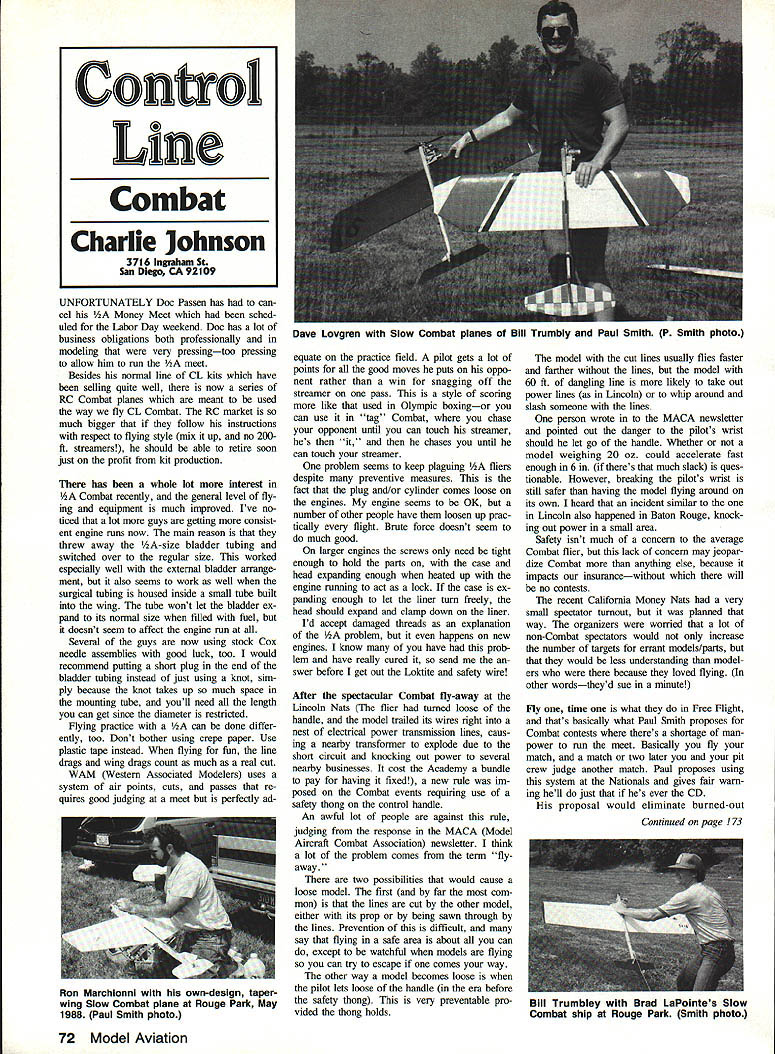
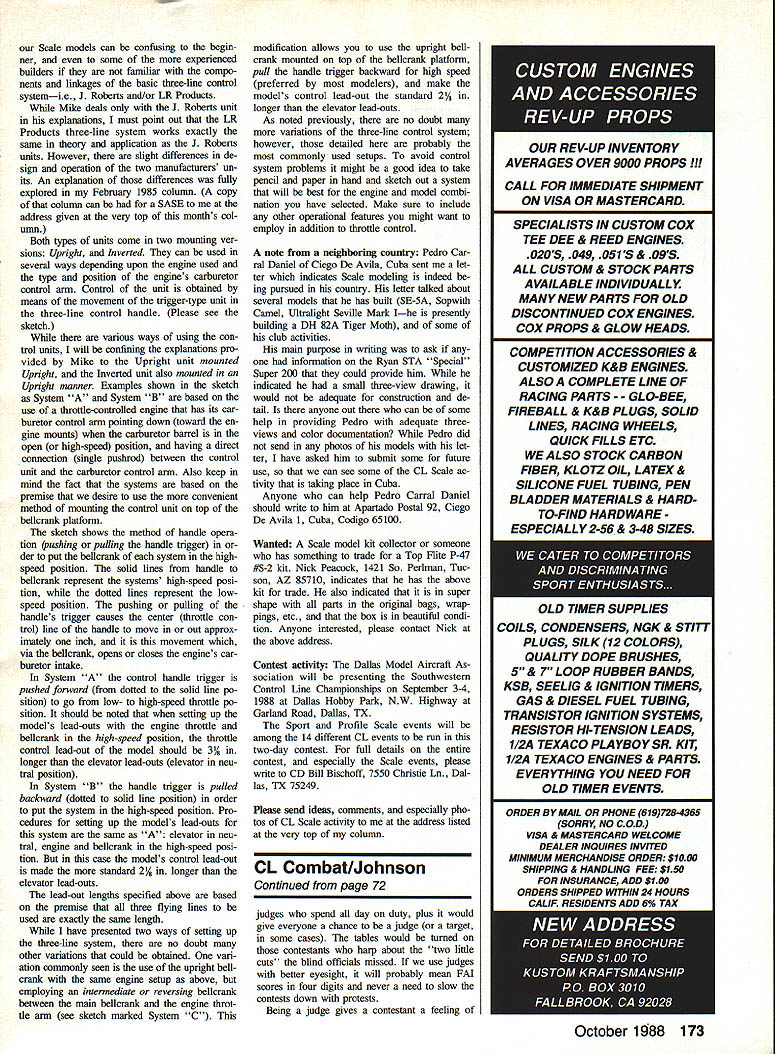
There has been much more interest in 1/2A Combat recently, and the general level of flying and equipment has improved. Many pilots are getting more consistent engine runs. The main reason appears to be switching from 'A'-size bladder tubing to regular-size surgical tubing. This change works especially well with an external bladder arrangement and also when the surgical tubing is housed inside a small tube built into the wing. The housing tube prevents the bladder from expanding to its normal diameter when filled with fuel, but it does not seem to affect engine run.
Several fliers now use stock Cox needle assemblies with good luck. I recommend plugging the end of the bladder tubing with a short plug instead of just tying a knot; the knot takes up valuable space in the mounting tube, and you need as much length as possible when the diameter is restricted.
Flying practice and scoring
Practice can be done differently, too:
- Use plastic tape instead of crepe paper for streamers.
- When flying for fun, line drags and wing drags count as much as a real cut for practice purposes.
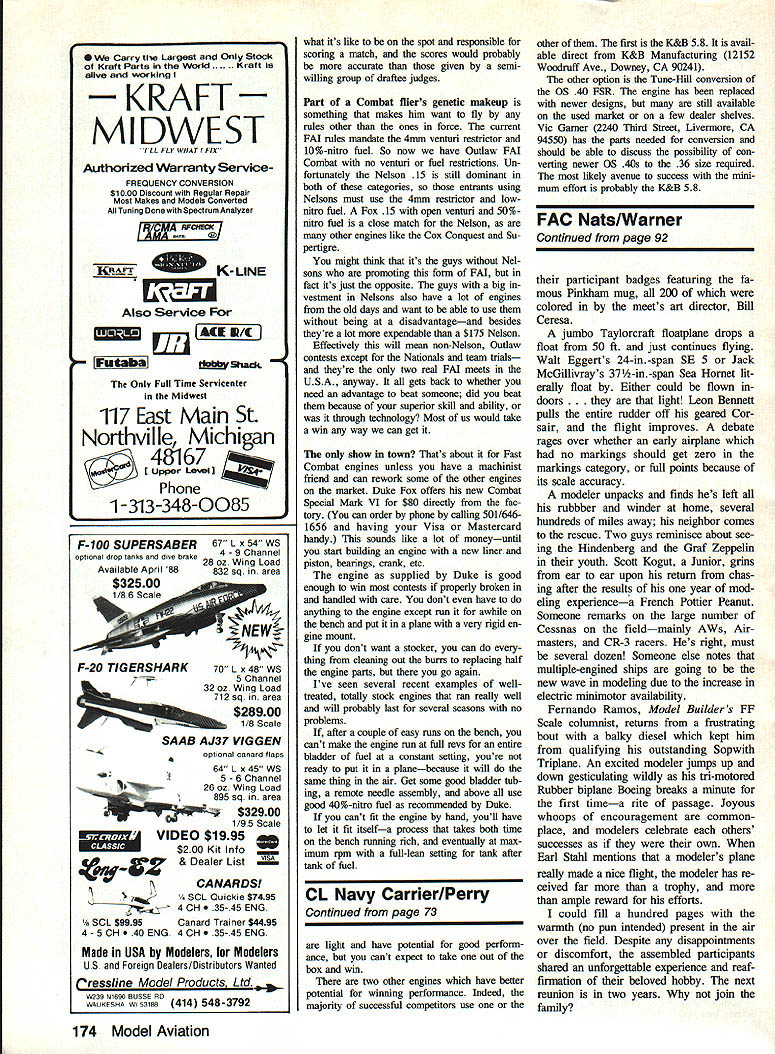
WAM (Western Associated Modelers) uses a system of air points, cuts, and passes that requires good judging; it works well on the practice field. In that system a pilot scores points for good moves that put the opponent at a disadvantage rather than just for snagging the streamer in a single pass. This style of scoring is similar to Olympic boxing, or you can use it in "tag" Combat: chase your opponent until you can touch his streamer; he is then "it" and chases you until he can touch yours.
Plug/cylinder loosening problem
A persistent problem is plugs and/or cylinders coming loose on engines. Engines may appear to be OK after parts come loose, but many have had parts loosen up practically in flight. Brute force tightening doesn’t always help. On larger engines, screws only need be tight enough to hold parts on; when the case and head heat up they usually expand and act as a lock. If the case expands enough to let the liner turn freely, the head should expand and clamp down on the liner. Damaged threads could explain some failures.
This problem affects 1/2A engines and even new engines. Many fliers have cured it; if you have a reliable fix, please send it in before I reach for Loctite and safety wire!
Flyaways and the safety thong rule
After a spectacular Combat fly-away at the Lincoln Nats — where a flier let go of the handle, the model trailed its wires into power transmission lines, caused a transformer to explode, and knocked out power to several nearby businesses (a costly restoration) — a new rule was imposed requiring the use of a safety thong on the control handle.
Many people are against this rule, judging from responses in the MACA (Model Aircraft Combat Association) newsletter. The controversy often comes down to the term "fly-away." There are two main ways a model can come loose:
- The more common: the lines are cut by another model (prop or lines sawing through). Prevention is difficult; flying in a safe area and being watchful helps but is not foolproof.
- The pilot lets go of the handle (pre-thong era). This is very preventable if the thong holds when the pilot releases.
A model with cut lines usually flies faster and farther, but a model dragging 60 ft of line is more likely to take out power lines or whip around and injure someone with the lines. One correspondent pointed out the danger to a pilot’s wrist if the thong holds; whether a 20 oz model could accelerate fast enough to break a wrist is questionable, but breaking a wrist is still safer than having the model fly uncontrolled.
Safety may not be a primary concern for the average Combat flier, but lack of concern could jeopardize the discipline because of insurance issues — without insurance there will be no contests. The recent California Money Nats had a deliberately small spectator turnout; organizers worried that many non-Combat spectators would increase the number of targets for errant models and would be less understanding than modelers (i.e., more likely to sue).
Meet management and judging proposal
Paul Smith proposes a "fly one, time one" system for Combat contests where manpower is short: you fly your match, and a match or two later you and your opponent judge another match. He suggests using this system at the Nationals and warns he will do so if he is ever the Contest Director. This proposal would reduce judge burnout and would give pilots a better feel for scoring while on the spot; scores might be more accurate than those from a semi-willing group of drafted judges.
Part of a Combat flier's makeup is a tendency to push rules; managing that temperament is part of running events and keeping safety and fairness intact.
Outlaw FAI Combat
Current FAI rules mandate a 4 mm venturi restrictor and 10% nitro fuel. Outlaw FAI Combat removes venturi and fuel restrictions. The Nelson .15 remains dominant under both restricted and unrestricted rules, so Nelson users still must fit the 4 mm restrictor and use low-nitro fuel at official FAI meets. A Fox .15 with open venturi and 50% nitro fuel can be a close match to a Nelson, as can other engines like the Cox Conquest and Super Tigre.
Despite appearances, it is not only non-Nelson fliers who promote Outlaw FAI; many Nelson owners also support it because they have older engines they want to use without a disadvantage, and those older engines are more expendable than an expensive Nelson.
Effectively, this will mean mostly non-Nelson, Outlaw contests except for the Nationals and team trials — the only two real FAI meets in the U.S.A. The debate is whether a win came from superior skill or from technology; most competitors will take a win either way.
Fast Combat engines: options and advice
If you want a competitive combat engine without extensive machining, options are limited unless you have a machinist friend. Recommendations and notes:
- Duke Fox Combat Special Mark VI
- Price: $80 direct from the factory.
- Order by phone: 501/646-1656 (have Visa or MasterCard ready).
- The engine as supplied is good enough to win most contests if properly broken in and handled with care.
- Break-in advice: run the engine on the bench for a while, gradually leaning to full-lean settings for successive tanks of fuel. Use a very rigid engine mount.
- Fuel recommendation: good 40% nitro fuel as recommended by Duke.
- If after a couple of easy bench runs the engine will not sustain full revs for an entire tank at a constant setting, don’t put it in the airplane — it will behave the same in the air.
- If you can’t fit the engine by hand, let it fit itself by time on the bench running rich, then progressively leaning.
- Other competitive engines
- K&B 5.8 — available direct from K&B Manufacturing (12152 Woodruff Ave., Downey, CA 90241). Likely the easiest avenue to success with minimal effort.
- Tune-Hill conversion of the OS .40 FSR — parts and conversions are available; the engine has been replaced by newer designs but conversions remain possible.
- Vic Garner (2240 Third Street, Livermore, CA 94550) has parts needed for conversion and can advise on converting newer OS .40s to the .36 size required.
Many well-treated, stock engines will run very well and last several seasons. If you don’t want a stock engine, you can rebuild or modify components, but that increases cost and effort.
Transcribed from original scans by AI. Minor OCR errors may remain.

