
Control Line: Combat
Charlie Johnson
3716 Ingraham St. San Diego, CA 92109
NEW GOODIES
If you're one of the many who just miss out on all the trick goodies, then your time has now come. The replacement ABC piston/liner sets for the Fox engines are almost ready for delivery. Some of the local SoCal fliers were using them during a recent get-together, and the performance seems to be on a par with the McCollum setup.
The price should be around $75, which will also get you a Venturi connecting rod — or about $20 less if you want to take a chance on the stock rod breaking and ruining your day. The last I heard was that Pete Athans was the distributor for this high-tech setup. All the price/delivery details should be worked out by the time my next column hits the streets, but if you just can't wait you can watch the MACA (Miniature Aircraft Combat Association) newsletter—or contact Pete.
AMA Combat goes berserk!
Just when you thought the performance level of Fast Combat couldn't escalate any more, someone comes along with a little touch that pushes the edge of the envelope further out. Steve Hills has pioneered the use of carbon-fiber arrow shafts as a lightweight, superstrong tail boom. A hole is drilled through the center wing rib, and the shaft is plugged in. Since there's so little weight aft, it's possible to push the engine way back—and that's just what he has done. The prop is so close to the wing on the model that it's scary trying to hold on during launch. Give me a Slow Combat model any day! Performance is right up there with the best of the best, owing to good design and a healthy engine.
Almost everyone has a healthy engine these days. Not too many stockers are getting trophies. ABC setups, Australian cranks, fuel regulators, and 40%–50% nitro in every bladder are the rule of the day.
For a while the destruction in Fast Combat, partly caused by the increase in performance, seemed to be causing a drop in attendance for that event. But recently the sheer wildness of the competition has drawn new and returning fliers back into the fray. Guys who never would have thought about flying Combat are taking it up because it is so wild and physical—and those $1,000 and $2,000 prizes don't hurt, either. This is one time that you don't have to look back at the golden age—because you're in it now! The Bladder Grabber North and South, the Money Nats, and a new money meet in Florida seem to have either succeeded or show great potential.
CL World Championships — America vs Soviet Union
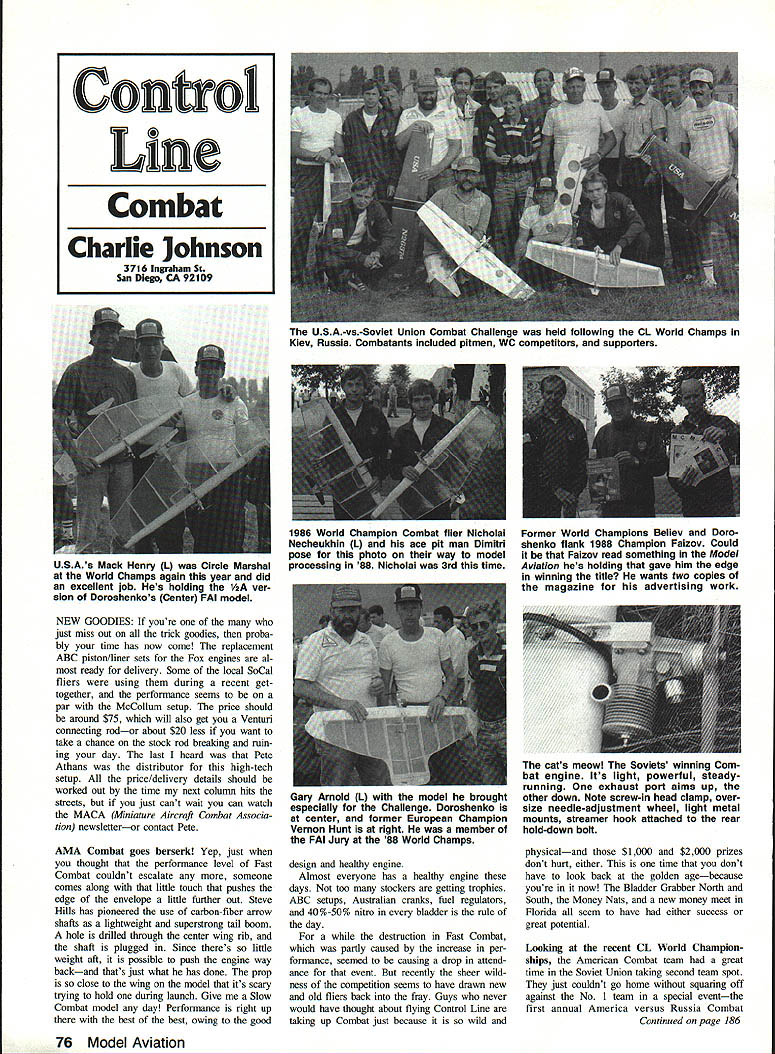
Looking at the recent CL World Championships, the American Combat team had a great time in the Soviet Union, taking the second team spot. They just couldn't go home without squaring off against the No. 1 team in a special event—the first annual America-versus-Soviet Union Combat Challenge.
The rather informal meet allowed competitors, pitmen, and supporters a chance to show their stuff. It was a free-for-all the likes of which we've not seen since the California-versus-the-World match at the 1971 Nats. Dozens of models were spread around the circle with their pilots out near the center just waiting for a break in the action so they could go up. Some were so eager that they flew three at a time. Gary Arnold brought a couple of models just for the bash and frantically worked to get engines mounted and everything hooked up before the rains came. It turned out that Gary made the first test flight of a model in a match with Oleg Doroshenko! Doroshenko got the best of him, but Rich Lopez came to his defense and led Oleg into the ground.
About one hour into the festivities the rain came down. The Soviets packed up their stuff and got into the vans. The Americans stayed in the rain hoping for the best, but eventually realized the rain wasn't going away. The Soviets thought that we'd all gotten into vans (as we probably should have), but upon finding out we were still in the rain, the entire Soviet team leaped out of the vans and insisted we get in out of the rain. They seemed embarrassed that their guests had been overlooked, even though it was our choice. The Soviets' sincerity and hospitality will long be remembered, as will the kinship between the two rival teams.
Soviet equipment and construction
From the pictures, you can see that the Soviets and others fly much different equipment than the Americans. What appear to be very simple models are in fact precision-built airplanes with lots of pieces. Every detail is done perfectly, from the mounting system to the lead-out guides (which are drilled for extreme rake). These guides are removable if the pit crew needs to switch them to the right wing to make the plane flyable again after a collision.
The Soviets favor a foam leading edge with balsa ribs and a thin ply covering. The foam is covered with a type of gray paper for strength, and small "feet" are placed against the foam for the ribs to butt against. Hardwood is used for the trailing edge. Some models used external controls with very lightweight bellcranks. All-up weight is about the same as Tom Fluker's models, but the ounce or so they save in engine weight is made up in structural strength that allows them to demolish lesser aircraft and survive ground impacts.
Their covering material is superior to anything we use. It was very hard to find an edge where it overlapped, and it shrinks up tight and doesn't seem to sag at all. We need to smuggle some of it out of the Soviet Union.
Engines and tuning
The twin-exhaust-shafted Combat engine is the latest and best in a line of ultralightweight and powerful Russian engines. With one stack above and one stack below the leading edge, it's possible to push the engine back against the leading edge of the wing without burning the foam or adding a deflector. The round-exhaust versions give the best thrust choice, as they are more of a "works" engine, whereas the square-exhaust engine is a production one and much slower.
The engines feature a screw-in head clamp that is removed with a special tool having "fingers" which plug into the clamp. Pitmen spent a lot of time pulling off the head between flights to change gaskets and inserts in order to tune the engine for varying atmospheric conditions.
One of the nicest features on the engines was the oversize wheel used to turn the needle valve, which doesn't have a locking collet. Instead, a piece of tubing is used to both seal the needle and keep it from turning on its own. The model was easily held in the left hand and the needle adjusted with the thumb. The wheel was also positioned very close to the crankcase so it wouldn't be broken off during a crash.
While at the Russian team's dorm we took several engines apart and found nothing out of the ordinary. The Nelson is probably more powerful, but the Soviet engine is lighter.
Flight style and tactics
Whatever prop pitch the Americans ran, the Soviets probably used about 1/2 in. less pitch, judging from the airspeed. The Russians rarely ever got up to top speed, as they were always in a turn or accelerating away from their opponents. Soviets accelerated away at about a 45° angle going up; in contrast, most other fliers immediately turned back in before getting clear.
It seems as if AMA Slow Combat is just beginning to adopt some FAI-style flying: pitch down, and don't worry about top speed. Only worry about the turns and accelerating out of them. Higher engine RPM with a suction fuel system means better fuel draw and the ability to use a slightly richer venturi—which adds even more to the power. When the 4 mm venturi-diameter rule went into effect in FAI, the fast guys pitched the props enough to keep the RPM at the same level as with the open venturi. Rather than run a Slow engine at 15,000 RPM, it might be the hot tip to depitch the prop and run it up to 19,000–20,000.
Training advantage and closing thoughts
Nowhere do the Soviets have a bigger advantage than in their training. We've all talked about it being advisable for the U.S. teams, but we've never done much about it. The Russians were at the facility in Chaika five or six weeks before the competition. They spent each and every day in individual practice and in flying matches against teammates and mechanics. Their expertise really showed when they flew during the half-hour official practice time allotted to each team. Despite suffering a single midair collision, the Soviet fliers were able to place their models exactly where they wanted them and change course at any time.
The 1988 U.S. Combat team was the most practiced and well-prepared of any to have gone to a CL World Championships, but they still lacked the precision that months of daily practice brings. Fortunately, their equipment and natural talents pulled them through, and in the case of Tom Fluker almost got him a repeat world championship title.
Look closely at the pictures of the models. Think about applying the FAI style of flying to Slow Combat, and if you can arrange with your boss for a six-week vacation before the 1989 Nats, we'll probably see you in the victory circle.
Transcribed from original scans by AI. Minor OCR errors may remain.

