
Control Line: Combat
Charlie Johnson 3716 Ingraham St. San Diego, CA 92109
Almost-ready-to-fly (ARF) models
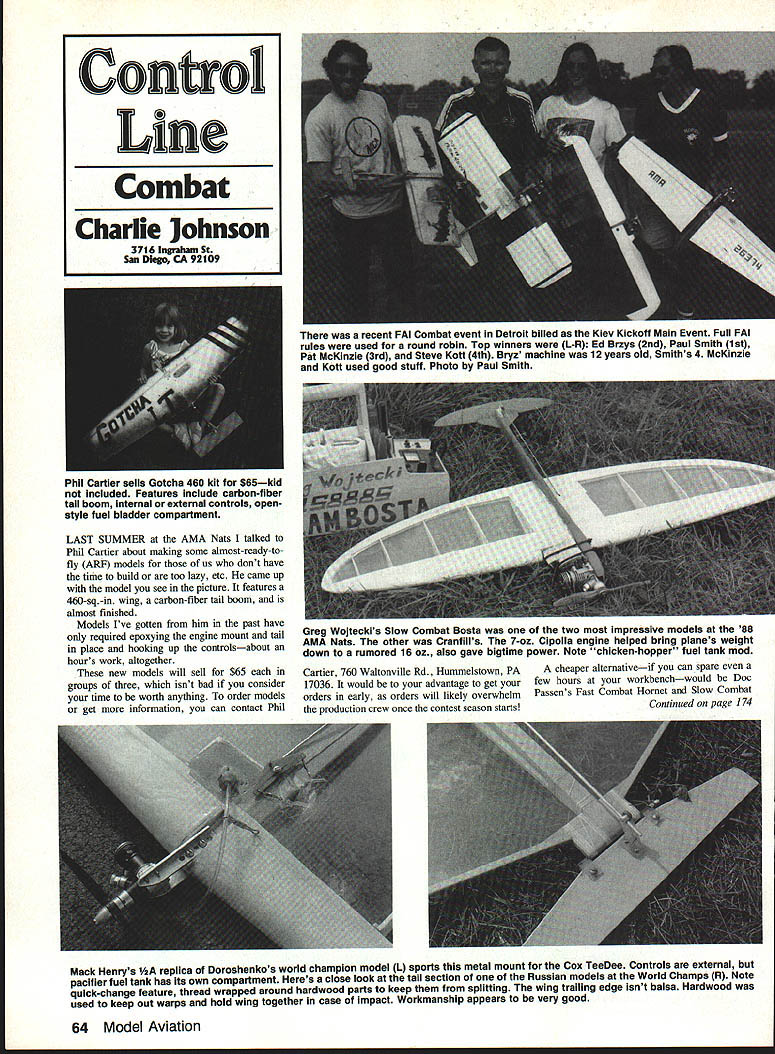
Last summer at the AMA Nats I talked to Phil Cartier about making some almost-ready-to-fly (ARF) models for those of us who don't have the time to build or are too lazy, etc. He came up with the model you see in the picture. It features a 460-sq.-in. wing, a carbon-fiber tail boom, and is almost finished.
Models I've gotten from him in the past have only required epoxying the engine mount and tail in place and hooking up the controls—about an hour's work altogether.
These new models will sell for $65 each in groups of three, which isn't bad if you consider your time to be worth anything. To order models or get more information, you can contact:
- Phil Cartier
760 Waltonville Rd. Hummelstown, PA 17036
It would be to your advantage to get your orders in early, as orders will likely overwhelm the production crew once the contest season starts!
Alternative kits
A cheaper alternative—if you can spare even a few hours at your workbench—would be Doc Passen's Fast Combat Hornet and Slow Combat Wasp, which require a little more work. Doc's kits include just about everything you need except for the adhesive. The sample kits he sent me had balsa that was very nicely cut, and the engine mount assembly was put together and semi-finished.
The model features a Voodoo-style leading edge, but has a full-depth spar and a solid trailing edge, and just over 400 sq. in. of area. Professional Combat fliers will likely have their own favorite model, so won't bother with this offering for the slightly less serious. Judging from a lot of experience with similar models, I would expect this one to perform well enough to place at most contests, but it does give away the "foam killer" advantage because of its solid-wood wing leading edge. Oh well, you get tired of patching all of those string cuts in the foam, anyway.
Doc's Generic kits (as he calls them) seem like really good values for the dollar and could be finished in an evening with the recommended super glue. Doc is holed up in his palatial estate in Jasonville during the winter, so now would be a good time to get in touch with him:
- Doc's Generic
P.O. Box 1011 Jasonville, IN 47438
Prices are less than $20 for the Combat kits, and he has Sport and Stunt kits, too.
Engines
What better to power your new model than a Nelson .15, examples of which now come in even more configurations than before? The more-or-less standard model is the rear-intake/rear-exhaust AAC (aluminum/aluminum/chrome piston/cylinder construction) that seems to motor domestic and foreign FAI Combat models. Variations include:
- Side-exhaust with rear intake
- Original version with front intake and side exhaust
- ABC liner/piston option (instead of AAC)
- Titanium crankshafts
And this is just the glow engine selection—not to mention the diesels!
Call Henry Nelson at (412) 538-5282 for information about his line of sophisticated engines. Prices start at $175 for the standard Combat engine, which isn't cheap—but they're the best you can buy. After years of battling with other engines, I'm taking the easy way out and using the Nelson rear-intake/rear-exhaust AAC setup with the short nose to help cut down on the weight and shorten the nose moment on my models. I still may not win anything—but I'll look more spectacular losing!
Rear-set engines and tail booms
If there is currently a trend in Combat model design, it is toward the rear-set engine. The prop on some of them is so close to the leading edge of the wing that you can't get your hand in there to hold it for launch! The lightweight carbon tail boom has made it possible to shove the engine way back into the wing. With such a short nose moment, the model requires a long tail moment to keep it from wobbling across the sky, and conventional wood tail booms were too heavy when made long enough, so aluminum tail booms are being used more.
The result was frequently a tail-heavy model that was not much fun to fly.
If you haven't seen such a model yet, just picture a conventional model without a boom. Drill a hole through the trailing edge and into the engine mount. Shove in a carbon-fiber arrow shaft with some epoxy on it, and mount the tail feather on. Most modern designs also have the controls mounted to the arrow shaft, too. A small piece of aluminum loops around the shaft, and the bellcrank is bolted to it. This seems to be pretty strong for Fast Combat models and makes for a practically indestructible center section.
Fuel systems
There is also another trend, and that is away from the external fuel bladder—which is probably a good idea. We've found that regular Fast Combat bladders work really well in skinny tubes in 1/4-scale models. The tubing never expands to the size allowed by the 1.25-in.-diameter tubes used in FAI. The needle setting is so much better when using 1/4-in. tubing, and you've got to break one. Another plus is that you don't have to have special bladders for your 1/4 models.
Cartier's group seems to be having good luck using open fuel pods in their models, where the tubing is allowed to expand to whatever size it wants. He claims better performance using this style than with the conventional tubing compartment. Greg Hull built two compartments, one on each side of the engine mount, to equalize the distribution of weight. I suppose the ultimate configuration would be having one tube in front of the C/G and one behind it with their masses centered in the middle of the model.
I know a lot of the guys use the outboard-located fuel as ballast in lieu of adding more wing tip weight, but as the fuel burns off it results in the plane getting looser on the lines and makes landing even more of a thrill.
Balancing and tips
Doctor Design claims that about nine grams of wing tip weight is required in a 48-in.-span model to offset the tendency of the lines to kick the outside tip forward when the plane is coming out of a turn. Too much weight sure makes the wing rock back in the turns, so maybe he's onto something.
Props
We'd been eyeing the Taipan 8 x 6 prop for use in Fast Combat models, but the hub looked a little small. The performance of the prop on a Fox is better than the 8-1/2 x 6-1/2 we've been using, but it threw a blade off when buzzed up on a Hoffner .36R. Upon close inspection we found one blade was in the hub area that made up about 30% of the area (gulp!). This is the only failure of a Taipan I've encountered, and that mainly because we spun it up way above its design limit. The design seems to be great, but we'd better wait until it's available in carbon or glass.
Control Line: Combat
Control lines and rule changes
I was about to suggest that you buy your control lines in bulk from somebody like Bear Manufacturing, but I noticed among the new AMA rules proposals that there's a possibility of going to .021s in Fast and Slow, along with .40-size engines, and you FAI guys will just love it if the FAI noise rule goes into effect for the 1990 World Champs. A good part of the civilized world isn't going to put up with your engine's noise any more, so it might be quiet in the Nineties.
I've always felt that you use a muffler if you need one, but it really puts people at a disadvantage at local meets not using a muffler rule if they have their planes set up to meet the tougher noise limits on the international scene.
Safety thongs
Steve Sacco sent me a note concerning the safety thong issue. His point was that when a model flies across the circle it's gonna jerk a lot harder than if you just let the handle fly loose. No argument from me on this one, so let's all use wide safety thongs or get someone to design a good one for us to buy.
I still think a plane flying loose is more danger than is potential damage to someone's wrist or arm. At least the flier is the one who is hurt and not some innocent bystander. I did some work in Johnson's Not-So-Scientific Testing Lab and found that I can break .018 lines every time with a good jerk. The difficult part was trying to break both lines at the same time. I had the lines fixed to a solid object, so it might be harder to do in a model where there'd be more flex in the control system, bellcrank, and a full 60 ft. of lines.
WAM (Western Associated Modelers—R/C/MA) has used safety thongs for many decades without any problems I've heard of, and several AMA meets in which I've flown required safety thongs because they were flown at airports.
Photos and follow-up
If you have pictures of your latest creation, please send them immediately so we can have a spring gallery of Combat models. You might also comment on what you think your chances are during the Combat season, but I'll do a follow-up in the fall, so don't get too carried away boasting about your world-beater.
Transcribed from original scans by AI. Minor OCR errors may remain.

