
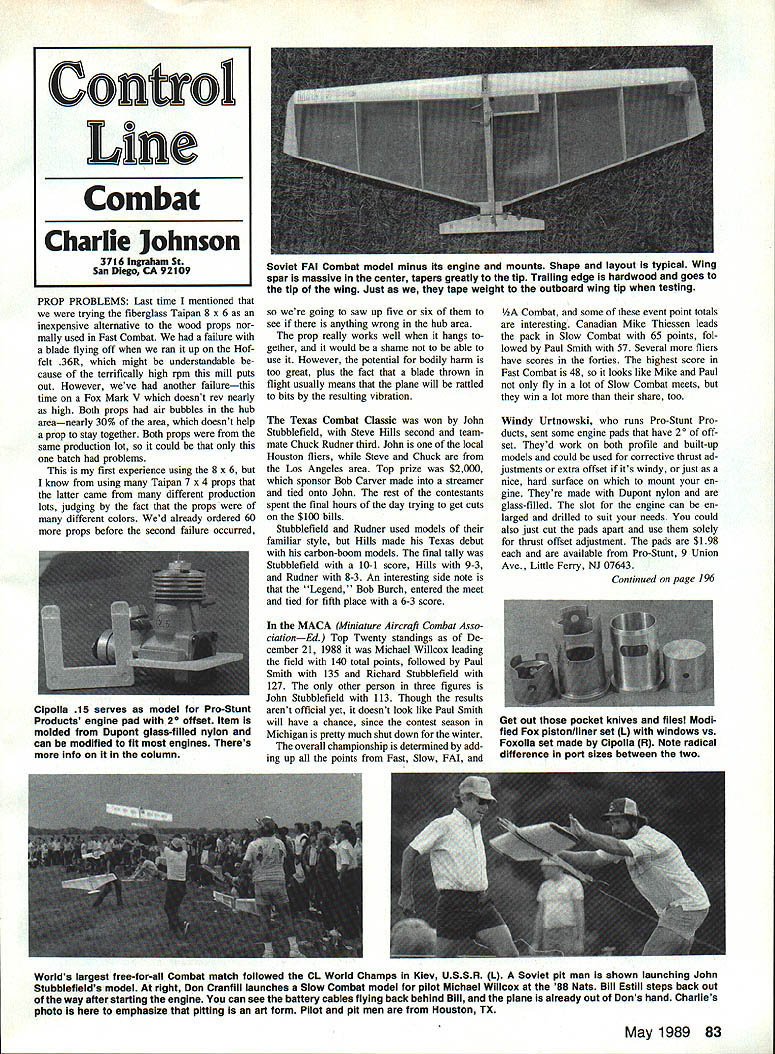
Control Line: Combat
Charlie Johnson 3716 Ingraham St. San Diego, CA 92109
Prop problems
Last time I mentioned we were trying the fiberglass Taipan 8 x 6 as an inexpensive alternative to the wood props normally used in Fast Combat. I had a failure with a blade flying off when we ran one on the Hoffelt .36R, which might be understandable because of the very high RPM that mill puts out. However, we've had another failure — this time on a Fox Mark V, which doesn't rev nearly as high. Both props had air bubbles in the hub area — nearly 30% of the hub — which doesn't help the prop stay together. Both props were from the same production lot, so it could be that only this one batch had problems.
This is my first experience using the 8 x 6, though I know from using many Taipan 7 x 4 props that those came from many different production lots, judging by the fact the props were many different colors. We'd already ordered 60 more props before the second failure occurred and sawed up five or six to inspect the hub area.
When the prop hangs together it works well, and it would be a shame not to be able to use it. However, the potential for bodily harm is too great — a blade thrown in flight usually means the plane will be rattled to bits by the resulting vibration.
Texas Combat Classic
The Texas Combat Classic was won by John Stubblefield, with Steve Hills second and teammate Chuck Rudner third. John is one of the local Houston fliers, while Steve and Chuck are from the Los Angeles area. Top prize was $2,000 — sponsor Bob Carver made it into a streamer and tied it onto John — and the rest of the contestants spent the final hours of the day trying to get cuts on $100 bills.
- Final tally:
- John Stubblefield: 10-1
- Steve Hills: 9-3
- Chuck Rudner: 8-3
Stubblefield and Rudner used models of their familiar style, while Hills made his Texas debut with his carbon-boom models. An interesting side note: "Legend" Bob Burch entered the meet and tied for fifth place with a 6-3 score.
MACA Top Twenty (as of December 21, 1988)
The MACA (Miniature Aircraft Combat Association) Top Twenty standings were:
- Michael Willcox — 140 points
- Paul Smith — 135 points
- Richard Stubblefield — 127 points
- John Stubblefield — 113 points
Though the results weren't official yet, it looked unlikely Paul Smith would catch the leader because the contest season in Michigan is pretty much shut down for the winter. The overall championship is determined by adding up points from Fast, Slow, FAI, and AMA Combat. Some event breakdowns of note:
- Slow Combat leader: Mike Thiessen (Canada) — 65 points
- Second in Slow Combat: Paul Smith — 57 points
- Highest score in Fast Combat: 48 points
It looks like Mike and Paul not only fly many Slow Combat meets but win a lot of them, too.
Products and suppliers
Windy Urtnowski of Pro-Stunt Products sent some engine pads that have 2° of offset. They work on both profile and built-up models and can be used for corrective thrust adjustments, extra offset in windy conditions, or as a hard-surface engine mount. They are molded from DuPont glass-filled nylon. The slot can be enlarged or drilled to suit needs, or the pads can be cut apart and used solely for thrust adjustment.
- Price: $1.98 each
- Available from: Pro-Stunt Products, 9 Union Ave., Little Ferry, NJ 07643
Also of interest in Windy's catalog:
- 0.5-oz. glass cloth from Aerospace Composites — $9
- Carbon fiber tape — $4.95
Windy specializes in aerobatics supplies including complete kits and engines; I expect his products to be top quality.
Fox piston/liner and ABC discussion
One of my photos this month shows two Fox piston/liner sets. The ones on the left are stock Fox parts with extra cutaways and windows cut in to help the engine breathe better. The ones on the right are an ABC setup made by Cipolla for the Fox engine — the piston/liner that Doc Passen was selling for a while.
You'll note that the ports in the ABC liner are much smaller than on the stock unit, but power output from the two is about the same. Most engine folks I’ve talked to say that a properly fitted liner/piston set (with or without chrome) is just about as fast as an ABC under controlled conditions. My experience has been that ABC "sets" seat better than a conventional setup and will tolerate an overly lean fuel mixture better.
These aftermarket liner/piston sets are produced more carefully than many stock units. I remember John McCollum talking about the special aluminum he imported for the sets he made — it had just the right amount of silicon and was machined to tight standards. The bottom line: you can still go plenty fast without the exotic parts, but it isn't as easy.
Long-term test projects and engine rework
Whatever happened to some of the long-term test projects? The Fox Mark V that threw the Taipan prop's blade was the same engine Bob George reworked for me a couple of years ago. It was basically stock except for its chromed liner and very careful fitting. The engine continues to give good service and makes an excellent unit for practice Combat flights. It has many runs on it and, to Bob's credit, it still starts and runs like new and shows very little wear despite having tasted its share of dirt.
For engine rework I'd recommend Bob George for any project, Control Line or otherwise.
- Contact: Bob George, 34 W. 883 S., St. James, St. Charles, IL 60174
I also had two Fox .15BBs that I’ve been running for many years. Both engines run strongly despite ground-pounding, dirt, and general abuse. If I had to recommend an inexpensive FAI-size setup, I'd suggest the Fox .15BB and one of Phil Cartier's foam models (I had one called the Tantrum and many hours of flying at 10 minutes a crack). When run with the stock venturi the Fox gets incredible fuel mileage, and the planes were strong enough to last for many years.
- Fox parts available from: Cote House, 760 Waltonville Rd., Hummelstown, PA 17036
Someone else I want to recommend is Bear Manufacturing (Bob Beaden). Bear is a Combat flier and promoter; his parts almost always fit and his service is excellent.
- Contact: Bear Manufacturing, RR 2 Box 70, Beecher, IL 60401
MACA membership and information
Most of the letters I get ask how to get started in Combat or where to buy necessary items. If you've made it this far in the column, just cut out your checkbook and send $15 to MACA for your 1989 dues. The MACA information and supplier list is worth it — and you won't have to write me about it!
- Send dues to: Mike Urban, Treasurer, 316 Spring Ave., Glen Ellyn, IL 60137
Photos and upcoming meets
The MACA Newsletter beat us at Model Aviation by printing a picture of the winners of the Combat Classic. I would have loved to have a picture for this column, but nobody sent one. I didn't get one from the King Orange either. All the columnists say the same thing: "If you want to be famous, you better send a picture of the winners." I feel the Nats winners in particular get too little credit for their accomplishments; the least we can do is put their picture in the magazine. Paul Smith and Jim Cameron are two fliers who have sent material to me. Thanks, guys.
The next big money meet is the Money Nats in Los Angeles on April 22–23. A thousand bucks is up for grabs — there's still time to catch a plane out to the coast for a shot at fame and fortune.
Transcribed from original scans by AI. Minor OCR errors may remain.

