
Control Line: Combat
Charlie Johnson
3716 Ingraham St. San Diego, CA 92109
Money Nats
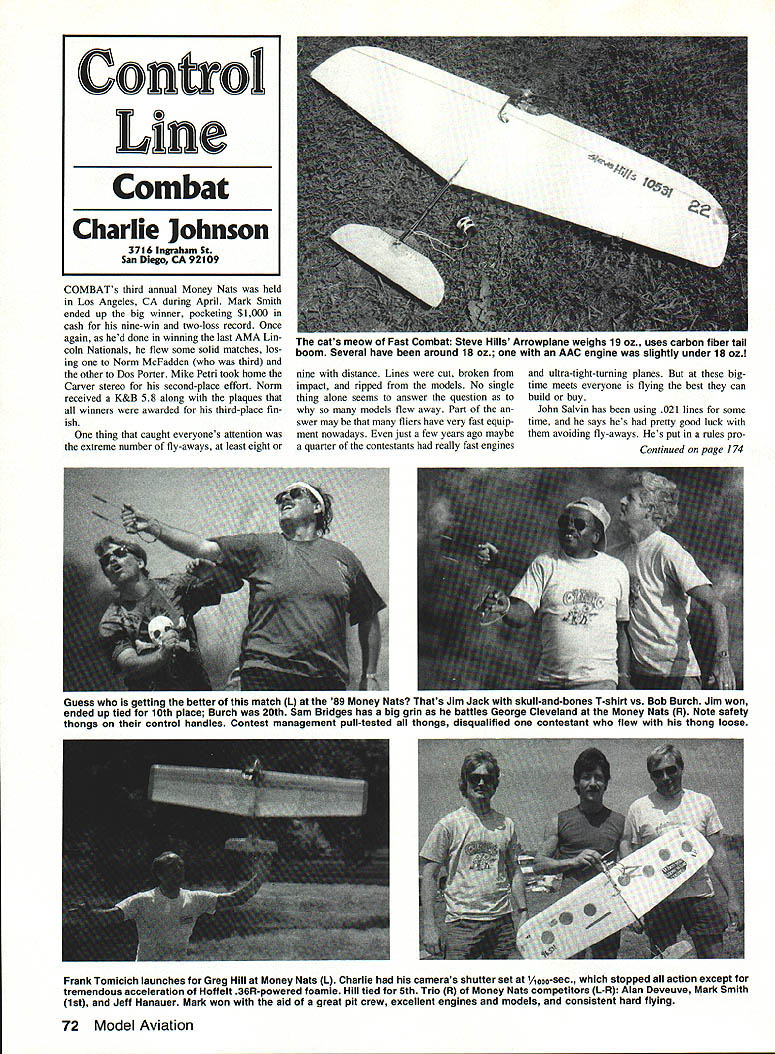
Combat's third annual Money Nats was held in Los Angeles, CA in April. Mark Smith ended up the big winner, pocketing $1,000 in cash with a nine-win, two-loss record. As he had done in winning the last AMA Lincoln Nationals, he flew some solid matches, losing one to Norm McFadden (who finished third) and the other to Dos Porter. Mike Petri took home the Carver stereo for his second-place effort. Norm received a K&B 5.8 along with the plaques awarded to all winners for his third-place finish.
Fly-aways and Lines
One thing that caught everyone's attention was the extreme number of fly-aways — at least eight or nine. Lines were cut, broken from impact, and ripped from the models. No single cause seems to explain why so many models flew away. Part of the answer may be that many fliers have very fast equipment nowadays. Even a few years ago maybe a quarter of contestants had really fast engines and ultra-tight-turning planes; at these big meets everyone is flying the best they can build or buy.
John Salvin has been using .021 lines for some time and reports good luck avoiding fly-aways. He put in a rules proposal to upgrade the current .018 lines to .021; however, proposal CL-90-34 was defeated.
One common failure seemed to be lines breaking at the crimp joint. Wrapping the line ends, rather than using the usual crimp method, produces a better, stronger joint. John Ballard, in his July CL Racing column, warned against using wire that is too thick when wrapping ends; many have trouble finding very thin wire and have resorted to heavier wire on a couple sets of lines. Luckily these didn't break — the ends loosened up — but fine wire takes a lot of turns to wrap and wrapped flying lines work better. The AMA rule book has diagrams showing the proper way to make line connections.
Safety Proposal and Engine Loss
Another of John Salvin's proposals, a safety proposal, has passed the CL Contest Board (see the Competition Newsletter). Had this proposal been in effect it would have come in handy: Frank Tomicich launched an engine right off the model Friday evening. Salvin's proposal requires a safety cable attached to the engine and anchored to the bellcrank bolt. Frank's engine flew far and landed out in the weeds; after several hours of searching it did not turn up until a fellow with a metal detector finally located it.
AAC Setups and Engine Modifications
The AAC setups that I've been writing about may turn out to be last year's hot tip. Mike Wisniewski is now offering an AAC setup (chromed aluminum liner with aluminum piston) for the Fox .36 Mark VI. The addition of this kit will:
- Lower the weight of the engine to just over eight ounces
- Produce more power
- Make the engine a lot harder to burn down
It will also cost about $110. The kit includes the liner, piston, pin, and some clips. Note:
- You'll only need one clip, since the pin boss is not bored all the way through on one side.
- The piston requires a larger-than-stock wrist pin, so you'll also have to purchase an RPM rod for your engine.
- When you order the rod, tell them what kind of piston you'll be using and they'll bore the little end for the Wisniewski piston.
Send orders to: Mike Wisniewski, 17635 Windward Terrace, Bellflower, CA 90706. (We have a several-year-old address for RPM which may still be good: Richardson Precision Machining, Inc., 5070 Golden Dr., San Jose, CA 95129 — telephone 1-408-257-7059 — Ed.)
I talked with Mark Smith at the Money Nats and learned that many of his engines used a modified Fox ABC setup. A local machinist that Mike is acquainted with ground the Fox pistons to accept regular clipless pins in place of the roll pin that seems to cause problems just when the engine is running at its best. The workmanship looked excellent, and the performance of Mark's engines was exceptional. A detail needs to be worked out with the machinist to do the work; Mark thought it might be less than $30 to machine the piston and fit it to the liner with the proper taper.
Combat Tour 1990?
Steve Hills and I spent a lot of time at the Money Nats — and since — discussing the possibility of a Combat tour for 1990. The tour would encompass major meets across the country, such as:
- Bladder Grabber
- Money Nats
- Houston
- Possibly the Nats, King Orange, and Detroit
Besides the awards at the contests, points would be awarded using a system like NHRA's or some similar scheme. The result would be a true Combat National Champion who would have flown head-to-head with the best in the country. Some contestants would tour the country and make all the contests, while others might wait for their local events and hope to ambush some of the tour regulars.
We don't know if Combat has the stamina for more than one year of such intensive flying, but surely 1990 would be a year we wouldn't soon forget. Local promoters would still run their meets independently but would be assured of a high turnout of fliers if they were one of the selected meets. A tour such as this could do wonders for Nationals attendance and prestige.
There's a possibility of combining advertising for all the meets and co-promoting. Besides all the fame and glory for becoming the 1990 National Combat Champion, there might be a special pot of gold at the end for those placing high in the points.
Things are in the dream stage at this point. The meets are just a suggestion, but they would give people in different parts of the country a chance to fly in a big contest and would spread the big meets out. The King Orange is usually the first meet of the year, with the others occurring at about two-month intervals and the final one held in Houston in October. Your suggestions would be appreciated (as would the emergence of any big-time corporate sponsors!).
Noise, Mufflers, and Community Relations
"Mufflers — I hate 'em!" That's the response from the majority of MACA members and most Combat fliers. Noise is part of the fun factor. Most of us think in terms of muffling the exhaust noise, and that's it. The blast from a Nelson .15 can exceed 115 dB, but that's only part of the overall noise problem. Add in prop noise, intake noise, and noise transmitted through the airframe and you have a very annoying package. The latter — vibration transmitted through structures — seems to be what the RC guys have found. Studies seem to show that even when model engine noise is quite loud, it's the vibration that bothers people. FAI Combat is coming under attack because of all the noise produced, and eventually the event may be changed quite a lot because of it.
Recommendations:
- Avoid damaging your hearing by wearing ear protection when running or launching Combat models.
- Don't fly early in the morning or late in the afternoon — people are at home, and in calm conditions without much background noise your neighbors can really pick out a hot Combat plane.
One psychological factor that has worked wonders is actually seeing Combat matches. People who come over to watch and listen are apt to get into the fun of Combat and forget to complain. We tolerate the noise because we enjoy flying airplanes. Getting the neighbors involved in at least watching and enjoying the Combat flying may keep them from becoming enemies (which is almost as good as making them friends). Also, neighbors with kids involved in flying find it difficult to complain; political types with children are often involved. There's one more excellent reason to promote those Junior programs!
Airport Flying Idea
Steve Hills told me about some regulations that are supposed to permit model flying (our type, anyway) at airports. There's supposed to be money available for such projects. Steve suggests a domed stadium with a canvas top and a chain-link fence around it. Noise at the airport shouldn't be too much of a problem, and the dome would help keep the models in the park. We may end up with a new breed of commuter Combat pilots flying into airports around the country for a few rounds of CL Combat.
Photography and Publications
Tom Zon and Bill Maywald sent pictures to be used in my July column and are much better people for it. There's a Combat column in Flying Models, of course there's the MACA (Miniature Aircraft Combat Association) newsletter, and the general CL column in Model Builder. They all need pictures too — but be sure to send me the best ones!
MACA Newsletter
The MACA newsletter contains a special section on Combat specialty manufacturers. If you're not a member you can still get a copy by sending me a SASE, and I'll get one off to you. For those of you who are already MACA members (the lucky ones), having a bunch of current news and articles in the mail is a great service to other modelers when you're out at the field and they need to know where to get something.
Transcribed from original scans by AI. Minor OCR errors may remain.

