

Control Line: Combat
Charlie Johnson
DAN RUTHERFORD became the all-time big money winner when he knocked off all competition at the Northwest "Bladder Grabber" combat affair held September 26 in Seattle. First prize in this all-combat battle was $1200 worth of stereo equipment! Dan reports that it took eight rounds to make it to the top plus another two flights because of double kills. There were only five mid-airs out of 56 matches flown with about 65% of the matches ending in kills so it turned out to be a well flown and easy on equipment type meet. Dan's planes were of foam construction with the smallest at 410 sq. in. and the largest at 480 sq. in., both weighing slightly more than 20 ounces. The winning planes were all powered by Fox as seems to be the trend in the rest of the country. For this contest Dan had shimmed up the head 4 thousandths and was running only 5% nitro which proved to be enough. There have been money meets in the past and many contests where engines and other merchandise have been given away but $1200 worth of goodies sure takes combat out of the amateur category. According to the organizers, there will be $3000 up for first place next year. Better get your plane reservations to Seattle now.
The San Francisco area fliers also competed at the Northwest Bladder Grabber but have a different approach to the ultimate combination. Rich Brasher prefers a lot of hop-up work on his Fox, 50% nitro and a smaller plane than Dan. He believes the new Top Flite pylon type 8½ x 6½ prop cut to 8¼ in. diameter is the prop to use on a Fox. The ferocious "Rotation Station" as Rich calls it brought many observers to their knees. It's that impressive. Brasher made it through the fifth round, winning on several kills and also just scaring his opponent into the ground. Last weekend at a local Southern California meet he managed to get a 5-second kill even counting the "courtesy lap" he gave his opponent. Gary Stevens is another Northwest terror and he also has a very interesting technique I've seen him use in several matches where he was up first. He just stays away from the guy after he launches and a lap or two later asks him if he's "got it" (sure you're ready?). Well, the competition is either insulted or temporarily forgets about flying in order to think up a wisecrack answer and, about that time, zap, no more streamer.
As mentioned previously, the Fox is really winning a lot of contests in the short time it has been out. Many of us wondered if that giant square-hole masquerading as a venturi was really necessary. A venturi is round, right? A Supertigre needle valve in place of the two-piece unit didn't slow things down, although settings were easier; even a .290 suction venturi produced over 100 mph. Fuel consumption was two ounces for 1 minute and 20 seconds with the wide-open venturi (30% nitro) and just over 3 minutes with the .290. Further testing was curtailed because our test engine broke crank — nothing new to combat engines, something everyone hoped would be corrected in the latest design effort. Anyone considering buying motors to use for Slow Combat would be advised to seal up the gap between suction venturi case since very erratic needle settings will result. Either 5-minute epoxy or Luther's Goose Grease may be used since just heat from a soldering gun will loosen epoxy enough to remove venturi when you're ready. Fast Combat Fox engines will last a long time with suction wide open; nitro life expectancy for a crank is about 25-30 hard runs regardless of grinding radius, things polishing or special heat treating. Dan Rutherford suggests keeping track of the number of runs on a crank and just replacing after 30 hard runs before a big meet. Done years in advance Supertigre called preventive maintenance a good way to save damaging cases and losing matches because of blown cranks. Rich Brasher has some test cranks made up by a machinist in the San Francisco area using four different alloys and reported two ... broke a crank, which is nothing new for combat engines but something everyone had hoped would be corrected on this latest design effort. For anyone considering buying one of these motors for use in Slow Combat they would be advised to seal up the gap between the suction venturi and the case since very erratic needle settings will result. Either 5-minute epoxy or Luther's Goose Grease may be used, since just the heat from a soldering gun will loosen the epoxy enough to remove the venturi when you're ready for Fast Combat.
The Fox engine will last a long time on suction but wide open and with a lot of nitro the life expectancy of a crank is about 25-30 hard runs regardless of grinding a radius on things, polishing or special heat treating. Dan Rutherford suggests keeping track of the number of runs on each crank and just replacing it after 30 hard runs or before a big meet as many had done for years with the Supertigre (called preventive maintenance). A good way to save damaging cases and losing matches because of blown cranks but not a solution to the problem designed into the motor.
Rich Brasher has had some test cranks made up by a machinist in the San Francisco area using four different alloys. He reported that two broke right off but the other two have survived three times the number of runs he'd ever gotten out of a Fox crank and he has some of the hardest working engines going in the business (120+ mph at Seattle in a fairly large plane that can approach 100 loops per minute!).
The best part may be that these cranks will be made available to the general combat crowd at $6-10 depending on heat treating and quantity ordered. Rutherford has one of these new cranks in his motor with orders from Brasher to "try to break it." Let's hope that Duke Fox can overcome the crank problem.
If you really want to be informed about combat you might join the biggest and best organization of its kind, The Miniature Aircraft Combat Assoc., or MACA. It has nearly 500 members from all over the USA and rest of the world. Members receive a monthly newsletter with pictures and the latest in combat news and results. Membership is available by writing Tom Southern, 2207 Paul, Longview, TX 75601. Be sure to enclose your full name and address, AMA or MACA number, and $5.00 if you live in the USA, or $10.00 if overseas.
I just received four newsletters and a T-shirt from a fellow combat flier in Sweden by the name of Ingemar Larsson. He edits a really class newsletter for the Swedish control-line group called SMAKA. All control-line events are covered but it looks like the favorite is combat. The copies contained many pages of fine pictures and articles in Swedish; well, I can almost read it. I'd met Ingemar at the World Champs and we'd agreed to exchange SMAKA for MACA T-shirts. The Americans were
CL Combat (continued)
generally short on goodies to trade at these international meetings. Most all the other contestants bring bags full of badges and other souvenirs from their own country to trade. Our MACA stickers were gone the first day and I even traded off my Bell Helmet beanie. For anyone going to an international meet I'd suggest stocking up on goodies to trade off.
By this printing we should know if there will be a California Nationals this year. The chances of rain at either of the two proposed sites would be practically zero and there is little wind at the inland site in Riverside and only a gentle sea breeze at Oxnard on the coast. Far better conditions for combat than at the swamp in Lake Charles or wet and wild Dayton. Since there is no World Championship this year, we might be able to draw some of the top FAI fliers from abroad. The USA could gain valuable experience in running FAI class competition to better prepare us in the event we get the nod for a full-blown World Champs in the future.
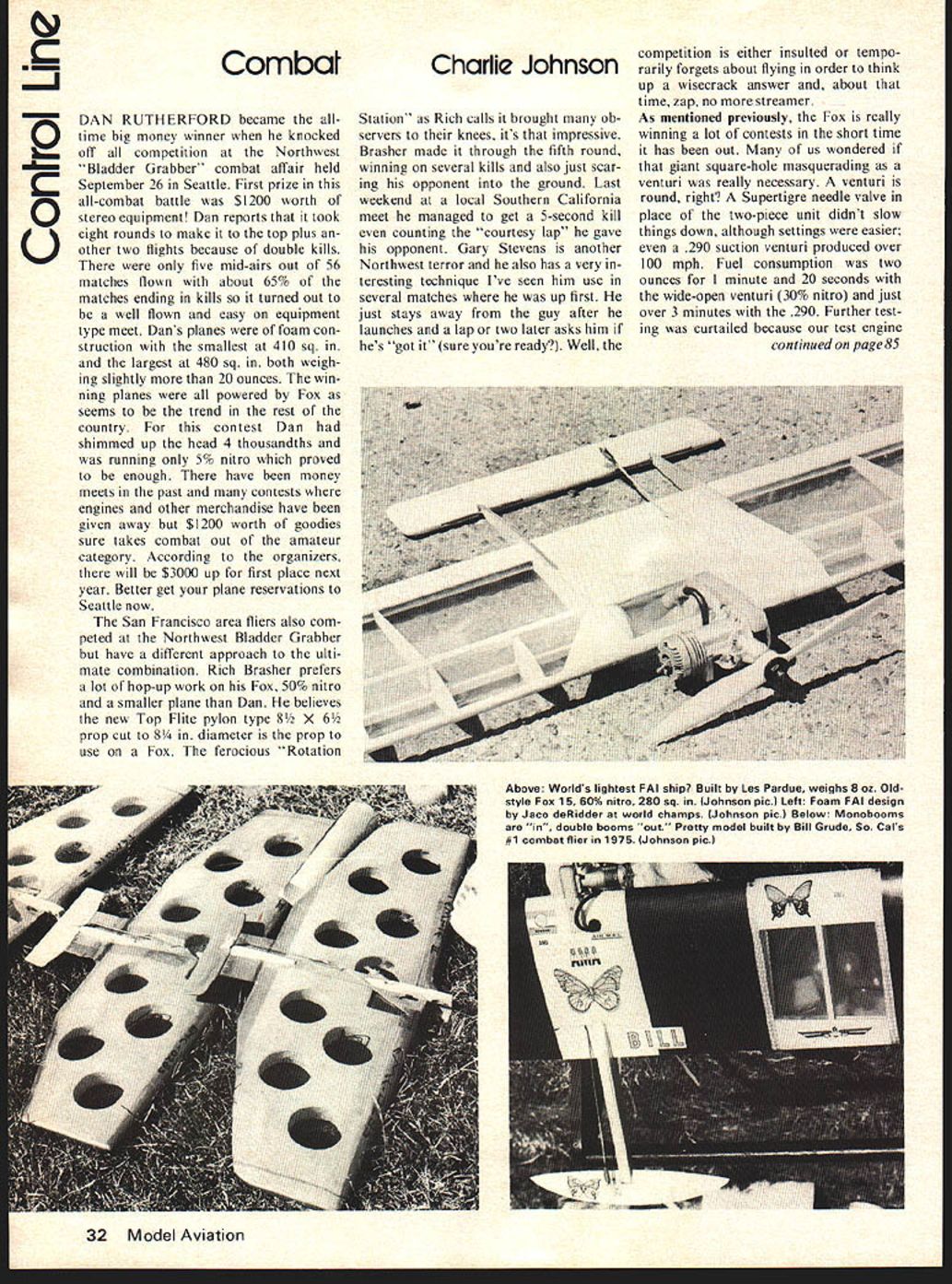
The latest trend in both Fast and Slow Combat has been to larger wings and simple foam designs. Dan Rutherford claims a maximum of 16 pieces in this 480 sq. in. Humongous design and with no precision fits. You just drop the bits in the jig and pour epoxy all over them—well, not exactly that imprecise. The new breed of model features a single half-inch rib in the center (no center sheeting at all), to which everything else fits, and the mono-boom solves the problem of having to beef up the area under the booms as in normal Nemesis-type planes. The center section takes all the engine, bellcrank and leverage stresses. Covering these huge monsters becomes not only expensive but adds almost two ounces in the case of the Humongous.
Disposable, throwaway models as are being built don't really need fuel proofing since they won't last long enough to get fuel-soaked, so some pilots tried spraying a coat of urethane on the center section where exhaust might get on it. No other covering or fuel proofing is needed; block sanded foam wings proved to be smooth enough. Another innovation seen at the latest contest was the reusable center section. The plan is to make a very strong center that can be reused many times by just cutting the spars and foam away and plugging on new parts, thus saving yourself the time it takes to construct a new engine pod, bellcrank setup, etc. Howard Rush suggested molding this center section out of carbon fiber or some such material which could be done commercially. The modeler would buy or make the center section then epoxy in two spars and possibly use contact cement to hold the foam in place, add an old mono-boom and be ready to fly.
I changed airfoil shapes on a Wilkens-type model which amounted to reusing the center and plugging on new foam blanks with different airfoil shapes. All this took less than an hour and I didn't even have to remove the motor. Repairs or revisions such as this could easily be done right at the flying field. One side benefit of foam is that in AMA Combat the string leader of your opponent's plane usually cuts right through the foam and locks on to the spars thus insuring a kill whereas on a wood leading edge it might have slipped over. In FAI Combat you do not want this to happen so you should reinforce the leading edge so the string slips, not digs in.
Charlie Johnson, 3716 Ingraham St., San Diego, CA 92109.
Transcribed from original scans by AI. Minor OCR errors may remain.

