

Control Line: Combat
By
Charlie Johnson 3716 Ingraham St. San Diego, CA 92109
Canadian Team Trials
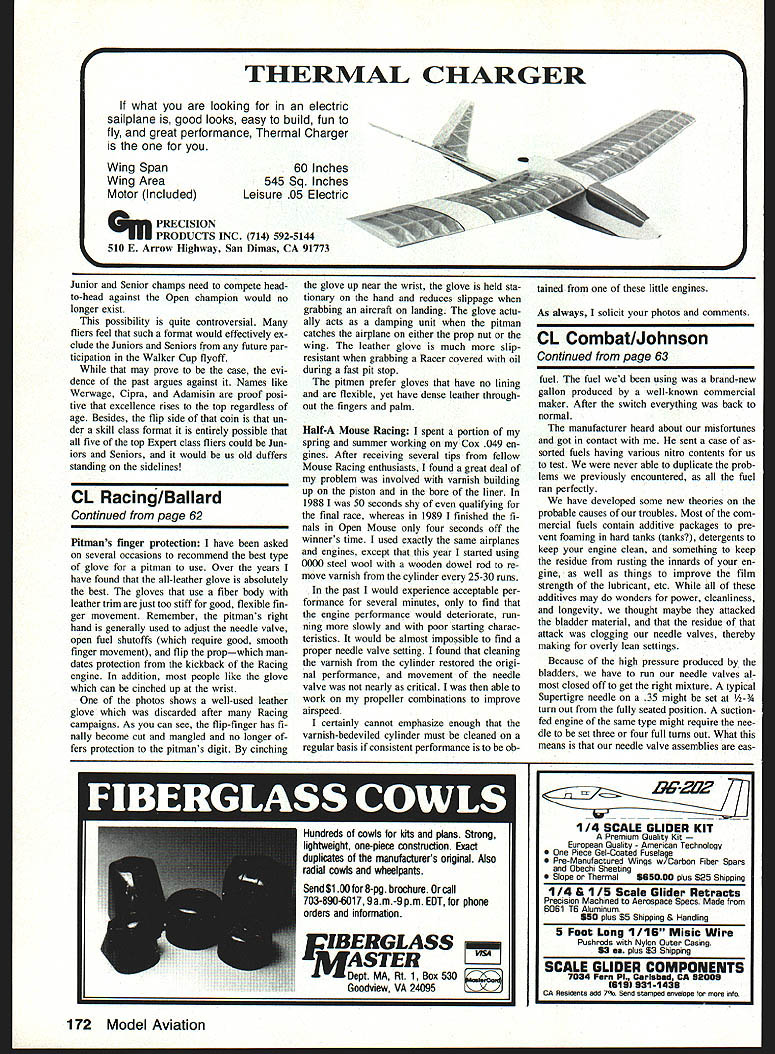
Up in the Great White North, the Canadians held their Combat team trials this past July to select a team to compete in the CL World Championships to be held in France this summer. Pat MacKinzie, Ron Malcolm, and Dave Lovgren will be the 1990 Canadian team. Ross Melhuish is the alternate member, failing to make one of the top spots for the first time since Combat became an official FAI World Championship event.
Paul Smith reported that both Malcolm and Lovgren used Nelson-powered, all-foam Monarchs, and that he and Steve Kott did the pitting. Pat MacKinzie also used Nelson power but had Russian-style models constructed of balsa/hardwood/foam composite materials. Melhuish used his familiar 1980-Doroschenko-style models. In Paul's report he mentioned the streamer-hook weakness that had not been effectively cured.
Canadian Nationals Winners
- Slow Combat: Pat MacKinzie
- Fast Combat: Wally Kruger
- FAI: Paul Smith
- 1/2A: Mike Palermo
All events were run double-elimination except for FAI, which was single-elimination but used the traditional two-airplane format. Team trials winner Pat MacKinzie was taken out in the first round of FAI by Steve Kott.
Bladder Grabber '89
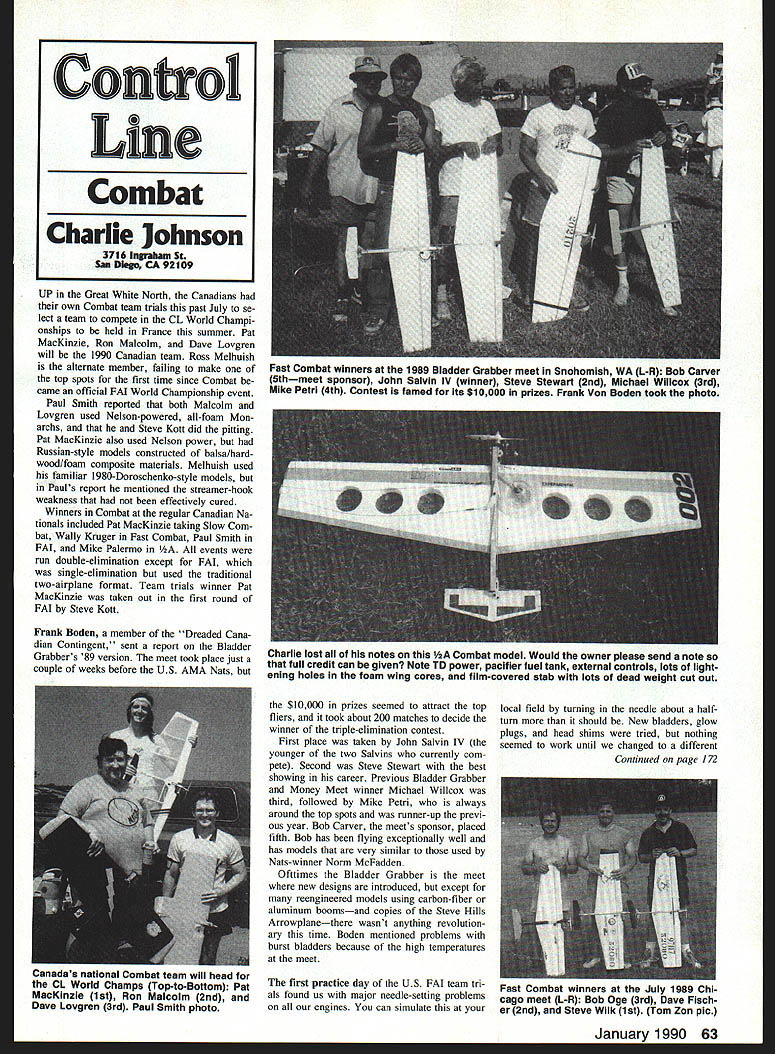
Frank Boden, a member of the "Dreaded Canadian Contingent," sent a report on the Bladder Grabber's 1989 version. The meet took place just a couple of weeks before the U.S. AMA Nats, but the $10,000 in prizes seemed to attract the top fliers, and it took about 200 matches to decide the winner of the triple-elimination contest.
- 1st: John Salvin IV
- 2nd: Steve Stewart (best showing of his career)
- 3rd: Michael Willcox (previous Bladder Grabber and Money Meet winner)
- 4th: Mike Petri (frequently near the top; runner-up the previous year)
- 5th: Bob Carver (meet sponsor; flying exceptionally well with models similar to those used by Nats-winner Norm McFadden)
Often the Bladder Grabber is the meet where new designs are introduced, but except for many reengineered models using carbon-fiber or aluminum booms — and copies of the Steve Hills Arrowplane — there wasn't anything revolutionary this time. Boden mentioned problems with burst bladders because of the high temperatures at the meet.
U.S. FAI Team Trials — Fuel Problems
The first practice day of the U.S. FAI team trials found us with major needle-setting problems on all our engines. You can simulate this at your local field by turning in the needle about a half-turn more than it should be. New bladders, glow plugs, and head shims were tried, but nothing seemed to work until we changed to a different fuel. After the switch everything was back to normal.
The manufacturer heard about our misfortunes and contacted me. He sent a case of assorted fuels with various nitro contents for us to test. We were never able to duplicate the problems we'd previously encountered, as all the test fuels ran perfectly.
We developed some theories on the probable causes. Most commercial fuels contain additive packages to prevent foaming in hard tanks, detergents to keep engines clean, corrosion inhibitors, and additives to improve lubricant film strength. While these additives may improve power, cleanliness, and longevity, we thought they might attack bladder material. The residue of that attack could be clogging needle valves, thereby making the mixture overly lean.
Because of the high pressure produced by the bladders, we have to run our needle valves almost closed to get the right mixture. A typical Super Tigre needle on a .35 might be set at 3/4 to 1-1/2 turns out from the fully seated position. A needle set this way will give the same mixture as one set three or four turns out on a normal vented-tank installation. This means our needle valve assemblies are extremely sensitive to minute bits of dirt and residue; even a small amount of contamination will change the setting drastically. Cleanliness is the key.
I remember problems with xylene in fuel used for the club's one-ounce Racing event. It melted some plastics and did something to the castor oil that made it turn stringy.
We always hear about how alcohol attracts moisture from the air, but it's really too busy trying to evaporate. What can happen is that the warm, moist air in your fuel container may condense on the walls of the container when you store it in your garage after the flying session. The moisture then runs down the inner walls into your fuel. A fuel manufacturer suggested topping off your fuel can when you get home, using fuel from a container that has remained in the garage.
While you worry about moisture getting into the fuel, the alcohol and nitro are busy evaporating out. As alcohol and nitro evaporate, the percentage of oil increases. If you leave the lid off the fuel bottle on a hot day, you not only get dirt and debris in the fuel, but you also get high-oil-content fuel that runs hot, makes less power, and is prone to flameouts.
Only as much oil as the engine needs for proper lubrication should be in the fuel. You won't find many people who can or will give you a definitive answer to "How much oil is enough?" In testing for our one-ounce Racing event, I tried oil contents around 30% and found that even though the quantity of fuel passing through the engine was about half normal (to give many laps), the oil percentage had to be 20% or lower. Most commercial fuels are around this figure because it is safe; they're not going to risk reliability just to get that last rpm. Engines generally like fuel with around 16% oil content.
Dan Rutherford told me that his group runs 7% Delta oil and 8% castor. The commercial teams have secret oils and additives, but good old castor oil or LB625 has been used successfully in the 16%–20% range for many years.
Union Carbide makes LB625, and you should be able to get it from any good chemical supply house. Also, with alcohol and 98%-pure nitro (if you can find it), you can buy ingredients as good as the big boys use, but they take greater pains to maintain quality during manufacture. That's why I've found it easier and cheaper to just buy fuel that works well in my engines. Save exotic fuel for special occasions when you're testing and don't need absolute reliability.
Bearings and Engine Tips
Have you heard about full-complement bearings? The .35s really tear up rear bearings if revs and loads get too high. Usually the retainer comes apart and takes out your new liner and piston. There are nice, expensive bearings that feature phenolic cages which solve the problem.
There's another way preferred by many, and you can practice on your old, blown-up bearings. Pull out what's left of the retainer and measure the diameter of one of the balls. If you don't have a caliper or micrometer, take the ball to the local bearing house. You can buy a small box of balls of the correct size for very little money. Fill the old bearing to capacity with the new balls — but there's one step left.
Take your Dremel Moto-Tool and grind a relief on the inner and outer races to allow you to insert the last ball or two. I did this while the bearing was still in one piece and with the old retainer in place. Wash the bits and grindings out of the bearing really well, and discard the old balls since you have a box full of new ones.
You'll be able to insert the new balls when those relieved indentations in the races line up. Of course the balls can fall back out when this alignment occurs (for example when the engine is running), so when you reinstall the bearing in the engine, put the ground-out side next to the crankcase.
Like most ideas, you'll find some guys swearing by this technique while others are swearing at it. There might be a slight power penalty because of the extra friction, but it's a lot cheaper than using high-tech bearings — and those have been known to come apart, while the reconditioned ones won't.
Dan Rutherford's group has been using all-stock-part Fox Mk VIs. This doesn't mean the engines are exactly right out of the box, just that no aftermarket parts are used. Dan said they had a lot of trouble with excessive piston expansion, which they think causes many broken-rod problems with these and other engines. Contrary to common practice, they lap in the piston and take down the high spots. The material will be polished off the piston and not off the hard-chrome cylinder.
The fit of the rod on both the wrist pin and crankpin is important, because if it becomes loose at either place it'll probably break the rod. The wrist pin is especially critical on Mark VIs because it is held in place in the piston by a roll pin and can rotate in the piston.
Duke Fox can give timing specifications which will greatly improve your engine run time. Crank timing seems to make a lot more difference than intake port timing. Exhaust timing is limited by the prop you want to pull.
Unfortunately, experience is gained by going too far — but that's how the fast guys found out how to make their engines run. Has anyone worked on the OS .32? If you've had good success, let the rest of us know about your modifications.
Transcribed from original scans by AI. Minor OCR errors may remain.

