
Control Line: Combat
Charlie Johnson
3716 Ingraham St. San Diego, CA 92109
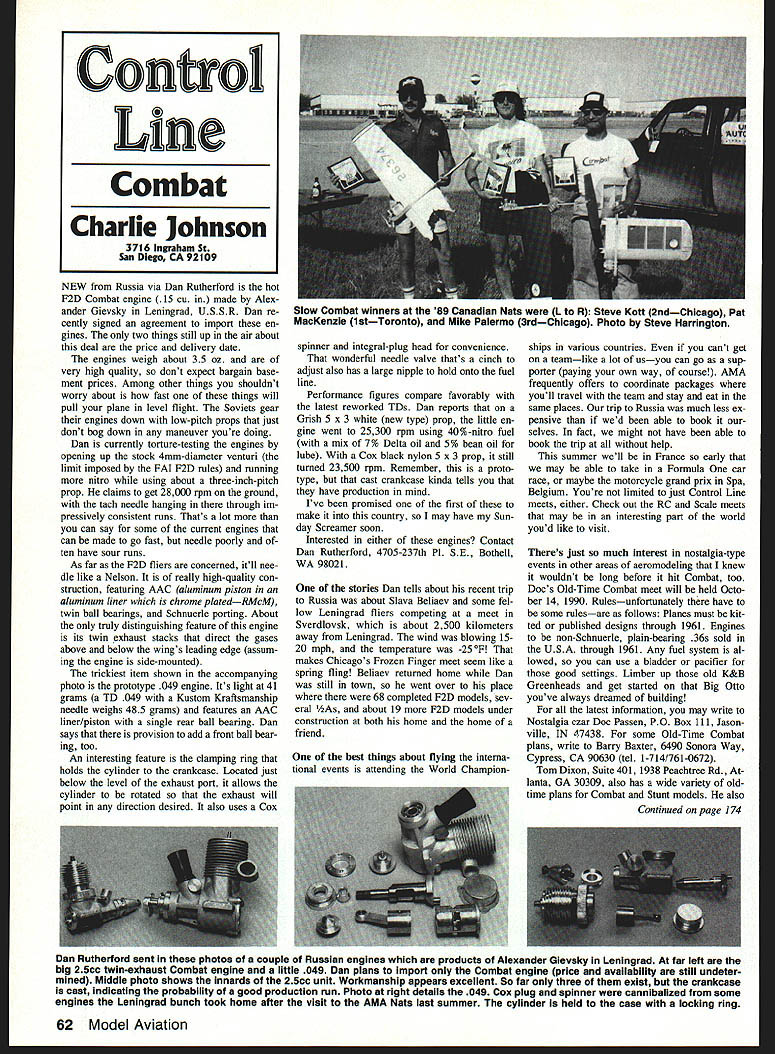
NEW from Russia via Dan Rutherford is the hot F2D Combat engine (.15 cu. in.) made by Alexander Gievsky in Leningrad, U.S.S.R. Dan recently signed an agreement to import these engines. The only two things still up in the air about this deal are the price and delivery date.
The engines weigh about 3.5 oz and are of very high quality, so don't expect bargain-basement prices. Among other things you shouldn't worry about how fast one of these things will pull your plane in level flight. The Soviets gear their engines down with low-pitch props that just don't bog down in any maneuver you're doing. Dan is currently torture-testing the engines by opening up the stock 4 mm-diameter venturi (the limit imposed by the FAI F2D rules) and running nitro using about a three-inch-pitch prop. He claims to get 28,000 rpm on the ground, with the tach needle hanging in there through impressively consistent runs. That's a lot more than you can say for some current engines that can be made to go fast, yet needle poorly and often have sour runs.
As far as the F2D fliers are concerned, it'll needle like a Nelson. It is of really high-quality construction, featuring:
- AAC liner/piston
- Chrome-plated parts
- Twin ball bearings
- Schnuerle porting
About the only truly distinguishing feature of the engine is its twin exhaust stacks that direct the gases above and below the wing's leading edge (assuming the engine is side-mounted).
The trickiest item shown in the accompanying photo is the prototype .049 engine. It's light at 41 grams (a TD .049 with a Kustom Kraftsmanship needle weighs 48.5 grams) and features an AAC liner/piston with a single rear ball bearing. Dan says that there is provision to add a front ball bearing, too.
An interesting feature is the clamping ring that holds the cylinder to the crankcase. Located just below the level of the exhaust port, it allows the cylinder to be rotated so the exhaust will point in the direction desired. It also uses a Cox spinner and integral-plug head for convenience.
That wonderful needle valve that's a cinch to adjust also has a large nipple to hold onto the fuel line.
Performance figures compare favorably with the latest reworked TDs. Dan reports that on a Grish 5 x 3 (white new-type) prop, the little engine went to 25,300 rpm using 40% nitro fuel (with a mix of 7% Delta oil and 5% bean oil for lube). With a Cox black nylon 5 x 3 prop, it still turned 23,500 rpm. Remember, this is a prototype, but that crankcase kinda tells you they have production in mind.
I've been promised one of the first of these to make it into this country, so I may have my Sunday Screamer soon. Interested in either of these engines? Contact Dan Rutherford, 4705-237th Pl. S.E., Bothell, WA 98021.
One of the stories Dan tells about his recent trip to Russia was about Slava Beliaev and some fellow Leningrad fliers competing at a meet in Sverdlovsk, which is about 2,500 kilometers away from Leningrad. The wind was blowing 15–20 mph and the temperature was −25°F — that makes Chicago's Frozen Finger meet seem like a spring fling! Beliaev returned home while Dan was still in town, so Dan went over to his place where there were 68 completed F2D models, several 1/4s, and about 19 more F2D models under construction at both his home and the home of a friend.
One of the best things about flying the international events is attending the World Championships in various countries. You can't get the team-like experience unless you're on the team — a lot of us go as supporters, paying our own way. Of course the AMA frequently offers coordinated packages where you'll travel with the team, stay and eat in the same places. Our trip to Russia was much less expensive than if we'd been able to book it ourselves. In fact, we might not have been able to book the trip at all without it.
This summer we'll be in France so early that we may be able to take in a Formula One car race, or maybe the motorcycle Grand Prix in Spa, Belgium. You're not limited to just Control Line meets either. Check out RC and Scale meets — they may be an interesting part of the world you'd like to visit.
There's just so much interest in nostalgia-type events in other areas of aeromodeling that I knew it wouldn't be long before it hit Combat, too.
Doc's Old-Time Combat meet will be held October 14, 1990. Rules — unfortunately we have some rules as follows:
- Planes must be kitted or published designs through 1961.
- Engines — non-Schnuerle plain-bearing .36s sold in the USA through 1961.
- Any fuel system allowed — can use bladder or pacifier.
Limber up old K&B Greenheads and get started on the Big Otto you've always dreamed of building. For the latest information write Nostalgia Czar Doc Passen, PO Box 111, Jasonville, IN 47438.
For some Old-Time Combat plans write Barry Baxter, 6490 Sonora Way, Cypress, CA 90630, tel. 1-714-761-0672. Tom Dixon, Suite 401, 1938 Peachtree Rd., Atlanta, GA 30309, also has a wide variety of old-time plans for Combat and Stunt models.
CL Combat — Continued
Bolly props are the hot ticket for high performance. Try just one on your F2D models, and you'll toss those Taipans back in your box. Be advised that they're expensive, so if you crash a lot you might want to pull the Taipans back out. You'll just have to fly a standard prop back-to-back with a Bolly to feel the performance improvement.
The carbon props look neat, but the glass props are a little cheaper and take a little more abuse. Unless you know how to properly finish a glass or carbon prop, you should pay the little bit extra to have the prop ready to go. If you insist on carving on the props, then at least don't do it in the living room where all those glass and carbon particles will end up giving you itchy feet.
My special thanks go to Steve Harrington, who sent pictures from the Canadian Nats. The postman bent the envelope into a figure eight, so if you see a bit of a crease in the middle of the picture, you know whom to thank.
Steve said that the Canadian Nats will be held in Centralia, Ontario on June 30–July 8, 1990. Our FAI team will be out of luck, but all of you returning from the extravaganza in Seattle (the 15th running of the Bladder Grabber) should be able to make the Canadian Nats — as well as the U.S. Nats. Steve's telephone number is 1-613-829-9866 in case you'd like more info on when and what they'll fly. He says that our planes will fit their rules just fine.
Get out a pen and write this name and address on your shop wall: Larry Driskill, 4916 Chaggar Ct., Las Cruces, NM 88005. That's where you send your $15 to join MACA (Model Aircraft Combat Association — RMCM).
I'll still send you the Combat suppliers' sheet if you send a SASE, but for in-depth information, the MACA newsletter is the cat's meow.
What works and what doesn't? The MRL clear film covering (Model Research Labs, 25108 Marguerite #160, Mission Viejo, CA 92692) proved to work really well on open-frame wood models. I did a Voodoo-style model using one piece of film in about 15 minutes. It sticks better than the ubiquitous FasCal, shrinks better, and doesn't loosen up at all. It has less tear resistance, but I like to mash models rather than tear them. The seams really disappear, and my quick-and-dirty job looked presentable.
Ken Powell (8439 "E" Sunset Trail, Rancho Cucamonga, CA 91730) has some nice Combat T-shirts in two styles. They're $12.95 each (plus $3 shipping). Buy two or more, and the price is $12 each. If I had to pick between the two styles, I'd take "B," which features a Texas-style model with external controls, holes in the wings, and the prop on backwards. The all-control, two-color designer is available in M, L, XL (or XS for your girlfriend) sizes.
Junk or junque? I made use of some of the goodies I've received lately to build some practice models. No state-of-the-art Hillis Arrowplane-type models for me, just simple and expendable fun-type planes. I've been getting around a dozen matches of 3–5 minutes' duration each week, and losses have been averaging less than one model per Sunday. These planes would have been hot-rods a decade ago, but their worn-out Rossis pale by comparison with the latest Nelson or Gievsky .15. The roar of the latest high-tech creature is something to behold, as is the ecstasy of victory at a major meet.
But 60 minutes of air time in a low-pressure environment has a lot going for it. I told a nonflying friend of mine about what we do, and his reply was, "That's what a hobby is supposed to be, right?" We surely don't want to give up the excitement brought on by a meet of the level of the Bladder Grabber, since it keeps us from falling into the doldrums. But I think the more informal Sunday shootouts are the foundation for the rest of the sport.
Transcribed from original scans by AI. Minor OCR errors may remain.

