
Control Line: Combat
Author
Charlie Johnson 3716 Ingraham St, San Diego, CA 92109
Old-Time (Nostalgia) Combat
Old-time combat is on the upsurge. Doc Passen's meet on October 14, 1990, at Jasonville, IN will probably draw quite a few fliers; many of the guys I've been talking to plan to attend.
Old-Time or Nostalgia Combat rules require models and engines to be 1961 or earlier, but there is no limitation on speed or fuel systems. Most of my informants plan to fly models like the early, short-boom VooDoo; however, they also plan to bring other interesting models, such as the Orbit Ace, Darwin, Greased Lightning, and the magnesium-panned Count Clipper.
My group had planned to use the Orbit Ace but has since changed to the Super Combat Streak using K&B .35 Series 61 engines for power. We were really convinced when we read the kit ad graphics that said, "The hottest Combat design ever."
For more information on the contest and a list of engines and models that qualify, write to Doc Passen, P.O. Box 111, Jasonville, IN 47438 (tel. 1-812-665-3723 after 8:00 p.m. CST). For Old-Time plans you can call Barry Baxter at 1-714-761-0672. He sells the plans at $6 per set.
Contests and Tournaments
The $1,000 meets are springing up all over. The latest in the series of professional Fast Combat tournaments will be held in Vacaville, CA over the Labor Day weekend, September 1–2, 1990. The site will be the Nut Tree Airport. For more information call Ken Manchester at 1-707-448-4368. Vacaville is about 50 miles east of San Francisco on I-80, and there's a Motel Six about a half-mile from the contest site. Oakland is the nearest large commercial airport, although those with private planes could fly into the airport and save travel time.
Besides the money, there will be the usual fine stereo prizes and other goodies. Vacaville is on the edge of the wine country in central California and about an hour's drive from the tourist attractions in the San Francisco area.
It's way too late to make the Pinelands Combat Tournament, but what style those guys have with the publicity! Chip Giordano sent some neat flyers and a small poster advertising their contest. Chip is also the MACA (Miniature Aircraft Combat Association — Ed.) treasurer, so you can send your $15 MACA dues to him at P.O. Box 1000, Toms River, NJ 08754-1000, or call him at 1-201-240-4451. From all reports this group has really taken off. If you're anywhere near Chip and the Pinelands group, you should look them up.
Money Nats and MACA Top 20
There were 39 entrants at the Money Nats held this year in Los Angeles. George Cleveland took first place, with Chuck Rudner second, and John Stubblefield taking the next two spots. That should help move those guys up on the MACA Championships ladder.
The MACA Top 20 appeared in the April edition of their newsletter with the following admonition: "Please do not consider this final or official until our volunteer Top 20 team of lawyers has blessed this guess. Driskill." Apparently nothing has changed the order, so here is MACA's Top 20 for 1989:
- Paul Smith — 88 pts
- Steve Wilk — 82 pts
- Richard Stubblefield — 78 pts
- Bob Nicks — 76 pts
- Mike Willcox — 64 pts
- Mike Urban — 64 pts
- Steve Kott — 62 pts
- David Fischer — 59 pts
- Ed Brzys — 57 pts
- Don Cranfield — 57 pts
- John Stubblefield — 54 pts
- George Cleveland — 45 pts
- Phil Cartier — 43 pts
- Mitchell Cleveland — 41 pts
- Mike Thiessen — 41 pts
- Rene Zeldenthuis — 40 pts
- Mike Palermo — 39 pts
- Dave Lovgren — 38 pts
- Mike Evans — 37 pts
- Pete Plunkett — 36 pts
Engine Mounts and Wing-Mounting Issues
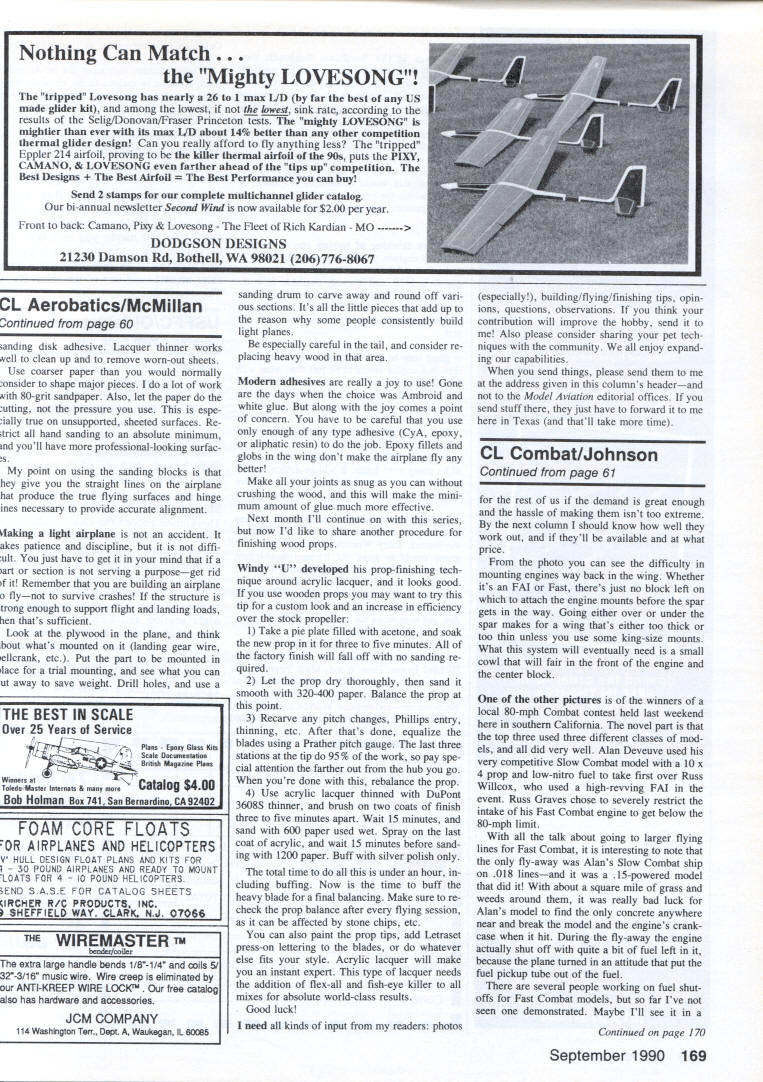
One of my photos shows a special engine mount used by Rich Lopez's FAI models. The first few were made by Rich, Chuck Rudner, and Steve Hills using John McCollum's equipment. One of the local fliers has since made a number of mounts for Rich that may be available. For the rest of us, if the demand is great enough and the hassle of making them isn't too extreme, they might be produced more widely. By the next column I should know how well they work, if they'll be available, and at what price.
From the photo you can see the difficulty in mounting engines way back in the wing. Whether it's an FAI or Fast ship, there's often no block left on which to attach the engine mounts before the spars get in the way. Going either over or under the spar makes for a wing that's either too thick or too thin unless you use some single-size mounts. What this system will eventually need is a small cowl that will fair in the front of the engine and the center block.
80-mph Combat Results
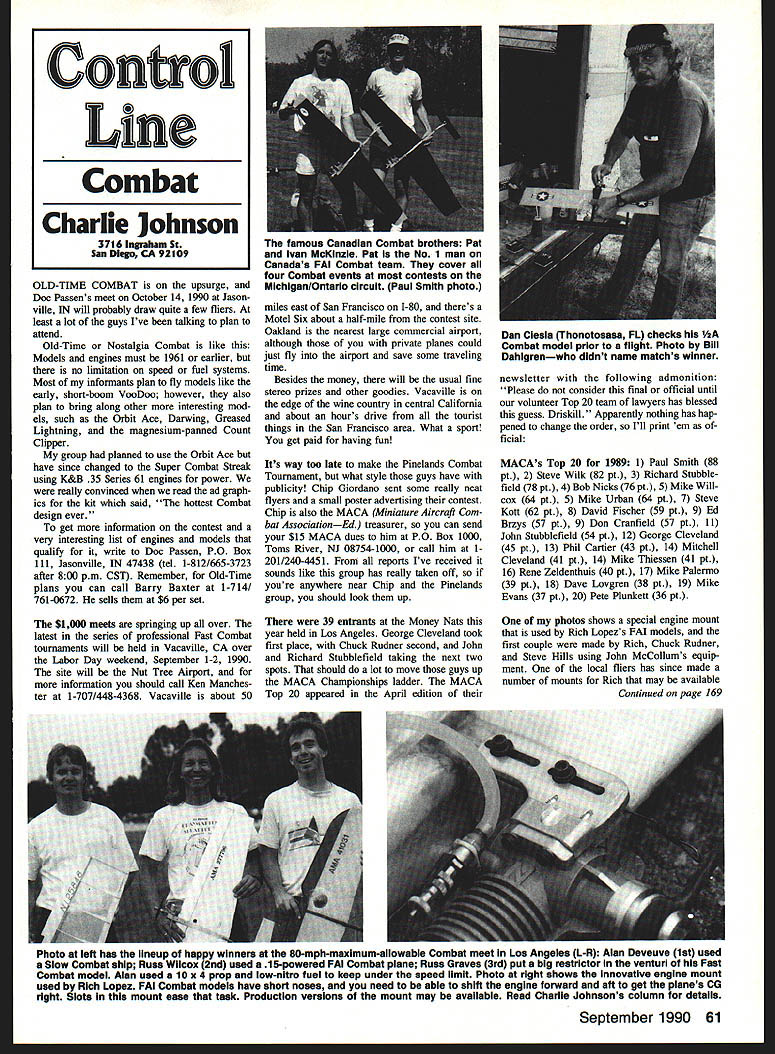
One picture shows the winners of an 80-mph Combat contest held recently in southern California. The novel part is that the top three used three different classes of models, and all did very well. Alan DeVeuve used his competitive Slow Combat model with a 10x4 prop and low-nitro fuel to take first over Russ Willcox, who used a high-revving FAI in the event. Russ Graves chose to severely restrict the intake of his Fast Combat engine to get below the 80-mph limit.
With all the talk about going to larger flying lines for Fast Combat, it's interesting to note that the only fly-away was Alan's Slow Combat ship on .018 lines — and it was a .15-powered model that did it. With about a square mile of grass and weeds around the site, it was really bad luck for Alan's model to find the only concrete anywhere nearby and break the model and the engine's crankcase when it hit. During the fly-away the engine actually shut off with quite a bit of fuel left in it, because the plane turned in an attitude that put the fuel pickup tube out of the fuel.
Safety and Fly-Aways
Several people are working on fuel shut-offs for Fast Combat models, but so far I haven't seen one demonstrated. Maybe I'll see one in a couple of weeks at the Bladder Grabber.
This year at the Northeast Regionals they didn't fly Fast Combat because of the fly-away problem—the contest is held at the airport in Eugene, OR, and there are lots of expensive commercial jets cruising around. It's bad enough having a fly-away model come to rest in the flying area, but it's even worse if it ends up in an area inhabited by nonfliers. Let's hope someone can come up with a reliable fuel shut-off that could be used in all the events—or at minimum something that would destabilize the model to keep it within the confines of the flying area so that competitors are the only ones who have to dodge it.
Engines: Fox Mark VI and Shuriken 1/4A
If you're thinking of buying one of the Fox Mark VI engines, you'd best call Duke Fox and do it now. The current price of the engine is $100, and it's only available from the factory (tel. 1-501-646-1656). The report I hear is that there are only 100 of these engines left, and when they're gone... well, you know the rest.
A giant leap in 1/4A technology: the new Shuriken 1/4A engine seems to be just that, with its 29,000-rpm redline and about 50% more power than the current Cox TD .049. Look for some very large models using this engine to appear soon. The manufacturer is reportedly swamped with orders for this little jewel, and even at about $200 a copy the fast guys are going to be going even faster. It will be difficult to fly one on our current 35-ft lines, so we may be forced to move up to 42 ft (or more).
Top Combat Pilots — A Personal Take
Somebody asked me who I thought was the best Combat pilot in the world. In the U.S., we have the legend Riley Wooten. Joining a very elite group would be guys like Richard Stubblefield and Howard Rush (who's entertaining to watch even if he doesn't always win). We have a whole bunch of top-notch fliers in a category that's too close to call—people like Flucker, Cleveland, McFadden, and the twin terrors John Stubblefield and Michael Wilcox.
There are many foreigners who deserve to be considered, too. The British have Richard Evans, Dave Wood, Mick Tiernan, and the always-tough Mr. Vernon Hunt. Consider the Soviet stars like Doroshenko, Beliaev, Necheukhin—and reigning World Champion Faizov. No list would be complete without the Wakermans and Fred Meyer, and we all remember Osterman's performance at the 1984 World Champs.
If John Madden can have his all-American team, I should be entitled to my all-world team. Maybe after the next World Champs I'll give it some thought. It may be safer to pick people who have already retired.
Transcribed from original scans by AI. Minor OCR errors may remain.

