
Control Line: Combat
Charlie Johnson 3716 Ingraham St. San Diego, CA 92109
New on the scene: Aerospace Composite Products
I have just received a few new product samples from Aerospace Composite Products (P.O. Box 16621, Irvine, CA 92714; telephone 1-714/250-1107).
- A special epoxy resin that is thin enough to work with other products such as glass cloth, Kevlar and graphite.
- A composite of carbon fiber strands sandwiched between layers of tissue. The tissue makes the carbon fiber easier to work with when gluing to wood or foam; the adhesive soaks through the porous tissue to hold the carbon strands in place.
- Kevlar cord in two thicknesses: .038 (rated at 85 lb.) and .054 (rated at 215 lb.). Kevlar thread is useful for jobs like holding a trailing edge to the center boom; it may also serve as a safety cable better than wire in violent midairs.
Composite Structures Technology also offers a range of similar products: carbon sheets, Kevlar, glass fiber cloth, a special epoxy resin and Rohacell foam. Howard Rush used Rohacell in his ultra-exotic FAI models.
Consolidated kits / Control Line Classics
Tony Drago sent a catalog listing a variety of Consolidated kits sold by Control Line Classics — remember Wow Wowee, Manx Cat V, Twin Terror? There’s also a Nostalgia Combat model (a 520-in. twin-engine model) suitable for a K&B 15/19 or Greenhead. Contact Tony at 24981 Nogal St., Moreno Valley, CA 92388. Telephone 1-714/242-5077.
Mystery H.A. model and Ken Powell
The mystery H.A. model that appeared in the January 1990 column belonged to Ken Powell. The newer SNOO3 replaces the SNOO2 pictured. Ken’s airplane features .010 unidirectional graphite bonded directly to foam with epoxy resin, a balsa body and .020 Kevlar-49 doublers.
Ken also sells two styles of T-shirts — his Combat tees are popular locally. Reach Ken at 8439-F Sunset Trail Place, Rancho Cucamonga, CA 91730.
Public relations for Combat
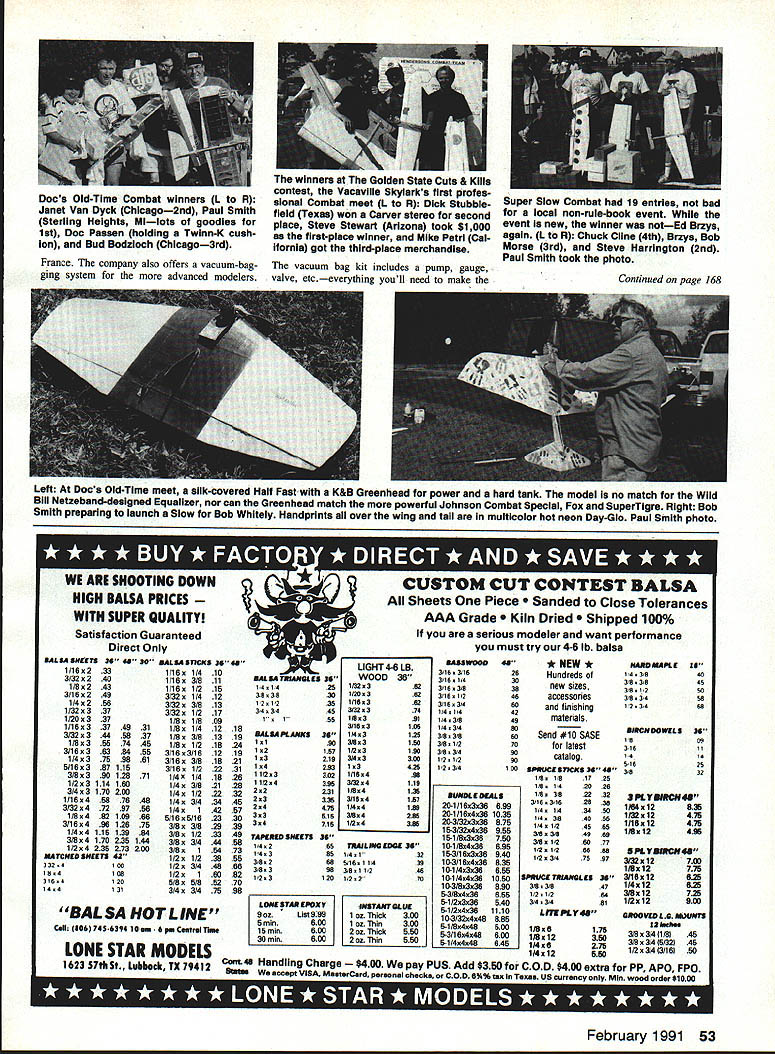
Chip Giordano sent a packet of PR materials the Pinelands Combat Team uses to present the sport positively. Reprinting local newspaper coverage helps. If you have similar PR materials, please send them along.
Other fliers in the news lately include Pete Plunket and Doc Passen. When Pete hosted the FAI team trials in Austin, MN, last year, the whole town knew about him and his Combat models. Doc promoted his Nostalgia Combat meet effectively. A phone call to a local paper or TV station often brings out a curious reporter — you might get more coverage than you expect.
Contests and models
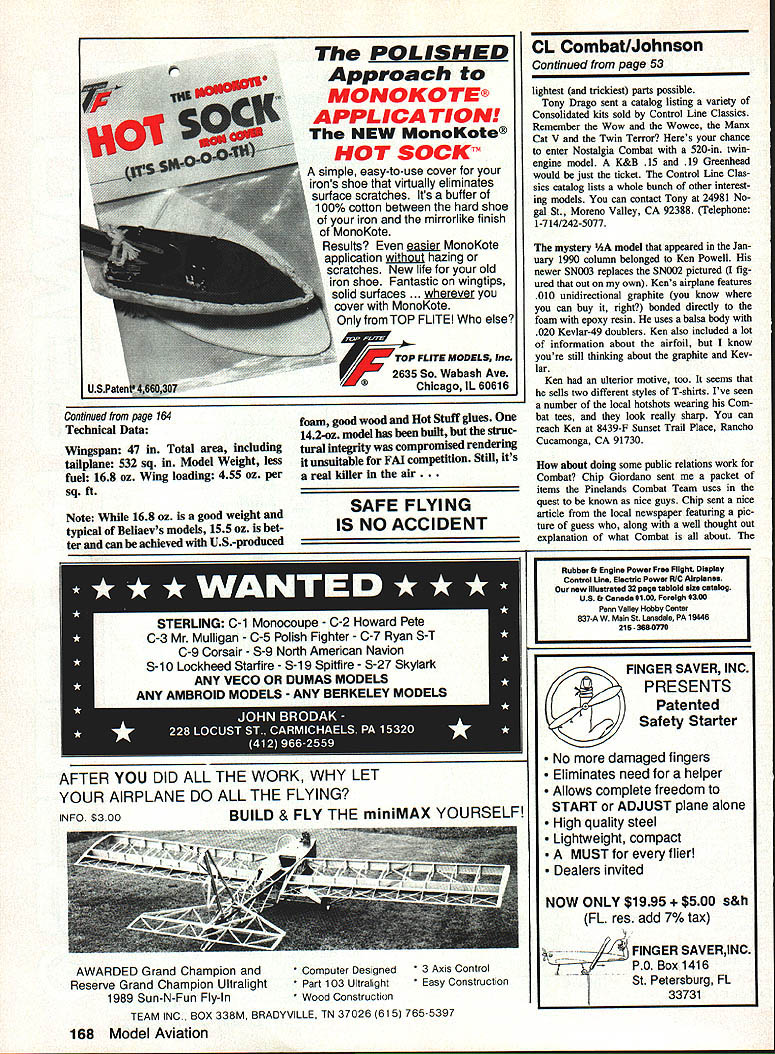
Steve Stewart claimed the $1,000 prize at the Vacaville Skylark's first professional Combat meet. Richard Stubblefield was second and took home a Carver stereo and other merchandise. Mike Petri finished third and won merchandise.
The contest was called (get this) The Golden State Cuts & Kills Contest. It was well-run, with a large flyoff area that Alan Deweuve used to the fullest when his model was cut loose during a match. From the full report Carl Bumgarner sent, everyone seemed pleased with the results of their first big-time contest.
Combat trends
More fliers are moving into 80-mph and Geriatric styles of Combat.
- 80-mph Combat: Any model is allowed, but two laps must take more than 6.5 seconds (about 79 mph). This style is popular on the West Coast, with both kills and FAI-style flown.
- Geriatric (G-2) Combat: Requires specific engines (for example, the Fox .35 Stunt) and often uses penalty systems to discourage hitting planes. Geriatric Combat is most popular in New Jersey, Pennsylvania and New England.
The goal of these variations is to have sane events where competitors can participate without the expense and destruction of official events.
Most successful 80-mph models are conventional Fast Combat designs using a restrictor in the venturi, but one that uses a jet rather than a spraybar. Typical prop choices:
- 11 x 9 works well to keep speed down.
- 10 x 5 can also work.
Experiment to ensure your top speed stays under the limit. With a wide-open venturi the engine produces so much power it’s nearly impossible to limit speed. Using a restrictor also lets you run the full five minutes on four ounces of fuel.
Tips to slow a timed model:
- Fly as low as you can and extend your arm.
- Walk a large circle along with your airplane.
- Learn Team Race back-whipping techniques to put a load on the model.
- For a club contest, try whipping for seven laps, then try to slow for seven — the biggest difference wins.
Doc's Old-Time (Nostalgia) Combat meet
There’s growing interest in 1950s–1960s nostalgia, and Old-Time or Nostalgia Combat fits that trend. Dr. Terry “Doc” Passen sponsored a meet on October 13–14 in Jasonville, Indiana (pop. ~3,000).
Doc’s rules required models and engines that were used in 1961 or earlier. Documentation arrived from all over to legalize engines and planes; magazines and dated letters (one with a 1961 postmark from Howard Rush accompanying Nemesis plans) were used to verify equipment.
The meet was held in downtown Jasonville (across from a Tastee Freeze) rather than at the Jasonville Airport. The small-town atmosphere was friendly — locals came out to be entertained, not annoyed. Doc’s basement is a treasure trove of about 200 models (some still with mud on the engines) and the equipment used to manufacture the 30-plus kits he sells, including kits for Old-Time Combat and Stunt events. Doc even has a dog named Surprise. Jasonville is a friendly place.
Some notable models and modelers:
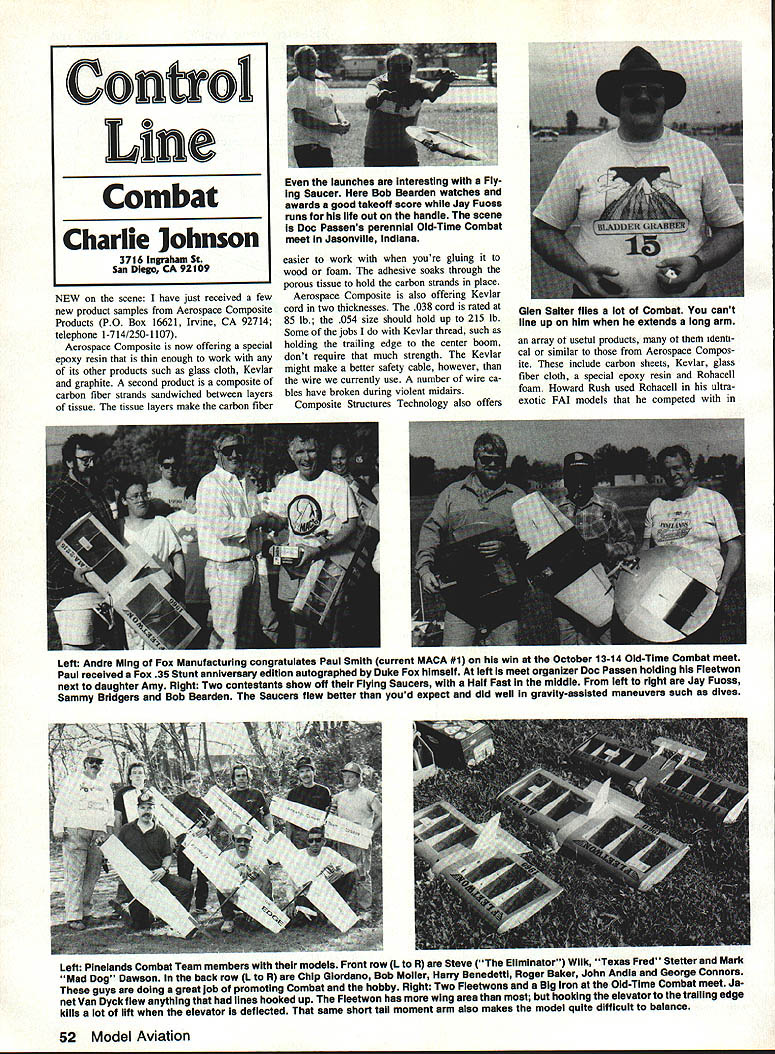
- The Chicago group brought Flying Saucers. These maneuver better than expected and tend to orbit high on the circle.
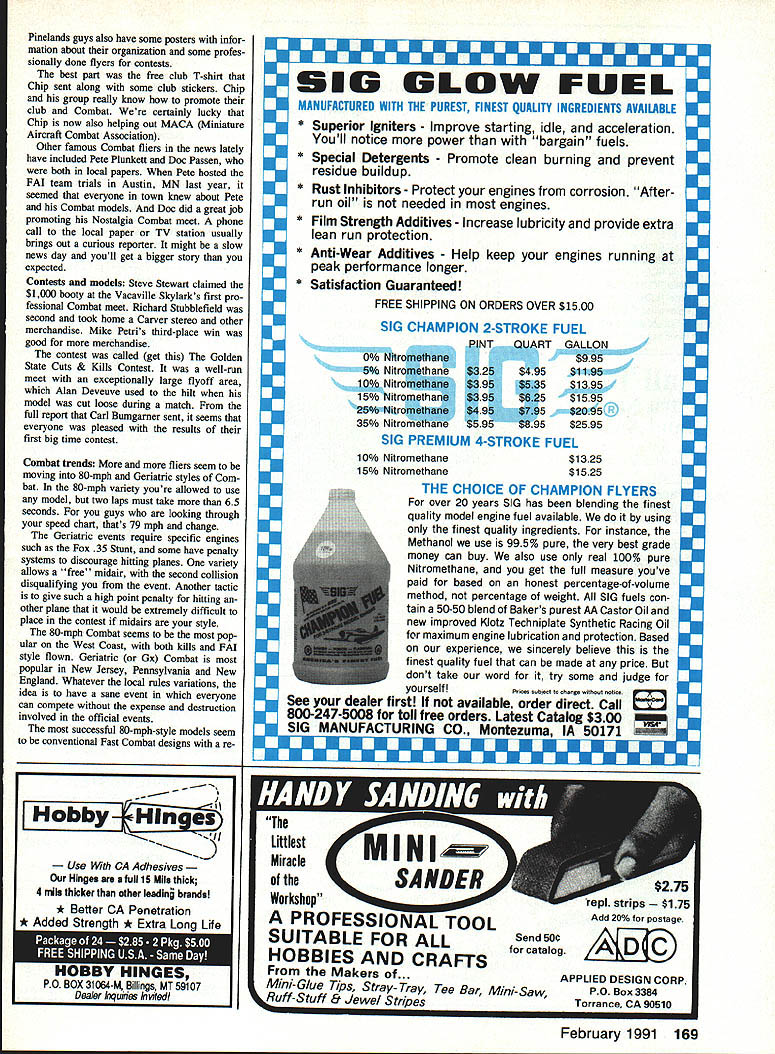
- Classic designs such as the Fleetwon, the Big Iron and the Wild Bill Netzeband Equalizer (the Equalizer proved the class of the show).
- Doc’s kits are legal for the event; some later models such as the Voodoo and the Flite Streak were legal too.
Results and highlights:
- Bob Bodzioch took third place with a Flite Streak.
- Paul Smith flew two Voodoos he’d bought at a garage sale, then moved to an Equalizer in his last bout (against the columnist).
- Janet Van Dyck flew a variety of rigs — Big Iron, Fleetwon with a strong engine, and another Fleetwon with a sick engine that cost her a match. When Janet's Big Iron struck a Saucer, the Saucer survived and continued to fly despite the damage.
Flying wing styles are at a disadvantage compared with boom models, though historically two-inch booms were considered long enough.
Engine issues and speeds Because no one knew exactly what the advertised G-21 looked like, the basic engine was allowed to compete. Paul Smith reached a top speed of 107 mph with the ST G-21, compared with slightly over 70 mph for re-chambered McCoy engines. Even the Johnson Combat Special couldn’t match Paul’s model. Since the first meet focused on fun, engine discrepancies were tolerated, but the issue will need to be settled for future contests.
Most competitors used bladders or pacers; the old hard tanks tended to promote bad settings, leaks and seizures. Props used varied — a Taipan 8 x 6 produces a pitch that some fliers preferred over older 9 x 8 props.
Suggestions and next steps
- Consider an 80-mph limit to protect older engines and spare parts; most old engines can reach 80 mph safely.
- Offer a bonus (e.g., 10 points) for truly legal 1961-and-earlier engines.
Next year Doc plans to hold the meet either in Jasonville or tie it into a larger Old-Time event that would include other activities. Kits and plans are available, and the engine rules should be nailed down by then. Some better designs such as the Equalizer could serve as backup models at regular Fast Combat meets.
If you like the unusual, build a Saucer and amaze your friends at the local control line field. Watch for the announcement for the 1991 meet.
Transcribed from original scans by AI. Minor OCR errors may remain.

