
Control Line Combat
Charlie Johnson 3716 Ingraham St. San Diego, CA 92109
From the Land of Perestroika (Mack Henry supplies)
Mack Henry is offering several items produced in the Soviet Union that, although designed for FAI Combat, may be useful in all Combat events.
- For $4 Mack will send a packet containing:
- a very lightweight bellcrank,
- a control horn,
- molded nylon hinge fittings.
These parts are contest-proven, will shave grams off your model's weight, and speed the building process.
- Ready-to-use fiberglass props from Latvia are available for $4 each. The props I’ve tried are perfectly balanced and seem among the best on the market for Nelson and other F2D Combat engines. They come with a fairly large center hole that fits a Nelson mini-spinner prop nut. If you use the prop on a Rossi-size crank, it will either require a bushing or careful centering on the shaft.
- Mack has sold a small number of engines acquired from the Soviets and hopes to import a variety of Soviet-made engines; if successful, the price might be as low as $125 each. Send $1.25 for more information or write to:
- Mack Henry, 269 Elysian Fields, Nashville, TN 37211.
Kits and Models
- Lite Kite (1/4A Combat)
- Kit comes complete with hardware including aluminum motor mounts, control system, removable bladder compartment, and a bladder.
- Resembles the Beliaev F2D model (featured in the February 1991 Model Aviation article "Beliaev's Winner" by Dan Rutherford and Svetlana Filippova).
- Wing span: 28 in (chord not specified). The wing has no airfoil — it needs an airfoil, about six ribs, and what appears to be an arrow shaft for the leading edge.
- Price: $19.95 plus fourth-class postage ($2.50) or $4.00 airmail.
- Available from Forward Models, 1183 Lockley Rd., Victoria, B.C., Canada V9A 4S7.
- Forward Models also lists a 1/4A trainer for $16.95 that it claims is nearly indestructible. Future offerings planned by the company include Control Line and RC kits, high-performance glow engines, diesel engines, and possibly engine rework/hop-up. The trainer drawing looks promising and uses an interesting bladder-attachment method that could be adapted for Fast Combat and FAI.
Newsletters and Clubs
I receive many newsletters from around the country and like to promote the MACA newsletter since it’s totally Combat-oriented.
- MACA membership: $15. Send to Chip Giordano, P.O. Box 1000, Toms River, NJ 08754-1000. Chip is doing a fine job promoting MACA and his club.
- Orbiting Eagles (Omaha, NE) produce a useful newsletter with articles by George Lieb and Bob Furr. Bob’s recent piece recommends browsing hardware stores for dowels, metal bits, paint stirrers, and yardsticks to repurpose as motor mounts, tail booms, and leading-edge stiffeners. The Orbiting Eagles meet at the Omaha Public Library.
- Newsletter humor: the Utah Dope Bucket ran a page left totally blank except for the sentence: "Your article or artwork could appear here." Editors Laron Huddleston and Jim Rhoades had some fun with the locals.
- A good practice: include a feature page listing contest sponsors and donated prizes (cut out sponsors’ logos). A little thank-you to sponsors goes a long way — many manufacturers never receive one.
Upcoming Meets and Prizes
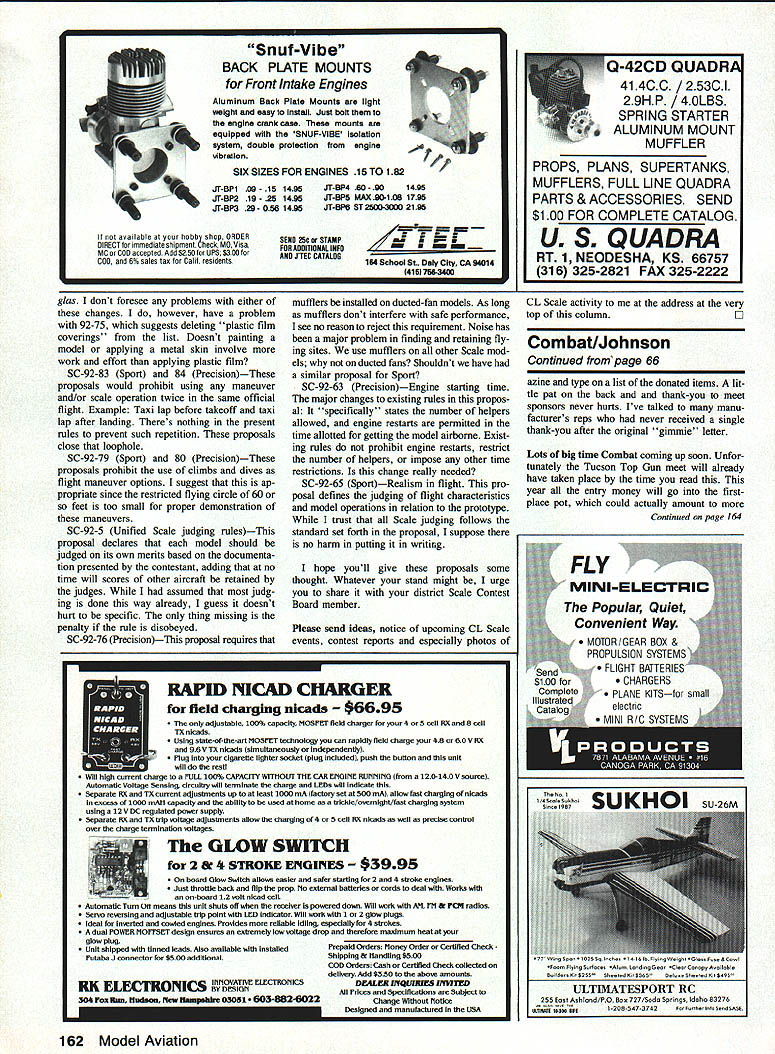
- Tucson Top Gun: large Combat meet (note — by the time you read this it may already have occurred). This year, all entry money goes into the first-place pot (likely more than last year’s $1,000). Second and third places receive typical prizes such as stereos and engines.
- Money Meet (Los Angeles): late April; features great prizes and a $1,000 top prize. Dates can depend on a giant carnival held on the same site.
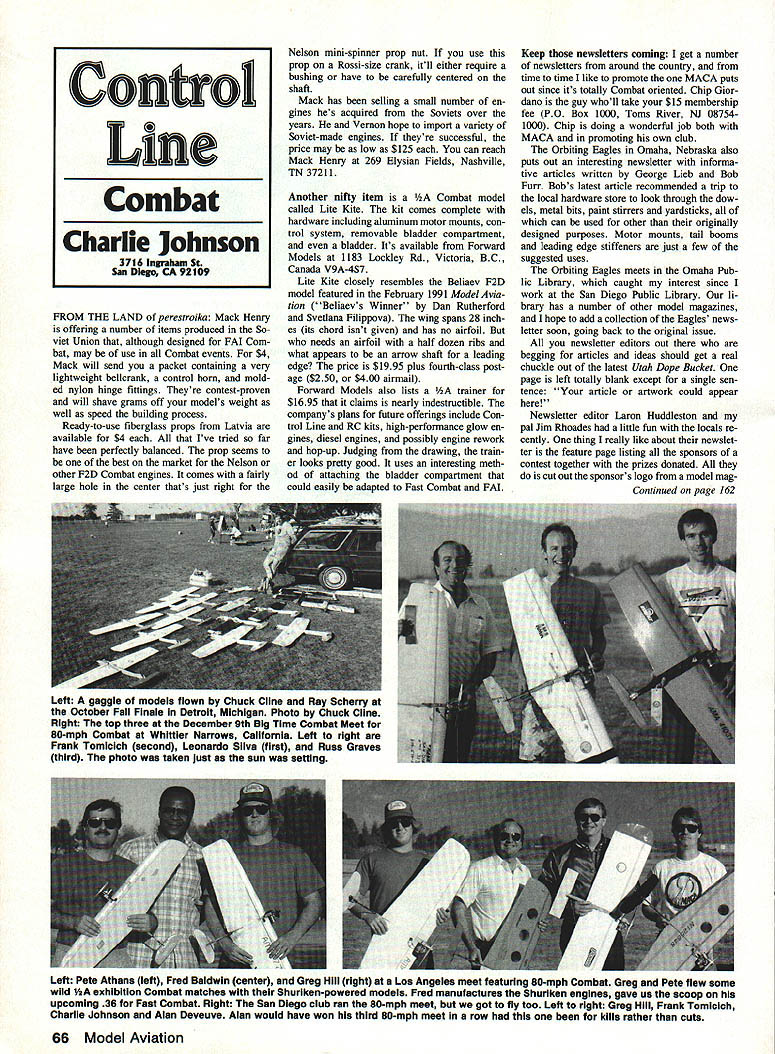
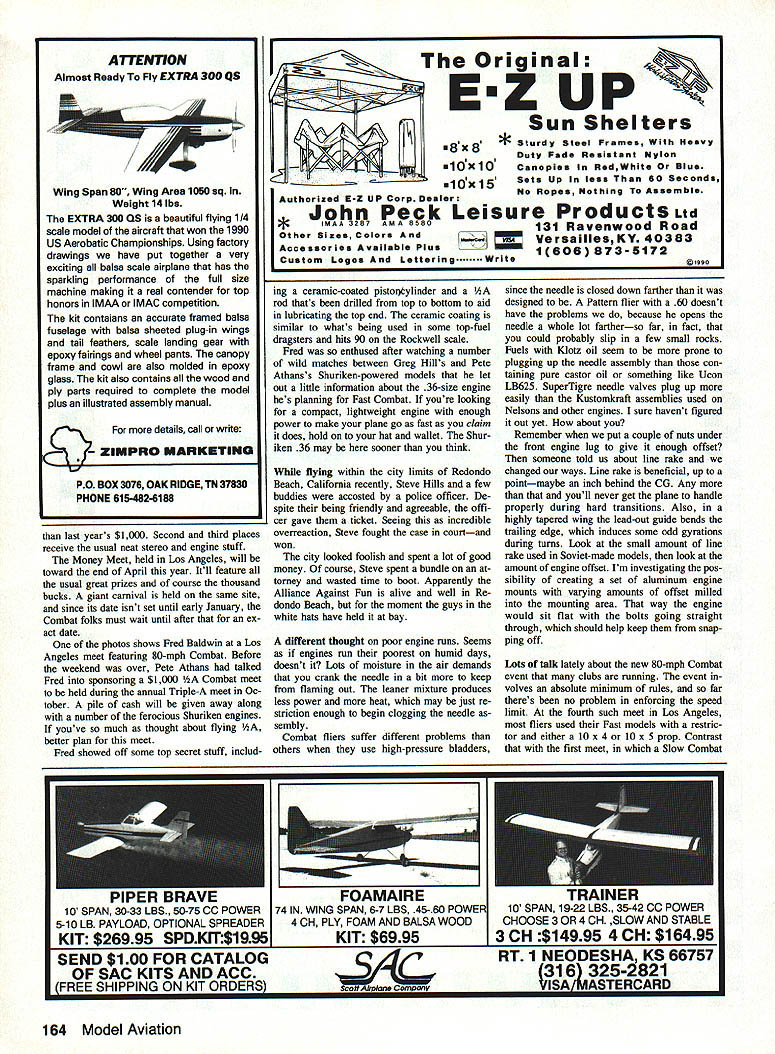
- Los Angeles 80-mph meets: one photo shows Fred Baldwin at a meet featuring 80-mph Combat. Pete Athans convinced Fred to sponsor a $1,000 1/2A Combat meet during the annual Triple-A meet in October. Several Shuriken engines will be given away.
Engine Developments
Fred Baldwin showed off some top-secret items:
- A ceramic-coated piston/cylinder similar to coatings used in top-fuel dragsters (about 90 on the Rockwell scale).
- A 1/4A rod drilled through to help lubricate the top end.
Fred also hinted at a .36-size Shuriken engine planned for Fast Combat — a compact, lightweight engine that could deliver significant power.
Legal Incident: Flying in Redondo Beach
While flying within the city limits of Redondo Beach, Steve Hills and friends were ticketed by a police officer despite being friendly and cooperative. Steve fought the ticket in court and won. The city looked foolish and spent money; Steve spent on an attorney and time, but for the moment the enforcement was checked.
Engine and Fuel Notes
- Engines often run poorest on humid days. Increased moisture usually requires tightening the needle to avoid flame-outs; the resulting leaner mixture produces less power and more heat, which may lead to needle-assembly clogging.
- Combat pilots using high-pressure bladders close the needle further than intended, increasing clog risk. Pattern fliers with large engines open the needle much more and don’t see the same problems.
- Observations on oils and needles:
- Klotz oil seems to be more prone to plugging the needle assembly than pure castor or mineral oils such as Unocal 76 or LB62S.
- Super Tigre needle valves tend to clog more easily than Kustomcraft assemblies used on Nelsons and some other engines.
- I haven’t fully figured out the causes yet — feedback welcome.
Airframe and Handling Tips
- Engine offset: we used to add nuts on the front engine lug to create offset, then switched to lock washers. The nut trick works only up to a point — maybe an inch behind the CG; beyond that you’ll have poor handling during hard transitions.
- Highly tapered wings (as used on some lead-out guides) can bend the trailing edge and cause odd gyrations during turns.
- Note the small amount of incidence used in Soviet-made models versus their engine offset. I’m looking into aluminum engine mounts with varying offsets milled into the mounting area so the engine sits flat and bolts go straight through, which should reduce bolt breakage.
80-mph Combat (event notes and observations)
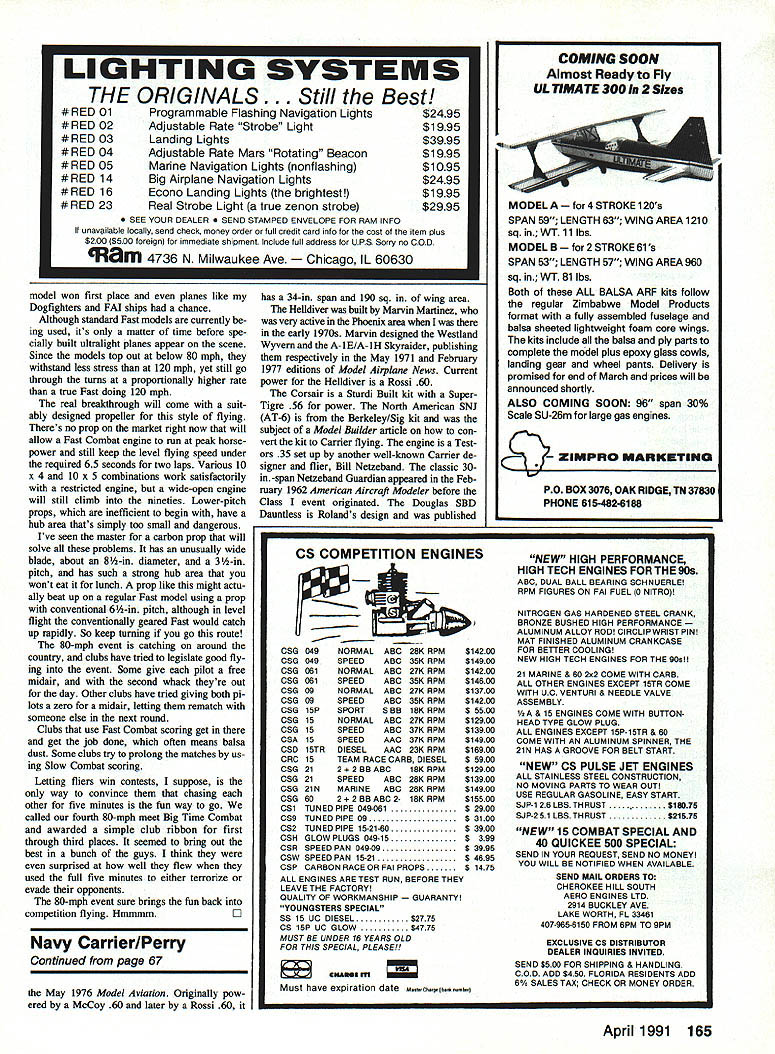
- The 80-mph event has minimal rules and has been enforceable so far. Many fliers use their Fast models with prop restrictions (thicker 1/4 or 10x5 props).
- Contrast: at the first meet a Slow Combat model won first place and even Dogfighters and FAI ships had a chance. At later meets, standard Fast models are often used, but it’s only a matter of time before ultralight, specially built planes appear.
- Performance notes:
- Models topping out below 80 mph experience less stress than at 120 mph but still turn at a relatively high rate.
- The key limiting factor is prop design: no current prop perfectly allows a Fast Combat engine to run at peak power while keeping two laps under the required 6.5 seconds. 10x4 and 10x5 combos work with restricted engines, but wide-open engines still climb into the 90s. Some low-prop hubs have too-small hub areas and are dangerous.
- A potential solution: a carbon prop master I’ve seen has unusually wide blades, about 8.5 in diameter and a 3.5 in pitch, with a very strong hub. A prop like this should allow restricted-level speed while keeping power manageable; it might even outperform conventional props in some situations.
- Scoring and club practices:
- Some clubs give each pilot a refly; if a pilot gets a second refly they’re out for the day.
- Others give both pilots a zero for a midair and rematch them with different opponents in the next round.
- Clubs using Fast Combat scoring tend to produce decisive, balsa-dust-filled matches; some clubs use Slow Combat scoring to prolong matches.
- Anecdote: our fourth 80-mph meet, called Big Time Combat, awarded simple club ribbons for first through third. Letting pilots use the full five minutes produced surprisingly good flying and lots of fun.
Keep those newsletters coming — there’s a lot of good stuff out there for Combat fliers.
Transcribed from original scans by AI. Minor OCR errors may remain.

