

Control Line: Combat
Charlie Johnson
3716 Ingraham St. San Diego, CA 92109
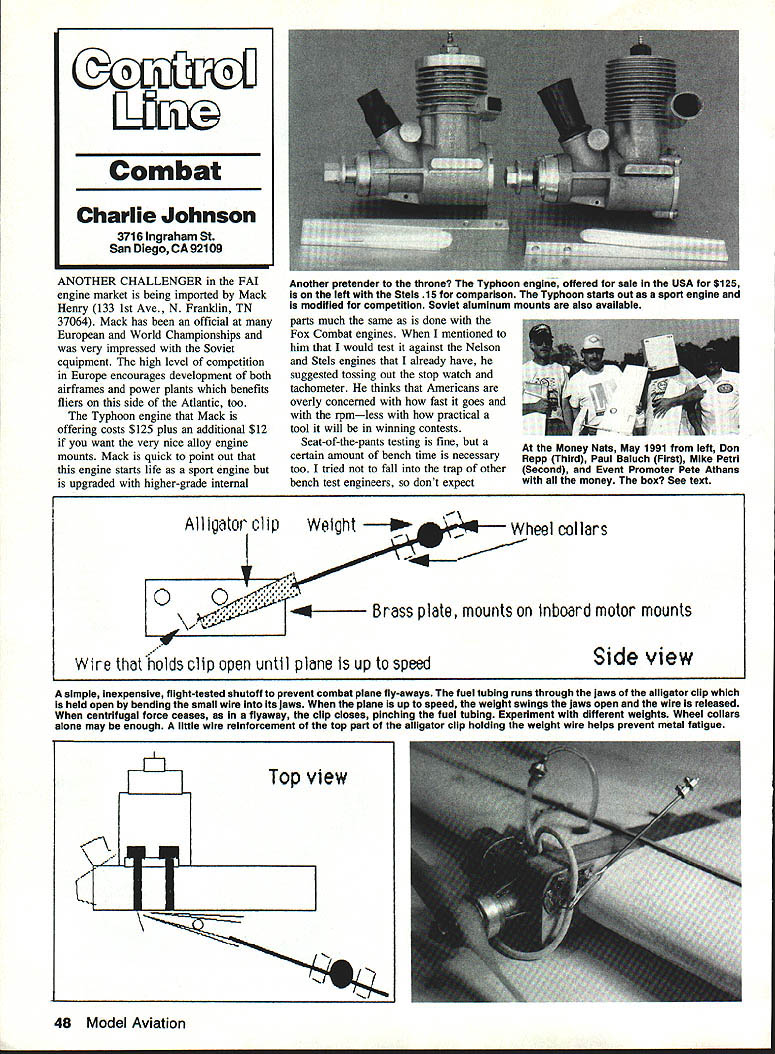
ANOTHER CHALLENGER in the FAI engine market is being imported by Mack Henry (133 1st Ave., N. Franklin, TN 37064). Mack has been an official at many European and World Championships and was very impressed with the Soviet equipment. The high level of competition in Europe encourages development of both airframes and power plants, which benefits fliers on this side of the Atlantic, too.
The Typhoon engine that Mack is offering costs $125 plus an additional $12 if you want the very nice alloy engine mounts. Mack is quick to point out that this engine starts life as a sport engine but is upgraded with higher-grade internal parts much the same as is done with Fox Combat engines.
When I mentioned to him that I would test it against the Nelson and Stels engines that I already have, he suggested tossing out the stopwatch and tachometer. He thinks that Americans are overly concerned with how fast it goes and with the rpm — less with how practical a tool it will be in winning contests.
Testing approach
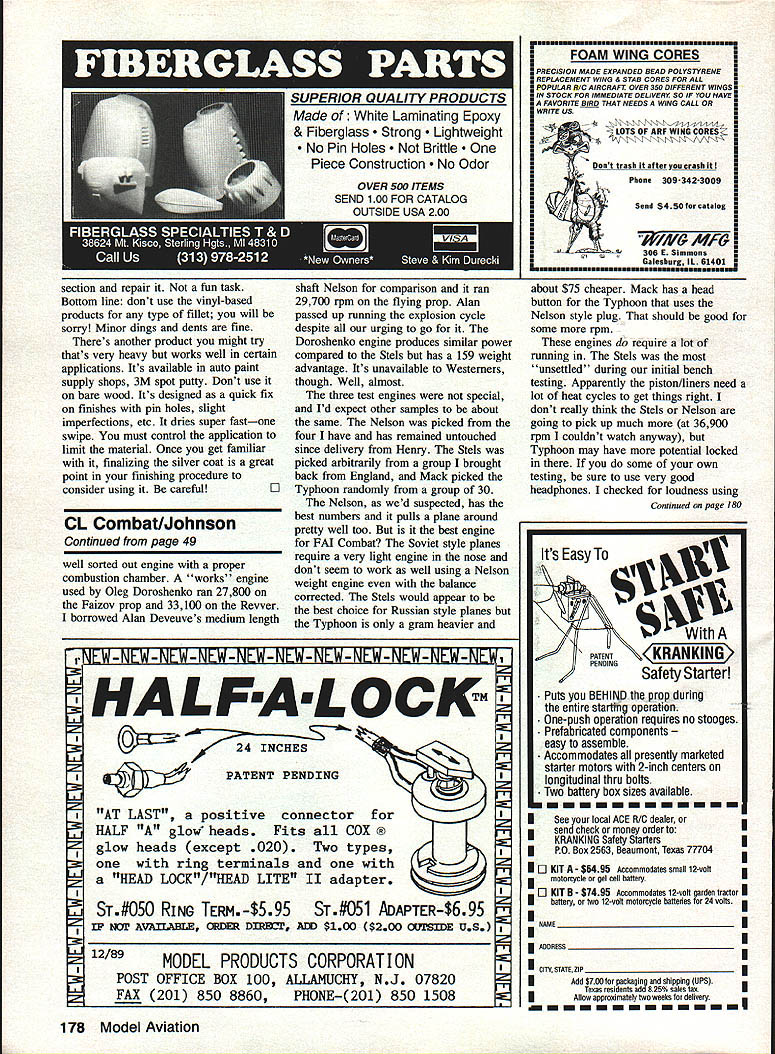
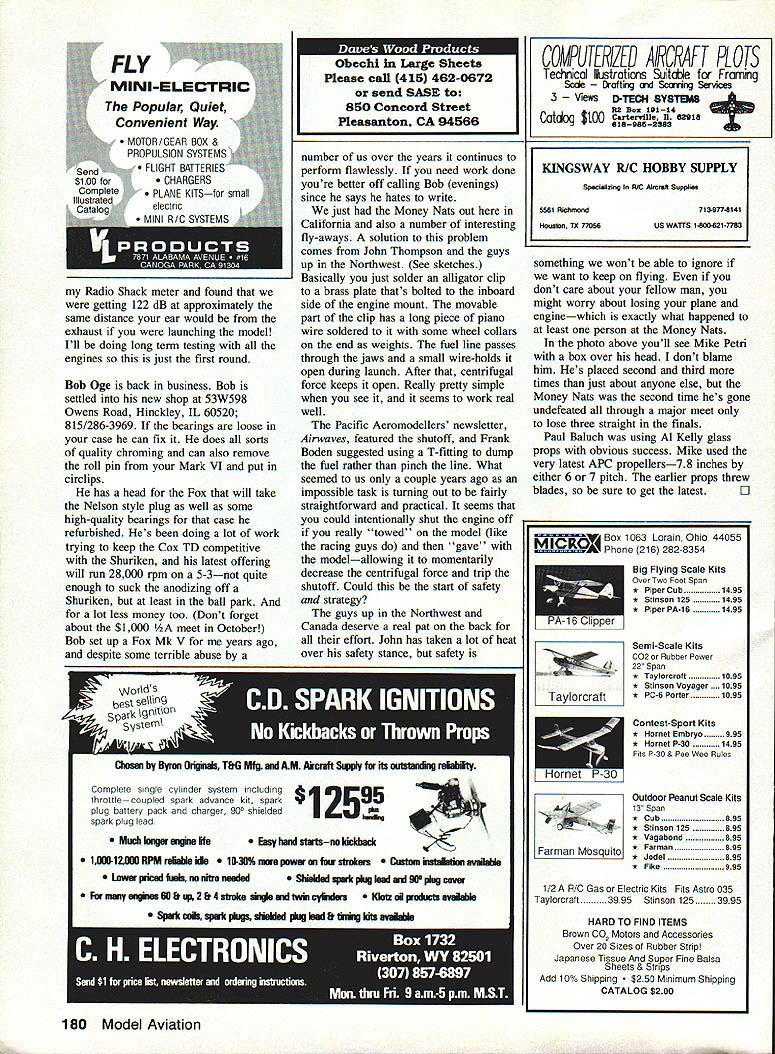
Seat-of-the-pants testing is fine, but a certain amount of bench time is necessary too. I tried not to fall into the trap of other bench-test engineers, so don't expect simple, inexpensive, flight-tested shutoffs to prevent a combat plane flyaway. A length of fuel tubing runs through the jaws of an alligator clip held open by bending a small wire in its jaws. As the plane comes up to speed the weight swings the jaws open; when the wire is released centrifugal force ceases and the flyaway clip closes, pinching the fuel tubing. Experiment with different weights. Wheel collars alone may be enough; a little wire reinforcement on the top part of the alligator clip holding the weight wire helps prevent metal fatigue.
Because of the large difference in weight and physical size of the engines it wasn't possible to test all the engines on one plane, but all the planes used were good ones and should enhance the performance of the engine.
Engines, pricing and availability
- Typhoon: $125 direct from Mack Henry. Alloy engine mounts available for an extra $12. Mack also offers a head button for the Typhoon that uses the Nelson-style plug.
- Stels: £99 (pounds sterling) or about $200 depending on the dollar-to-pound rate.
- Nelson: Varies from $180 to around $250 depending on titanium, magnesium, etc., and the configuration. A magnesium-case Nelson would be slightly lighter than a Stels ABC and would be slightly heavier than the Typhoon.
Suppliers:
- Stels engines: Engines From Russia, 12 Heathland Terrace, Shaw Heath, Stockport, Cheshire SK3 8DU.
- Nelson engines: RD 2, Box 233, Ramsey Rd., Zelienople, PA 16063.
- Faizov prop and other items: available from Mack Henry.
A number of props were used during testing, though only legal FAI fuel was used and no effort was made to tune the engines by shimming liners or such. Even though we have rpm readings on a number of props I believe the two results reported are representative of what was going on. The Faizov prop is designed for calm-wind conditions and is available from Mack Henry for $5.00 ready to go, so you should be able to duplicate these results fairly accurately.
Propellers and rpm notes
- The Revver started life as a Beliaev prop (sold by Dan Rutherford). This sample had the tips pretty beat up, so we clipped off about one inch per side, which puts very little load on the engine.
- We tried a Taipan 7-4 for a "load" prop but the Typhoon will not pull much prop and even when it was cut to 44 inches it kept it out of its ideal rev range.
- A 161 g Rossi Mk II was also run with the flying prop and turned 28,300 rpm with a legal venturi.
- A well-sorted "works" engine used by Oleg Doroshenko ran 27,800 rpm on the Faizov prop and 33,100 rpm on the Revver.
I borrowed Alan Deveuve's medium-length-shaft Nelson for comparison and it ran 29,700 rpm on the flying prop. Alan passed up running the explosion cycle despite all our urging to go for it. The Doroshenko engine produces similar power compared to the Stels but has a 159 g weight advantage. It's unavailable to Westerners, though—well, almost.
The three test engines were not special, and I'd expect other samples to be about the same. The Nelson was picked from the four I have and had remained untouched since delivery from Henry. The Stels was picked arbitrarily from a group I brought back from England, and Mack picked the Typhoon randomly from a group of 30.
The Nelson, as we'd suspected, has the best numbers and it pulls a plane around pretty well too. But is it the best engine for FAI Combat? The Soviet-style planes require a very light engine in the nose and don't seem to work as well using a Nelson-weight engine even with the balance corrected. The Stels would appear to be the best choice for Russian-style planes but the Typhoon is only a gram heavier and about $75 cheaper. Mack has a head button for the Typhoon that uses the Nelson-style plug. That should be good for some more rpm.
Running-in, noise and long-term testing
These engines do require a lot of running in. The Stels was the most "unsettled" during our initial bench testing. Apparently the piston/rings need a lot of heat cycles to get things right. I don't really think the Stels or Nelson are going to pick up much more (at 36,900 rpm I couldn't watch anyway), but the Typhoon may have more potential locked in there.
If you do some of your own testing, be sure to use very good headphones. I checked for loudness using headphones and my Radio Shack meter and found that we were getting 122 dB at approximately the same distance your ear would be from the exhaust if you were launching the model! We'll be doing long-term testing with all the engines, so this is just the first round.
Service and parts — Bob Oge
Bob Oge is back in business. Bob is settled into his new shop at 53W598 Owens Road, Hinckley, IL 60520; 815/286-3969. If the bearings are loose in your case he can fix it. He does all sorts of quality chroming and can also remove the roll pin from your Mark VI and put in circlips.
He has a head for the Fox that will take the Nelson-style plug as well as some high-quality bearings for that case he refurbished. He's been doing a lot of work trying to keep the Cox TD competitive with the Shuriken, and his latest offering will run 28,000 rpm on a .5–.3 — not quite enough to suck the anodizing off a Shuriken, but at least in the ballpark. And for a lot less money too. (Don't forget about the $1,000 V 2-A meet in October!) Bob set up a Fox Mk V for me years ago, and despite some terrible abuse by a number of us over the years it continues to perform flawlessly. If you need work done you're better off calling Bob (evenings) since he says he hates to write.
Flyaway shutoff improvements and safety
We just had the Money Nats out here in California and also a number of interesting fly-aways. A solution to this problem comes from John Thompson and the guys up in the Northwest. Basically you just solder an alligator clip to a brass plate that's bolted to the inboard side of the engine mount. The movable part of the clip has a long piece of piano wire soldered to it with some wheel collars on the ends as weights. The fuel line passes through the jaws and a small wire holds it open during launch. After that, centrifugal force keeps it open. Really pretty simple when you see it, and it seems to work real well.
The Pacific Aeromodellers' newsletter, Airwaves, featured the shutoff, and Frank Boden suggested using a T-fitting to dump the fuel rather than pinch the line. What seemed to us only a couple years ago as an impossible task is turning out to be fairly straightforward and practical. It seems that you could intentionally shut the engine off if you really "towed" on the model (like the racing guys do) and then "gave" the model — allowing it to momentarily decrease the centrifugal force and trip the shutoff. Could this be the start of safety and strategy?
The guys up in the Northwest and Canada deserve a real pat on the back for all their effort. John has taken a lot of heat over his safety stance, but safety is something we won't be able to ignore if we want to keep on flying. Even if you don't care about your fellow man, you might worry about losing your plane and engine — which is exactly what happened to at least one person at the Money Nats.
In the photo in the original article you'll see Mike Petri with a box over his head. I don't blame him. He's placed second and third more times than just about anyone else, but the Money Nats was the second time he's gone undefeated all through a major meet only to lose three straight in the finals.
Paul Baluch was using Al Kelly glass props with obvious success. Mike used the very latest APC propellers — 7–8 inches by either 6 or 7 pitch. The earlier props throw blades, so be sure to get the latest.
Transcribed from original scans by AI. Minor OCR errors may remain.

