
Control Line: Combat
Charlie Johnson
AFTER READING European accounts of our style of combat it becomes rather apparent that they think their brand of combat is far superior to our two AMA varieties. AMA Combat is portrayed as one mid-air, line-tangle or head-on pass after another. The first guy up bellcranks his opponent to win on air time and just look at all the broken models and destroyed engines (they love to see pictures of the debris). We all know this sort of thing happens all too frequently but when we take a close look at the alternative, FAI combat, things are not all so rosy.
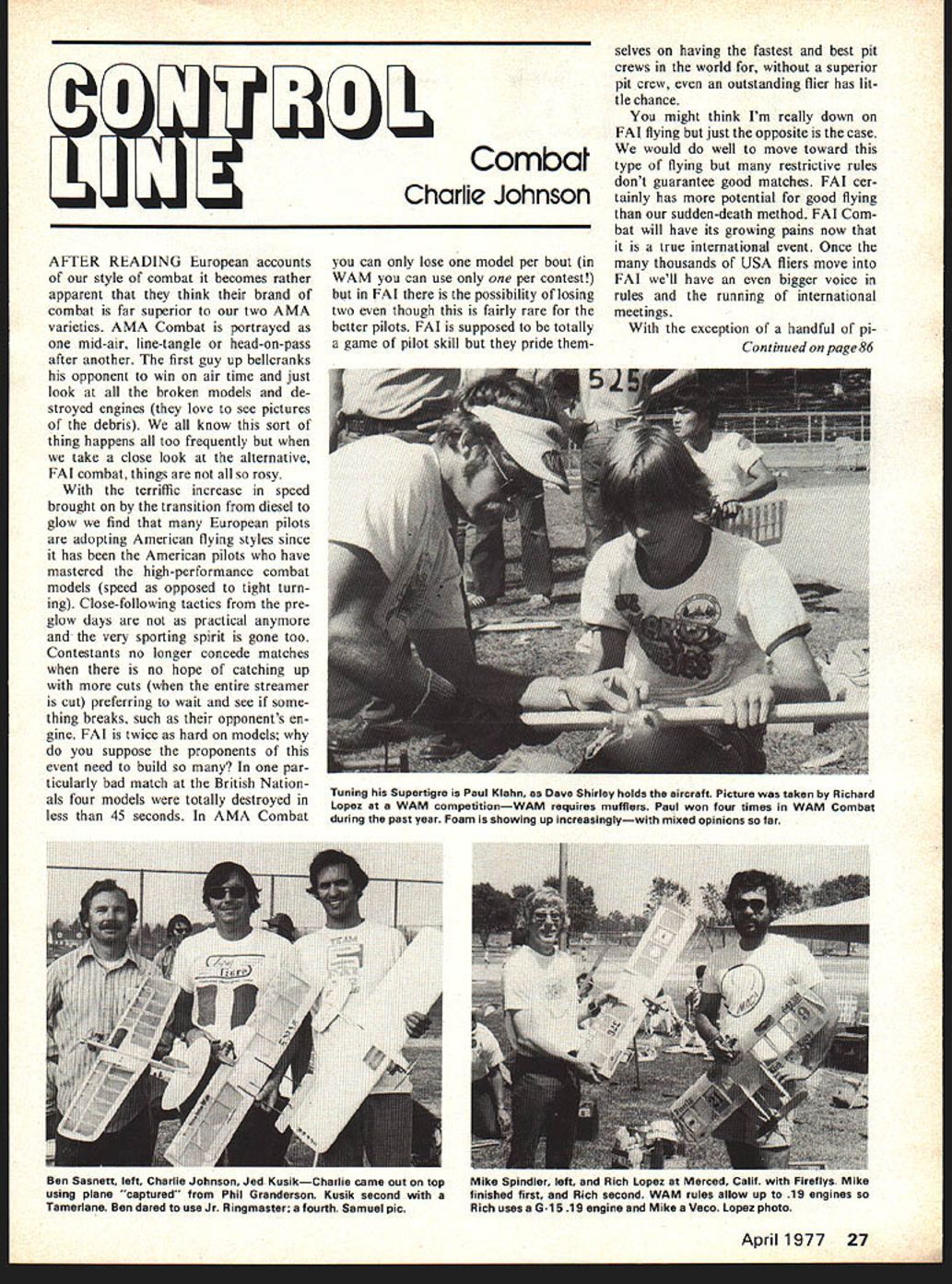
With the terrific increase in speed brought on by the transition from diesel to glow we find that many European pilots are adopting American flying styles since it has been the American pilots who have mastered the high-performance combat models (speed as opposed to tight turning). Close-following tactics from the pre-glow days are not as practical anymore and the very sporting spirit is gone too. Contestants no longer concede matches when there is no hope of catching up with more cuts (when the entire streamer is cut) preferring to wait and see if something breaks, such as their opponent's engine. FAI is twice as hard on models; why do you suppose the proponents of this event need to build so many? In one particularly bad match at the British Nationals four models were totally destroyed in less than 45 seconds. In AMA Combat you can only lose one model per bout (in WAM you can use only one per contest!) but in FAI there is the possibility of losing two even though this is fairly rare for the better pilots. FAI is supposed to be totally a game of pilot skill but they pride themselves on having the fastest and best pit crews in the world for, without a superior pit crew, even an outstanding flier has little chance.
You might think I'm really down on FAI flying but just the opposite is the case. We would do well to move toward this type of flying but many restrictive rules don't guarantee good matches. FAI certainly has more potential for good flying than our sudden-death method. FAI Combat will have its growing pains now that it is a true international event. Once the many thousands of USA fliers move into FAI we'll have an even bigger voice in rules and the running of international meetings.
With the exception of a handful of pilots
CL Combat/Johnson
lots in the USA, the rest don't have the remotest idea about FAI Combat, so how do we get any practice and develop skills? AMA Slow Combat is a good starting place if flown FAI style. Eliminate the kill entirely and only count paper cuts. If 100 points is given for cutting the string, we are right back where we started with everyone having to get in real close to get the last bit. Our last two contests have been flown this way; you'll find you have to turn away from a guaranteed cut because too much streamer will be taken off. Five minutes of combat is an awfully long and enjoyable time so why not spend it in the air and forget the quick kill. It's attitude and not equipment that makes good matches. Gentlemen flying T-Squares will put on a better match than rascals flying the latest Fast Combat creation.
During the Condor Legion contest in San Francisco one pilot had his plane fly out into the Bay! Two weeks later at the Special Pro meet the infamous Rich Brasher and yours truly were flying when Rich's plane went into orbit. Over 20 minutes on the clock when the model landed unhurt about 100 yards from the launch site. By the way, AMA Junior member Russell Hester won the meet, beating Brasher in the final, his latest triumph after winning his club's annual double elimination combat meet last September. The Hesters have had two spectacular fires lately, the most recent at the Early Bird Contest in Poway, Calif. where it looked like the Chinese set off another 10-megaton bomb.
Fox Combat Special: The 1976 version has become the universal choice of both Fast and Slow Combat fliers who want some extra zip in their planes. Nothing really needs to be done if the engine is intended for Slow Combat, but if it is going in a Fast ship it might be a good idea to replace the rear bearing with a more precision unit. The only bearing I could find that was superior to the one in the engine and the too expensive Class VII was the FAG SR8K1. If you have trouble finding these bearings on your own you may take the easy way out and send $6.00 to Hoffelt Group Aerosport Division, 1021 Sapphire St., San Diego, California 92109.
The bearing you'll receive is quite a bit better than what you're replacing but you will need to "fit it" to the crankshaft. Put several layers of masking tape on the threaded portion of the crank, stick this end in a drill and polish with some emery paper and oil. Make sure you don't take off too much and the bearing fit is just a nice push fit. Don't tell your machinist friends about your technique either. Most of the broken cranks (like mine) have gone at the counterweight and I figure this might help, although nothing is guaranteed. Be sure to check the head clearance on any new engine including the Fox. The tightest of my four Foxes was .004 and the loosest was .016. I prefer the looser fit. Head clearance isn't the whole story since the combustion chamber volumes vary too. Find a good running motor that doesn't blow plugs and see how many drops of light machine oil it takes to fill up the chamber to the first plug thread (with engine at TDC).
Slow Combat and the Inboard Tank:
The next set of rules may ban the inboard tank but for now it is very much a part of Slow Combat. Motors are sliding farther aft and bodies are becoming more like monoboons. As simple as tanks are it is often the hardest problem to solve especially when mounted inboard of the engine and the plane maneuvered violently. The most common problem is having the engine go over-rich after launch. It is possible to "fool the engine" by running the pickup tube out the extreme inboard side of the tank. The engine still has to suck the fuel uphill against centrifugal force and the small amount of fuel in the line doesn't seem to present any siphoning problem. Stand your model on its right wing tip and you'll get an idea of where the fuel is going during flight.
The wide flat tanks as used in stunts seem to work better than the tall narrow profile tanks. In either case the pickup tube should be in the outboard rear corner with the uniflow vent slightly inside and about 1/8 in. in front (both exit from the extreme inboard side). An overflow vent may be used to simplify fueling and it should be located in the top left corner where the sealing plug will be easy to remove. Uniflow tanks have to be airtight so be sure to pressure check yours before use. Hint: When running the engine on the ground seal off the uniflow vent with your finger, if the engine doesn't lean and die then you have a leak someplace. Brass sheet may be soldered to the tank and these feet attached to the engine mounting bolts where they come through the body. One engine/fuel tank package can be transferred to another plane very easily. One last note, if you have been running the plane with a conventional tank set-up and move it inboard you will probably have to add more wing-tip weight. It took another half ounce to properly trim my model. If you don't add the weight your model may visit you out in the center circle.
Looks like the FAI Trials will be in St. Louis over the July 4th holidays. The selection process will pick the three best pilots and alternates but not necessarily the best team. Team members not only will have to fly well but will have to pit for their fellow competitors. Good pilots aren't necessarily good pitmen nor will the team be entirely compatible. (AMA HQ note: It hasn't yet been determined whether the U.S. Combat Team will consist only of three pilots or three pilots plus three pitmen.)
Rules interpretations: Remembering what you just read about the fire, would you consider a plane flyable if the outboard wing was burned off? The rest of the plane was sound and safe to fly. What do you think about a person being disqualified because his engine blew up and the crank and prop left the airplane? This happened at a recent combat meet. The rules say that you lose if a part of your airplane falls off "not the result of a collision." I always thought that breaking cranks was kind of an act of God and rather poor misfortune for the pilot.
Charlie Johnson, 3716 Ingraham St., San Diego, CA 92109; (714) 273-6530.
Transcribed from original scans by AI. Minor OCR errors may remain.

