
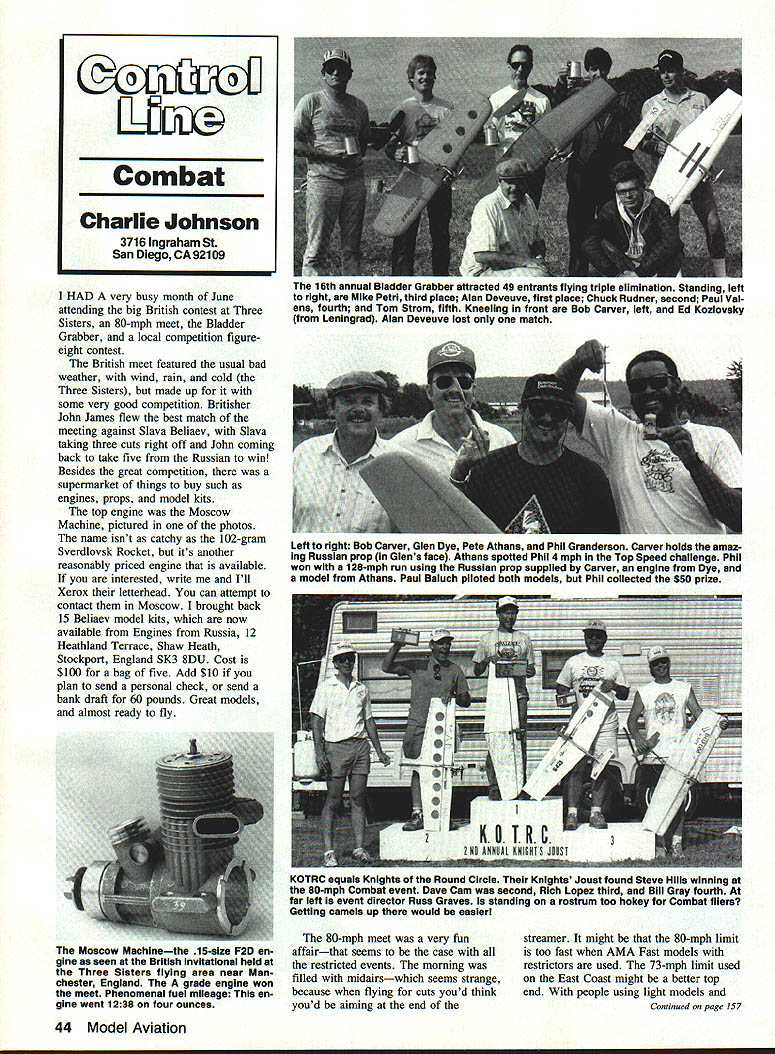



Control Line: Combat
By Charlie Johnson
3716 Ingraham St., San Diego, CA 92109
Events and reports
I had a very busy month of June attending the big British contest at Three Sisters, an 80-mph meet, the Bladder Grabber, and a local figure-eight contest.
The British meet featured the usual bad weather at Three Sisters—wind, rain, and cold—but it made up for that with very good competition. Britisher John James flew the best match of the meeting against Slava Beliaev: Slava took three cuts early and John came back to take five from the Russian to win. Besides great competition, there was a supermarket of things to buy—engines, props, and model kits.
I brought back 15 Beliaev model kits, now available from Engines from Russia:
- Engines from Russia, 12 Heathland Terrace, Shaw Heath, Stockport, England SK3 8DU.
- Cost: $100 for a bag of five. Add $10 if you plan to send a personal check, or send a bank draft for 60 pounds.
The 80-mph meet was a very fun affair—restricted events tend to be. The morning was filled with midairs, which seems strange because when flying for cuts you’d think fliers would aim at the end of the streamer. It might be that the 80-mph limit is too fast when AMA Fast models with restrictors are used; the 73-mph limit used on the East Coast might be a better top end.
A quick survey of the pits at the Bladder Grabber showed the Arrowplane to be the most plentiful design, but there were many other potent models. Alan Deveuve’s winning model had a wing somewhat like an Arrowplane but with Maverick metal mounts and external controls. The engine is set far enough forward that you can hold the engine and still trim the model. Alan’s model entered at about the 115-mph angle in the semifinal and did the same in the final with only slight wrinkling of the leading-edge covering. The use of Kevlar and carbon has made these airplanes nearly indestructible except in model-to-model contact; Alan didn’t lose any models during 12 rounds. Both Bob Carver and Ed Kozlowski used some of Ed’s FAI models converted to Fast Combat with good success.
Pete Athans is generally acknowledged to have some of the fastest Fox setups in competition, thanks to his connections with Mike Wisniewski developing AAC setups and special Australian crankshafts that require extensive crankcase rework. Pete was baited by Phil Granderson into a Top Speed challenge at the Bladder Grabber. Phil used a fiberglass Russian prop supplied by Bob Carver that sounded slow on the ground but ran like a rocket in the air—about 128 mph. Pete was a couple of mph behind and couldn’t close the gap; Phil won the $50 bet.
Gary Perkins sent a full contest report from the Tucson Top Gun Invitational last February. Most of the top finishers also did well at the Bladder Grabber. Alan Deveuve earned $1,000 (and a stereo system) for first place; Steve Hills was second, Chuck Rudner third, and Greg Hill fourth. Alan had a 10–1 record to take the meet.
One thing Gary points out is that the West Coast contingent seems to be in a period of domination that carried into the Money Nats and the Bladder Grabber. The biggest difference now is that West Coast fliers are flying a lot more practice Combat. The Texans’ past dominance came from the huge number of matches they flew; practice counts.
Safety innovation: engine fuel shutoffs
The Bladder Grabber turnout and the new fuel shutoff systems are encouraging. My last column included sketches of a fuel shutoff used by John Thompson and others during the Northwest Regionals. Norm McFadden came up with his own very simple, light, and easy-to-make system that dumps the fuel if the plane loses centrifugal force (as in a cutaway or when flying across the circle). Norm’s system bolts to the engine lug, weighs only a few grams, and can be made quickly. I hope a commercial copy will be on the market soon.
Engine wrist restraints have made Combat safer, but this cutoff system is a major step and may save many contests from liability worries that could otherwise shut Combat down. I had a new model and engine cut away during a match; it flew off into the clouds and was never seen again. I was glad it flew away rather than coming down under power. When people gripe that they’ll quit Combat if some safety items are required, I can only hope they quit before they do real damage to the sport.
Money Nats and Top Speed Challenge
Our club was so encouraged by Bladder Grabber turnout and the fuel shutoff systems that we will run the Money Nats next year on May 2–3. It will be the usual triple-elimination tournament with at least a few foreign entrants. Slava Beliaev, World Champion and long-time Soviet number one, got a warm reception at Three Sisters. A thousand-dollar prize was suggested to entice him to use his own designs and possibly a Soviet Fast Combat engine.
The meet will also feature the Hoffelt Group Top Speed Challenge with a $200 prize for top speed for Combat planes. The record from a few years ago is 129+ mph, so the challenge will be tough; I know several people who intend to make a run for it. Expect to hear a lot about Fast Combat in the coming months.
Leading-edge strength and model durability
It was pointed out how strong some leading edges were following the Carver vs. Hill match—the string was unable to rip through the leading edge. Carver actually had about five kills on the leading edge, but the horizontal reinforcing spar kept it from snagging off. The importance of the “leading-edge kill” is now well understood.
Engines: notes and observations
The top engine at the meet was the Moscow Machine (pictured in the original column). The name isn’t as catchy as the 102-gram Sverdlovsk Rocket, but it’s another reasonably priced engine available from the Soviets.
Moscow Machine highlights:
- Two ball bearings
- ABC construction
- Screw-in backplate
- Distinctive twin exhaust
As they come from the factory the exhaust stacks are much longer; I had mine milled down. We’ve had excellent results so far—over two hours of flying time in two days—and phenomenal fuel mileage, with standard runs of over twelve minutes on four ounces. Engines that are capable of hot restarts seem to be the best. The twin exhaust is handy for priming: shoot fuel down one stack with the piston up and excess drains out the bottom.
The manufacturer sells engines in various grades, with the fastest (A) engines at a premium. Since factories have top fliers using their engines, chances are the very fastest engines will be used by those fliers and B-grade engines sold to Western customers. A good Nelson-style insert can often bring power back up to the same level.
Some specific engine notes:
- The Typhoon engine ran behind the Steils and the Nelson in my tests. Mack Henry installed a special head insert that accepts the Nelson plug, which netted a 1,600 rpm increase and put it back in contention.
- We tried an insert made by Bob Fogg (Shahan/Fogg racing team) on a Doroshchenko engine; it added several hundred rpm even though it had been fitted to a different engine. For maximum power each engine should have its own correctly fitted insert; if not fitted properly, power will fade.
- The Russian copy of the Rossi plug isn’t particularly good. If possible, order engines with a Nelson-style insert or one designed for screw-in plugs.
- Production engines can’t be expected to perform like “works” specials. The Doroshchenko specials are lighter and have a small performance edge. The newest Sverdlovsk Rocket is lighter than most but hasn’t yet shown a clear performance advantage.
I have a limited number of these engines that I brought back, but I’ll leave dealerships to Mack Henry and Dave Clarkson. If you need someone’s address, write me and I’ll Xerox his letterhead.
Final notes
The sport is changing—better models, more practice, and safety innovations are pushing Combat forward. I’m optimistic that with these advances (engine inserts, hot-restart-capable engines, edge reinforcements, wrist restraints, and fuel shutoffs) the contests will stay exciting and viable for years to come.
Transcribed from original scans by AI. Minor OCR errors may remain.

