
Control Line: Combat
Charlie Johnson 3716 Ingraham St. San Diego, CA 92109
Tools and Finishing Tips
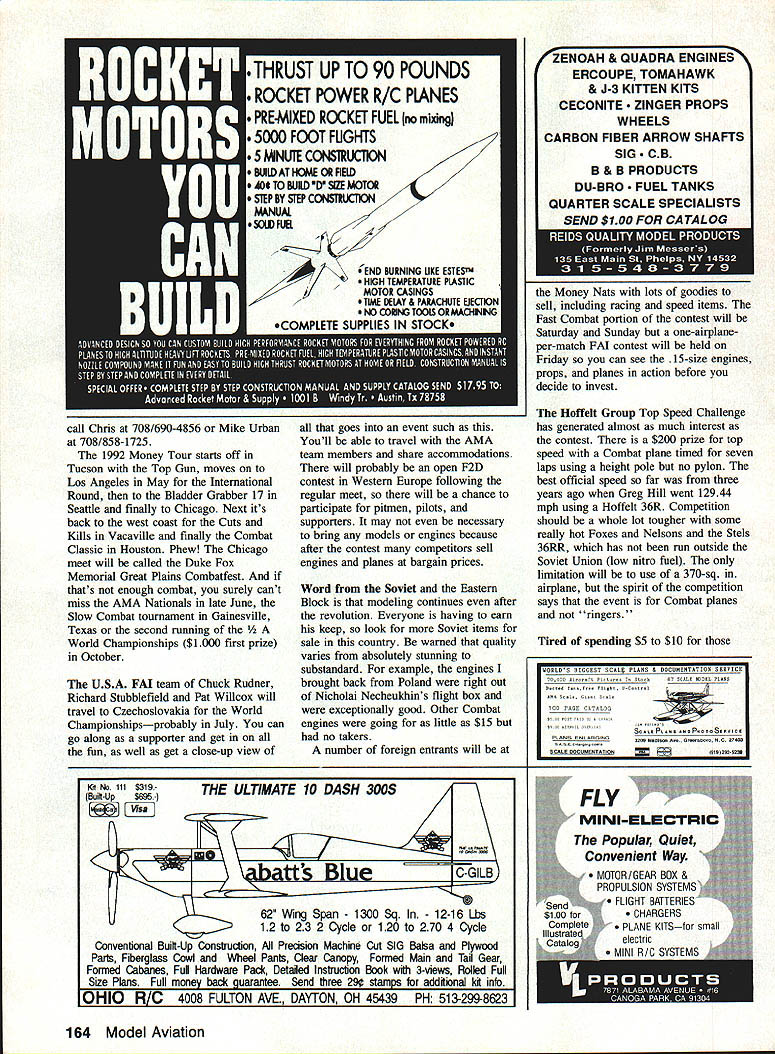
Not just for combat: one photo this month features a rather confusing array of items available through Art Gross, 12516 Maplewood Ave., Edmonds, WA 98026; Tel. 206/743-9332. The hand belt sander combines the practical use of a sanding block with a continuous belt so you can use all 54 square inches of the paper. An easy-to-use locking device allows quick removal and replacement of the proper type and grit so you won't have ten different blocks lying around. By spraying some silicone on the paper you can keep it from loading up, and thanks to the ability to unlock and rotate the paper, the residue just falls off when it goes around the corner. Art demonstrated this technique at the Bladder Grabber, and when you get your sander you'll find out it works just as well.
In the photo you'll see the sander on the bottom with a pack of replacement belts from Wedge Lock. You'll also notice some strange tubes on top of the sander. These are called Drop-Ets and are dispensers for cyanoacrylate (CA) glue. Yeah, I know you only buy the one-use size of this glue, but what if you want to save some money and buy the big bottles? You could be like me, pour some into little bottles and end up with half in the bottle and half on the carpet, but this provides a better way.
To use a Drop-Et you squeeze out all the air and then place the long tube into the CA, allowing vacuum to draw glue up into the bulb. Art warns that when using the Drop-Ets you must not let the tip touch your work or you'll contaminate the glue and make it set up in the tip. Moisture and contamination will make the glue set up pronto. When storing the bulbs, you should keep them vertical and lightly squeeze the bulb so the tip stays clear; squeeze a couple of times to clean out any CA left in the tube.
Your local hobby shop may already have the Drop-Ets for sale; if they don't, have them contact Dave Brown Products at 513/738-1576; they'll be distributing the Drop-Ets. If you just can't wait to get your hands on some of these, call Art Gross or send $5.00 for five of the Drop-Ets.
The special finishing tool kit includes the belt sander with an 80-grit belt and four resinoid-bonded belts (coarse, medium, fine, extra fine). The kit is priced at $25 plus postage direct, but you can get a $5 discount if you have a coupon or mention you saw the write-up in Model Aviation.
Be careful as you apply the final coats of color and clear; you don't want to soften the paint. Consider using a spot-repair thinner for these coats. Also, when you've finished building up the paint, let it age before you wet sand and buff. The tendency will be for the repair to shrink as it ages, so the longer you wait, the better. As you get to the color stage, start thinking about using some ink to hide the repair. An additional line access panel, and perhaps some tastefully done rivets, can help the repair blend in.
GRW
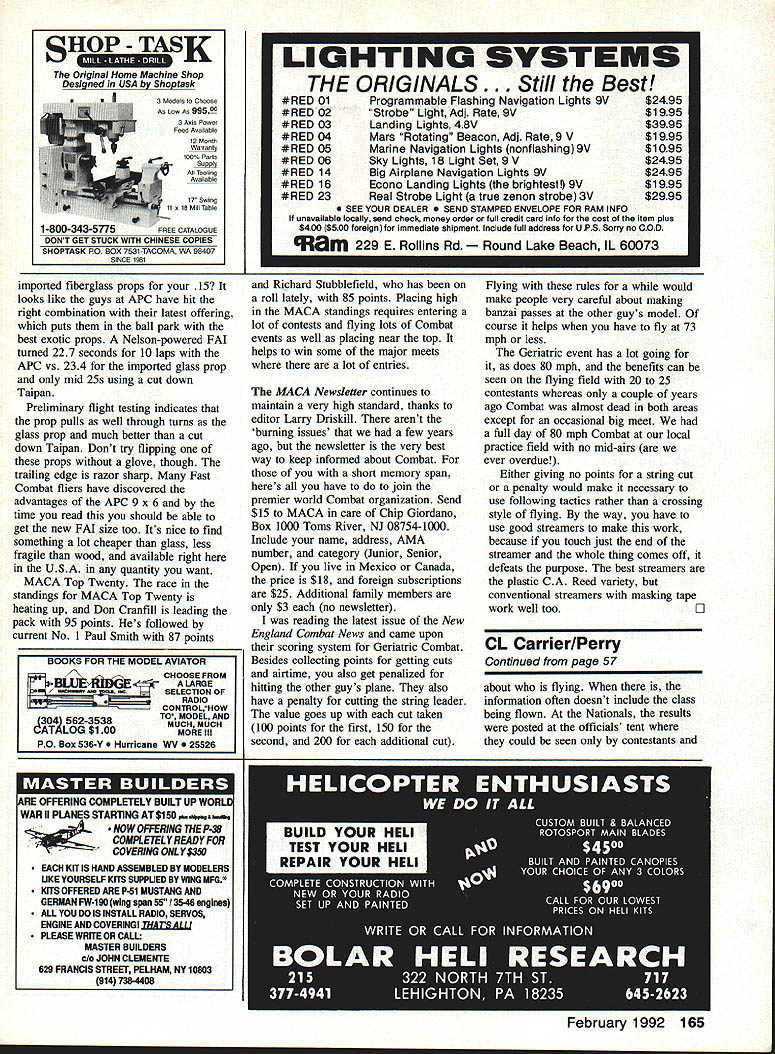
Let me steer you in the direction of another fine company called GRW, P.O. Box 1011, White Oak, TX 75693 (Glen Wells: 903/759-3942). Glen is the man behind some of the best combat engine products anywhere. He offers a beautiful Slow Combat kit of the East Texas Slow. The photo shows one of his sturdy and well-designed tanks and slotted motor mounts. One of these tanks helped take a sixth place at the 1991 Nationals. The bolt-style elevator horn offers a huge amount of variation in leverage and will never wear out the aluminum horns do.
Glen has become one of the leading suppliers of bulk flying lines and other specialty items. In this world of back orders, it's nice to find someone who takes pride in providing good service. If at all possible, he'll fill your order the same day he receives it. As you probably know, I don't like to recommend someone unless he has a good track record, and I think Glen will get high praise from the hundreds of fliers around the country who deal with him. His hours are from 8:00 a.m. to 8:00 p.m., so you might give him a call and ask about all the fine kits he has available. While you're at it, get a copy of his catalog.
Fast Combat Money Tour
The Fast Combat Money Tour continues to grow with one of those super triple-elimination meets taking place in Chicago on August 15–16, 1992. Chris Gay reports that after several years of badgering by Pete Athearn, the Chicagoland Combat Coalition decided it is their turn to host one of the Money Meets. For information on the $1,000 meet, call Chris at 708/690-4858 or Mike Urban at 708/858-1725.
The 1992 Money Tour schedule:
- Tucson — Top Gun
- Los Angeles (May) — International Round
- Seattle — Bladder Grabber 17
- Chicago — Duke Fox Memorial Great Plains Combatfest (August)
- Vacaville — Cuts and Kills
- Houston — Combat Classic
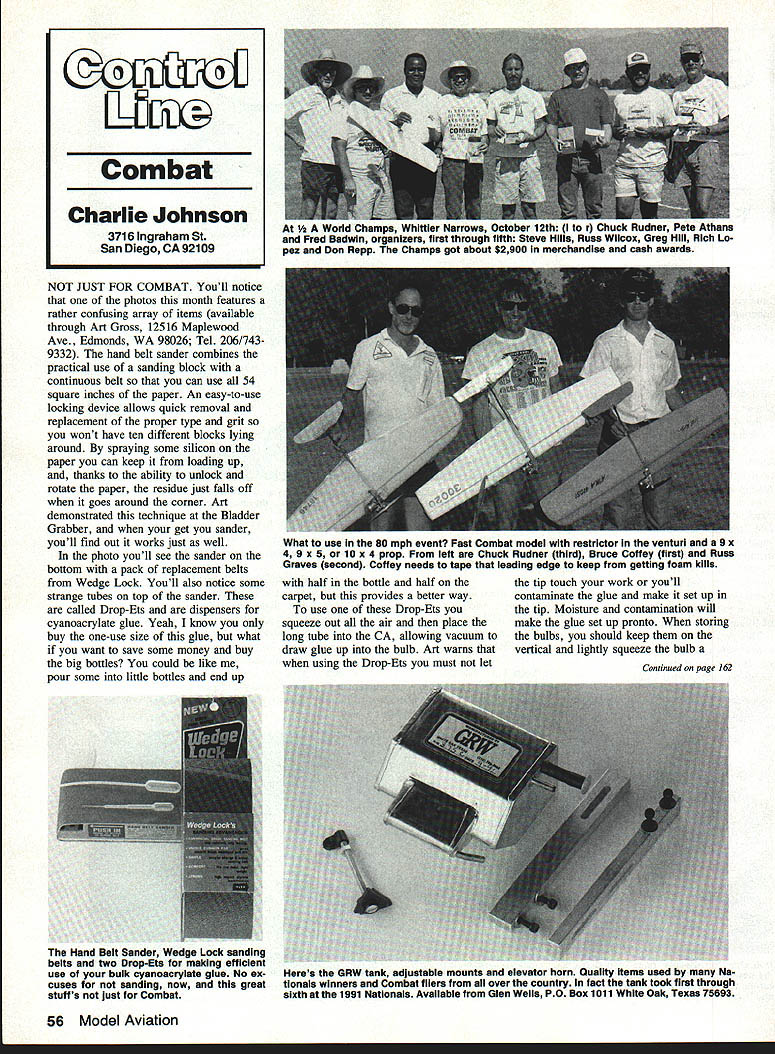
Also be sure not to miss the AMA Nationals in late June, the Slow Combat tournament in Gainesville, Texas, or the second running of the 1/2 A World Championships (with a $1,000 first prize) in October.
U.S.A. FAI Team and International Events
The U.S.A. FAI team of Chuck Rudner, Richard Stubblefield and Pat Willcox will travel to Czechoslovakia for the World Championships—probably in July. You can go along as a supporter and get in on all the fun, as well as get a close-up view of all that goes into an event such as this. You'll be able to travel with the AMA team members and share accommodations. There will probably be an open F2D contest in Western Europe following the regular meet, so there will be a chance to participate for pitmen, pilots, and supporters. It may not even be necessary to bring any models or engines because engines and planes are often sold by competitors at bargain prices.
Word from the Soviet Union and the Eastern Bloc is that modelers continue even after the revolution. Everyone is having to earn his keep, so look for more Soviet items for sale in this country. Be warned that quality varies from absolutely stunning to substandard. For example, the engines I brought back from Poland were right out of Nicholai Necheukhin's flight box and were exceptionally good. Other combat engines were going for as little as $15 but had no takers.
A number of foreign entrants will be at the Money Nats with lots of goodies to sell, including racing and speed items. The Fast Combat portion of the contest will be Saturday and Sunday, but a one-airplane-per-pilot match for the Combat FAI contest will be held on Friday so you can see the .15-size engines, props, and planes in action before you decide to invest.
Props and Performance
Looking for improved fiberglass props for your .15? It looks like the guys at APC have hit the right combination with their latest offering, which puts them in the ball park with the best exotic props. A Nelson-powered FAI turned 22.7 seconds for 10 laps with the APC vs. 23.4 for the imported glass prop and only mid-25s using a cut-down Taipan.
Preliminary flight testing indicates that the prop pulls as well through turns as the glass prop and much better than a cut-down Taipan. Don't try flipping one of these props without a glove, though—the trailing edge is razor sharp. Many Fast Combat fliers have discovered the advantages of the APC 9 x 6 and by the time you read this you should be able to get the new FAI size too. It's nice to find something a lot cheaper than glass, less fragile than wood, and available right here in the U.S.A. in any quantity you want.
Hoffelt Group Top Speed Challenge
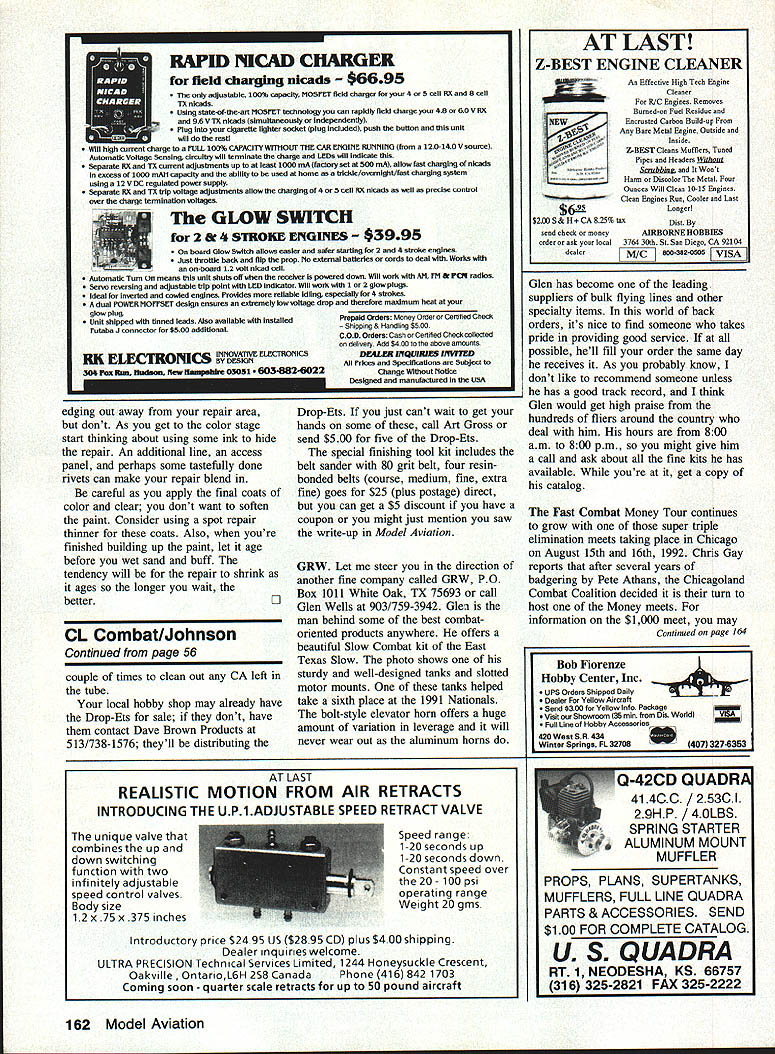
The Hoffelt Group Top Speed Challenge has generated almost as much interest as the contest. There is a $200 prize for top speed with a Combat plane timed for seven laps using a height pole not to exceed eight feet; the best official speed so far was from three years ago where Greg Hill went 129.44 mph using a Hoffelt .36R. Competition should be a whole lot tougher with some really hot Foxes and Nelsons and the Stels 36RR, which has not been run outside the Soviet Union (on low-nitro fuel). The only limitation will be to the use of a .370‑sq. in. airplane, but the spirit of the competition says that the event is for Combat planes and not "ringers."
MACA Top Twenty
The race in the standings for MACA Top Twenty is heating up, and Don Cranfill is leading the pack with 95 points. He's followed by current No. 1 Paul Smith with 87 points and Richard Stubblefield, who has been on a roll lately, with 85 points. Placing high in the MACA standings requires entering a lot of contests and flying lots of Combat events as well as placing near the top. It helps to win some of the major meets where there are a lot of entries.
The MACA Newsletter continues to maintain a very high standard, thanks to editor Larry Driskill. There aren't the "burning issues" we had a few years ago, but the newsletter is the very best way to keep informed about Combat. To join the premier world Combat organization, send $15 to MACA in care of Chip Giordano, Box 1000, Toms River, NJ 08754-1000. Include your name, address, AMA number, and category (Junior, Senior, Open). If you live in Mexico or Canada, the price is $18, and foreign subscriptions are $25. Additional family members are only $3 each (no newsletter).
Geriatric Combat and Streamer Rules
I was reading the latest issue of the New England Combat News and came upon their scoring system for Geriatric Combat. Besides collecting points for getting cuts and airtime, you also get penalized for hitting the other guy's plane. They also have a penalty for cutting the string leader. The value goes up with each cut taken (100 points for the first, 150 for the second, and 200 for each additional cut).
Flying with these rules for a while would make people very careful about making banzai passes at the other guy's model. Of course it helps when you have to fly at 73 mph or less.
The Geriatric event has a lot going for it, as does 80 mph, and the benefits can be seen on the flying field with 20 to 25 contestants—whereas only a couple of years ago Combat was almost dead in both areas except for an occasional big meet. We had a full day of 80 mph Combat at our local practice field with no mid-airs (are we ever overjoyed!).
Either giving no points for a string cut or imposing a penalty would make it necessary to use following tactics rather than a crossing style of flying. By the way, you have to use good streamers to make this work, because if you touch just the end of the streamer and the whole thing comes off, it defeats the purpose. The best streamers are the plastic C.A. Reed variety, but conventional streamers with masking tape work well too.
Transcribed from original scans by AI. Minor OCR errors may remain.

