
Control Line: Combat
Charlie Johnson 3716 Ingraham St. San Diego, CA 92109
Nationals and coverage
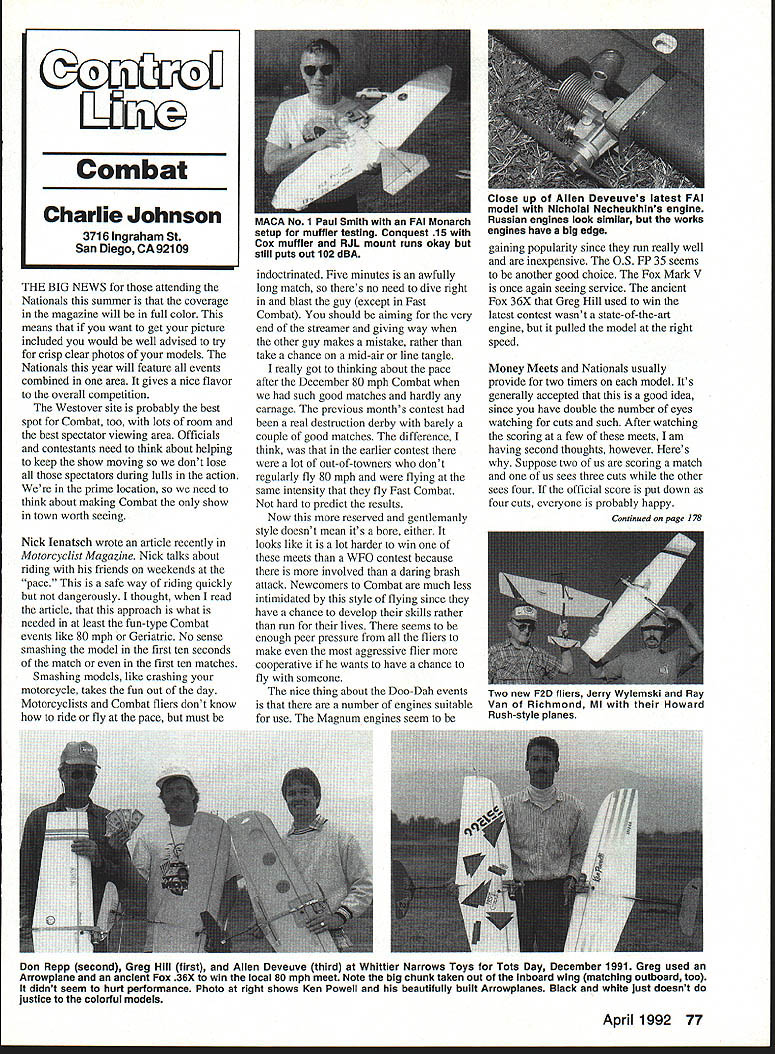
The big news for those attending the Nationals this summer is that the magazine coverage will be in full color. If you want your picture included, be sure to get crisp, clear photos of your models. The Nationals this year will feature all events combined in one area, which gives a nice flavor to the overall competition. The Westover site is probably the best spot for Combat — lots of room and the best spectator viewing area.
Officials and contestants need to help keep the show moving; don't lose the spectators during lulls in the action. We're in a prime location, so we should make Combat the one show in town worth seeing.
The pace
Nick Ienatsch recently wrote in Motorcyclist about riding with friends at "the pace" — a safe way of riding quickly without being dangerous. That idea translates well to the fun-type Combat events like 80-mph and Geriatric. There's no sense in smashing a model in the first ten seconds of a match (or the first ten matches). Smashing models, like crashing a motorcycle, takes the fun out of the day.
Many motorcyclists and Combat fliers don't know how to ride or fly at the pace; they must be indoctrinated. A five-minute match is long — there's no need to dive in and blast the other guy except in Fast Combat. In most events you should be aiming for the very end of the streamer and giving way when the other pilot makes a mistake, rather than risk a mid-air or line tangle.
80-mph Combat — observations
After our December 80-mph Combat show we had many good matches and hardly any carnage. The previous month's contest had been a real destruction derby. I think the difference was that the earlier contest drew many out-of-towners who don't regularly fly 80 mph and were flying with the same intensity they use in Fast Combat. Not hard to predict the results.
A more reserved, gentlemanly style doesn't mean it's a bore. It appears to be harder to win one of these meets than a WFO contest because success involves more than a daring, brash attack. Newcomers are less intimidated by this style since they can develop skills rather than run for their lives. Peer pressure among fliers also tends to make even aggressive pilots more cooperative if they want to continue flying with others.
Engines for Doo-Dah events
One nice thing about the Doo-Dah events is that a number of engines are suitable. Popular choices include:
- Magnum engines — gaining popularity because they run well and are inexpensive.
- O.S. FP .35 — another good choice.
- Fox Mark V — seeing renewed use.
- Fox .36X — an older design (Greg Hill used one to win a recent contest); not state-of-the-art but it pulled the model at the right speed.
Timers and scoring
Money meets and Nationals usually provide two timers per model. That's generally a good idea because you have twice the eyes watching for cuts. However, I've seen problems reconciling differing counts. For example, if one timer sees three cuts and the other sees four, and the official score is recorded as four, everyone may appear happy — but the timer who saw only three may feel his judgment isn't trusted.
I think the best procedure is:
- Use three timers and accept the majority count.
- Position the timers for the best views.
- Rotate timers periodically so no one becomes fatigued or biased.
Having people stand around the circle at various vantage points can allow more cuts to be seen, but you must have a clear method for reconciling differences.
Construction note
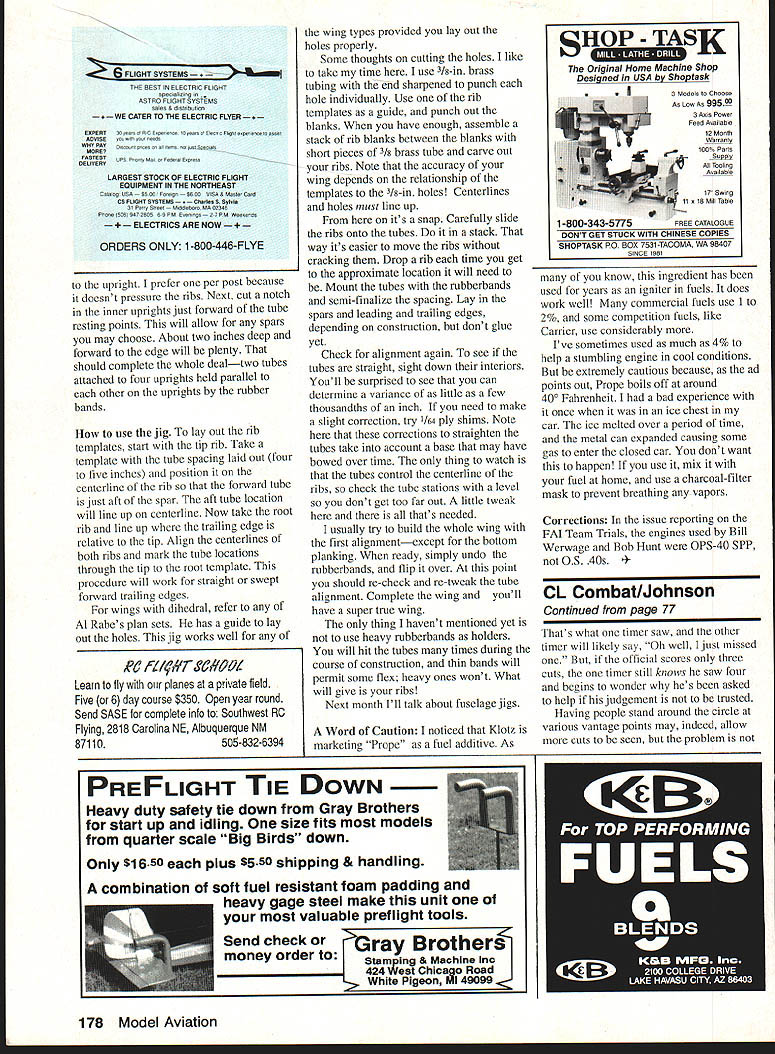
You will hit the tubes many times during construction. Thin bands permit some flex; heavy ones won't. What will give is your ribs! Next month I'll talk about fuselage jigs.
Noise, nitro, and event costs
There will always be proposals — 10% nitro for 1/2A Combat or the use of mufflers — and those ideas won't be universally popular. I don't have to adopt either; I don't have a noise problem now, and I have plenty of nitro left. Even if some suggested changes were adopted, the world will not end; we might have a bit less noise, but flying will continue.
Was it a good idea to make 1/2A Combat an official event? Years ago 1/2A was a fun event you could enter at the Nationals for $5; the top five received TD engines and other prizes. Now that 1/2A is official the entry fees are higher, there are fewer entrants, and winners often receive only a trophy. I don't think we need so many official events. Possibly Fast Combat should be the "big gun" and the other events could remain Doo-Dah — flown for fun and without large entry fees.
Many racing organizations recognize the difference between professional competitors and amateurs. Charging $50 to enter a Fast Combat tournament may be acceptable, but much more than a few bucks makes the novice think about being a spectator.
As far as technology goes, I like the new high-horsepower engines, but will a $200 1/2A really be more attractive than a TD .049 you can buy for under $30? (Well, it will if I've got the Shuriken and you don't!) The new Nelson 36 makes so much power that you'll be looking for .021 lines.
Lines and suppliers
Paul Smith reports he has located the manufacturer of the wire we use for control lines: Strandflex. The price is a little under one cent per foot for both .018-in. and .012-in. wire. Roughly:
- A set of Fast and Slow lines costs about $1.15.
- A set of 1/2A lines costs about $0.74.
Strandflex is happy to do business with individuals, but there is a minimum order quantity. This has varied a bit, but you can consider $250 a worst-case scenario. You might be able to reduce that to about $100 if you can take an odd-lot order.
Transcribed from original scans by AI. Minor OCR errors may remain.

