
Control Line
Combat
Charlie Johnson 3716 Ingraham St. San Diego, CA 92109
New engine-kill device
Just in time for the contest season is a new engine kill for Combat models. The device is manufactured by Rob Martin, owner of Forward Models (1183 Lockley Rd., Victoria, B.C., Canada V9A 4S7); telephone: (604) 381-5543. Cost: $19.95, plus $3.50 shipping and handling.
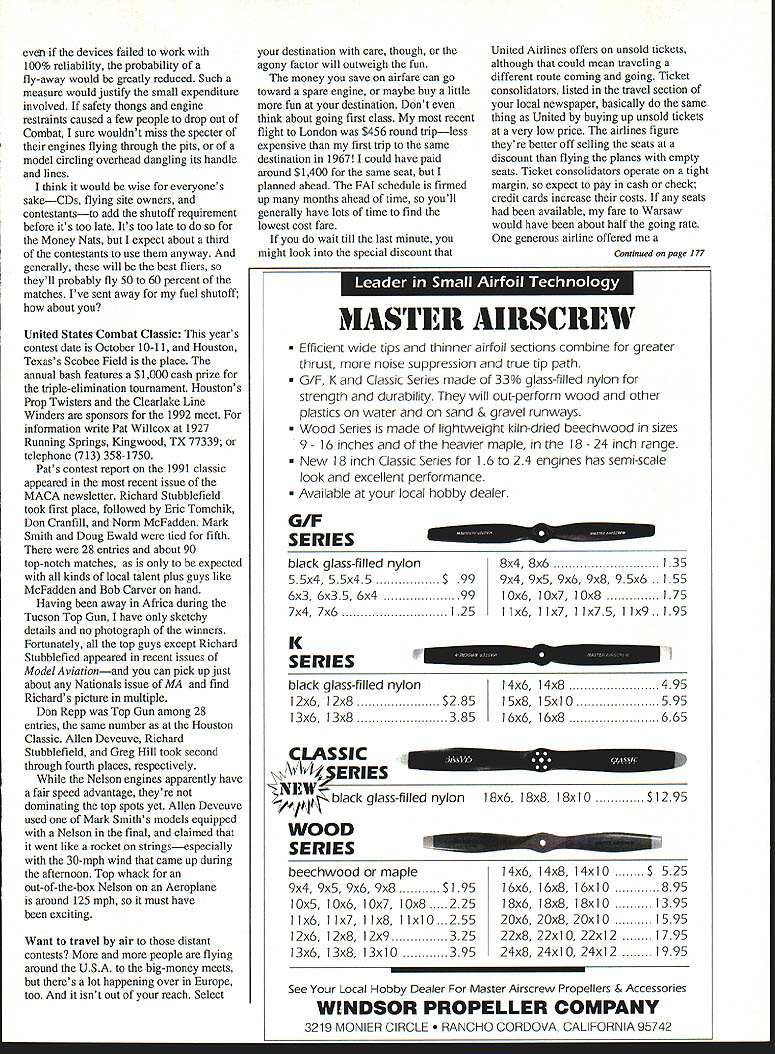
The Forward Models device is quite similar to the one perfected by Norm McFadden, but it works as a fuel dump rather than a fuel shutoff. If the model is cut away, the fuel flows out through a second line, bypassing the needle assembly. The difference is that a fuel shutoff actually cuts off the supply of fuel and is triggered by a lack of centrifugal force, whereas in the fuel dump the centrifugal force keeps the bypass line pinched.
I expect the fuel dump to be more reliable than a shutoff; we've all seen shutoff-equipped racing planes limping around with a partially pinched line. Steve Hills told me it's even possible to intentionally shut off an engine equipped with a centrifugal shutoff simply by suddenly "giving" with the model. The Forward Models item is a Contest Director's dream and ought to be at the top of your must-get list. It reportedly already saved Norm McFadden from a fly-away at last year's Houston Classic.
Safety proposal
The fly-away problem has been getting worse every year and has forced at least one regional contest to require shutoffs on Fast Combat models. If the AMA were to mandate engine shutoffs, even if the devices did not work with 100% reliability, the probability of a fly-away would be greatly reduced. Such a measure would justify the small expenditure involved.
If safety thongs and engine restraints caused a few people to drop out of Combat, I sure wouldn't miss the specter of engines flying through the pits or of a model circling overhead dangling its handle and lines. It would be wise for everyone's sake—Contest Directors, flying site owners, and contestants—to add a shutoff requirement before it's too late. I expect about a third of the contestants to use the devices at the Money Nats this year; generally, those will be among the best fliers, so they'll probably fly 50 to 60 percent of the matches. I've sent away for my fuel shutoff; how about you?
United States Combat Classic
This year's contest date is October 10–11 at Scobee Field, Houston, Texas. The annual bash features a $1,000 cash prize for the triple-elimination tournament. Sponsors for the 1992 meet are Houston's Prop Twisters and the Clearlake Line Winders.
For information write:
- Pat Willcox, 1927 Running Springs, Kingwood, TX 77339
- Telephone: (713) 358-1750
Pat's contest report on the 1991 Classic appeared in the MACA newsletter. Richard Stubblefield took first place, followed by Eric Tomchik, Don Cranfill, and Norm McFadden. Mark Smith and Doug Ewald tied for fifth. There were 28 entries and about 90 top-notch matches, as is only to be expected with local talent plus visiting top fliers such as McFadden.
Recent contest results and equipment notes
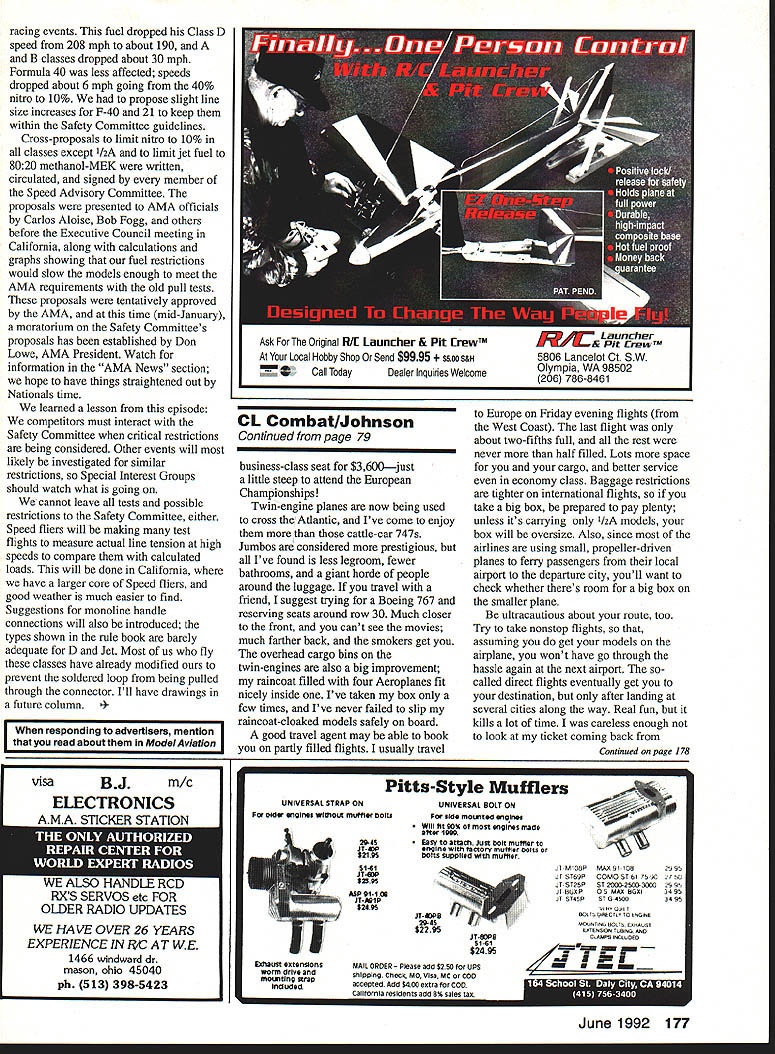
At Tucson Top Gun, Don Repp was Top Gun among 28 entries. Allen Deveuve, Richard Stubblefield, and Greg Hill took second through fourth places, respectively.
Nelson engines appear to have a fair speed advantage, though they are not completely dominating the top spots yet. Allen Deveuve used one of Mark Smith's models equipped with a Nelson in the final and reported it went like a rocket—especially when a 30-mph wind came up during the afternoon. A stock, out-of-the-box Nelson Aeroplane can reach around 125 mph, which must be exciting to watch.
Travel notes for attending contests
- Aircraft and seating: Twin-engine planes (for example, Boeing 767s) can be more comfortable than the larger jumbos; I suggest reserving seats around row 30 for a balance of comfort and convenience. Overhead cargo bins on twin-jets are an improvement—I can usually fit a raincoat-cloaked box of models in one.
- Baggage and routing: Baggage restrictions are much tighter on international flights, and a big box will usually be oversized. Many airlines use small turboprops to ferry passengers to departure cities—check whether there’s room for a large box on those smaller planes. Try to take nonstop flights to avoid repeated offloading and rechecking of your models; so-called direct flights may stop several times and add hours to your trip.
- Customs and security: Expect thorough X-ray and security checks. Do not pack anything illegal. Even mentioning purchases of unusual items (for example, foreign engines) can trigger extra inspection. Customs officials are generally not overly interested in model items, but there are limits and gray areas; if you are carrying expensive items, be prepared to declare them and pay duties if required.
- Frequent-flyer programs: Join them. On my travels I've accumulated enough bonus miles for several free trips—Africa, Greece, London, Florida—and another European trip is possible if something interesting comes along.
- Car rental and insurance: Use a gold credit card to avoid extra insurance charges where accepted. Some countries ignore gold cards and will still charge insurance; pay with your card and dispute any erroneous charges with the bank later. Budget messed up one of my rentals twice in Africa, but I did manage to snag a nicer car than I paid for—there is occasional justice.
Want to travel and attend distant contests? Between big-money meets in the U.S. and events across Europe, it's not out of reach—plan carefully and pack smart.
Transcribed from original scans by AI. Minor OCR errors may remain.

