

CONTROL LINE COMBAT
Rich von Lopez 8334 Colegio Drive, Los Angeles, CA 90045
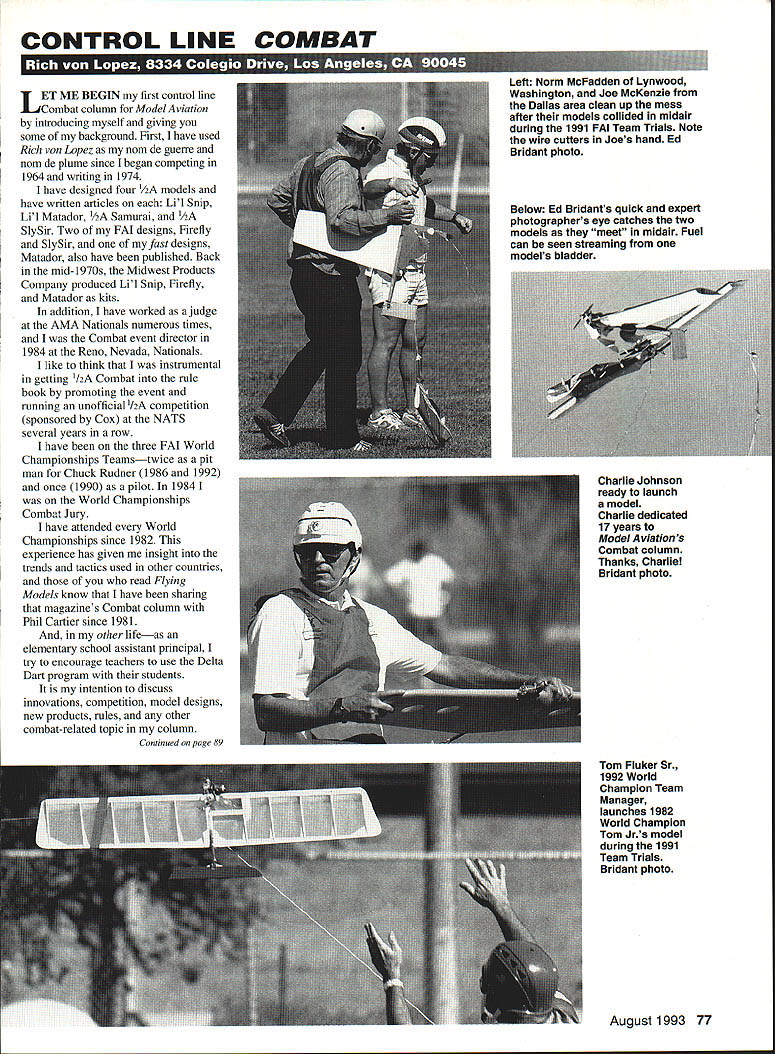
Let me begin my first Control Line Combat column for Model Aviation by introducing myself and giving you some of my background. I have used Rich von Lopez as my nom de guerre and nom de plume since I began competing in 1964 and writing in 1974.
I have designed four 1/2A models and have written articles on each: Li'l Snip, Li'l Matador, 1/2A Samurai, and 1/2A SlySir. Two of my FAI designs, Firefly and SlySir, and one of my fast designs, Matador, have also been published. Back in the mid-1970s, the Midwest Products Company produced Li'l Snip, Firefly, and Matador as kits.
I have worked as a judge at the AMA Nationals numerous times, and I was the Combat event director in 1984 at the Reno, Nevada Nationals. I like to think that I was instrumental in getting 1/2A Combat into the rule book by promoting the event and running an unofficial 1/2A competition (sponsored by Cox) at the NATS several years in a row.
I have been on three FAI World Championships teams—twice as a pit man for Chuck Rudner (1986 and 1992) and once (1990) as a pilot. In 1984 I served on the World Championships Combat Jury. I have attended every World Championships since 1982. This experience has given me insight into the trends and tactics used in other countries, and those of you who read Flying Models know that I have been sharing that magazine's Combat column with Phil Cartier since 1981.
In my other life—as an elementary school assistant principal—I try to encourage teachers to use the Delta Dart program with their students.
It is my intention to discuss innovations, competition, model designs, new products, rules, and any other combat-related topic in my column. If you wish to share some of your ideas, feel free to write to me; my address is at the top of this column.
Proposed rule discussion
A discussion of the proposed rules is now in order, since they will be acted upon in the near future. I am the person responsible for the bulk of these new proposals.
#### 1/2A Combat (CL 94-12)
- CL 94-12 seeks to change 1/2A Combat from a supplemental event to a regular event. I see no problem in striking "supplemental" from the rule book starting January 1, 1994.
- I was one of the promoters of 1/2A Combat in the late '70s and early '80s. The idea then was to create a low-cost event accessible to everyone. That is changing with the advent of the Shuriken engines; you can't hold back progress.
- I proposed two minor modifications to the rules:
- Increase the engine displacement to allow .051 engines. The rationale is that many used and new Tee Dee .051s are available and there is no advantage to using a .051 over a .049.
- Widen the streamer from 1/2 inch to 3/4 inch and lengthen the kill zone from four feet to five feet. This should slightly reduce the number of midairs and make streamer production by organizers more manageable.
- None of these proposals will change the nature of the event.
#### Slow and Fast Combat
Three proposals will affect Slow and Fast Combat:
- Change line length tolerances from 59 feet 6 inches–60 feet 6 inches to 59 feet 9 inches–60 feet 3 inches. A possible one-foot difference in line length could be a contributing factor to flyaways. All of us can live with a plus-or-minus six-inch tolerance.
- Increase the kill zone from six feet to seven feet. This will increase the number of kills at a competition, help prevent some midairs, shorten the time needed to run a competition, and in the long run save competitors' equipment.
- Offer competitors alternative methods of attaching a safety cable that are as safe as—if not safer than—the prescribed method.
For years I had been drilling holes through the four webs on my Fox Combat Specials and running the safety cable through those holes. As the rule is currently written, the safety cable must go around the engine cylinder. Depending on how much slack is given, the engine could slip out of its loop. Again, none of these proposals will change the nature of the event.
Proposal for an 80 mph Combat event
Now here is a proposal that will be a significant departure from the status quo: the creation of an 80 mph (supplemental) Combat event. This is not a new idea, but rather a resubmission (somewhat modified) of a rules proposal submitted by Barry Baxter several years ago.
Let's face it: Slow Combat is no longer slow. Jeff Dawson has stated that his Nelson-powered Slow Combat models are going 112 mph. The models have been modified and have evolved into highly specialized fighting machines that have all but forgotten the original spirit of the event.
As far as AMA Fast is concerned, speeds of 120 mph are in the upper range, while 130+ mph is in the high range. This is hardly an event for beginners.
I have seen 1/2A models hit speeds of 75 to 80 mph with Tee Dees, and I am sure that Steve Hill's Shuriken-powered models are in the 90+ mph range. This is real fast on 35-foot lines—again, hardly a beginner's event.
FAI Combat models go in the 90 to 102 mph range and will be somewhat slower in 1993 because of the muffler rule. On 52-foot lines, these models are quick. So where does that leave the entry-level pilot?
Some areas of the country have Fox .35 Combat, .75 Combat, or other variations. Eighty-mph Combat is simple, does not restrict a competitor to one particular engine or model, and is cheap. We must remember that we do not want to make an entry-level event so costly that it is beyond the affordability of the limited-budget modeler.
My rules proposal follows.
CL 80 MPH COMBAT (SUPPLEMENTAL)
- General
- Applicability, equipment, purpose, rules, procedures, and judging are the same as CL Combat, except as specified below.
- Procedure
- A kill does not end the match. Either or both competitors may score a kill in the same match. Not more than one (1) kill may be scored by one (1) competitor at a time in a match.
- Once both strings have been cut, at a signal from the judge, both fliers must fly level and counterclockwise.
- The fliers shall fly level and counterclockwise in such a manner as to avoid midair collisions, near misses, etc.
- A kill counts 100 points.
- No aircraft may exceed 79.09 mph (6.5 seconds for two [2] laps). Exceeding the speed limit will result in forfeiture of the match.
- A judge will be assigned a stopwatch for the purpose of timing the speed of the model. The judge may call for timed laps at any time during the flight (i.e., before the start of combat, during the match, after a restart, or after the match period is over, as long as the model or models are still in the air).
- When called for a time, the pilot(s) will level off at an altitude of 10 to 15 feet within two laps. The timing will then commence for two laps. At a signal from the judge that the timing is complete, the pilots will separate 180° and restart Combat.
- While timing, a pilot alone in the circle must pivot about a point; if both pilots are in the circle, each must walk in as small a circle as practical. It is the pilot's responsibility to get to the prescribed altitude within two (2) laps; exceeding the speed limit because of altitude will result in forfeiture.
- No cuts or kills accidentally or deliberately achieved during the timing period will be counted; the offender will only have a smaller target (or none at all).
- Flying is permitted below fifteen (15) feet for timing purposes when no model is in the air.
- Pilots must start their own engines at all times (i.e., at the start of the match and after each pit stop). Junior pilots are exempted from starting their own engines.
Transcribed from original scans by AI. Minor OCR errors may remain.

