
CONTROL LINE: COMBAT
By Phil Cartier
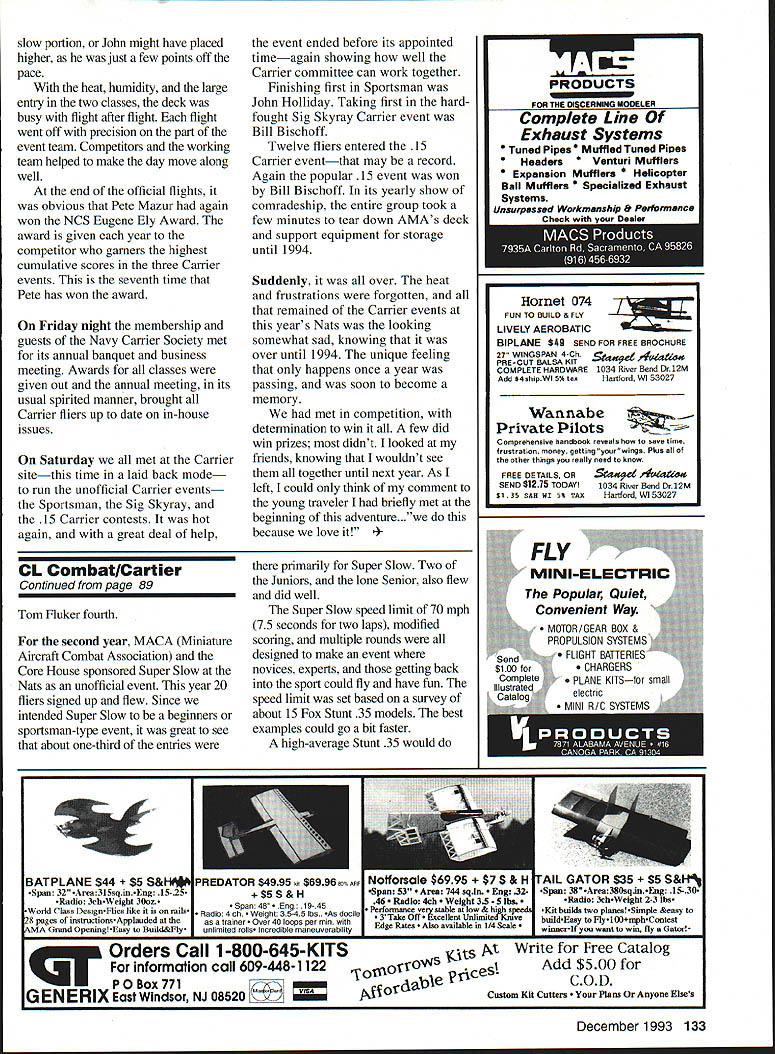
Monday morning was hot and humid. Combat action started in earnest at 10 a.m. when four Juniors entered and began a flyoff. The Juniors—sons of veteran combat fliers—had their acts together: equipment worked, they got good starts, and they flew some fine matches.
- Junior results:
- 1st: Mike Carlson
- 2nd: Matt Arunski
- 3rd: Ryan Blair
- 4th: Skyler Skelly
Emily Cartier was the only Senior to show up; she elected to fly Open rather than put in a solo trophy flight. That made 22 fliers entered in Slow Combat—almost all experienced pilots with good equipment. Names like McKinzie, Fluker, Kott, Driskill, Owen, and Henry meant the matches were hotly contested.
Slow Combat and Notable Matches
Early on Steve Kott and Tom Fluker had a tremendous match. Both models were going fast—Kott using a Nelson and Fluker a Fox. Kott got the first cut, taking all but the knot. Fluker came back with a good-sized cut. After another minute and a half of chasing they had a midair at 3:40 into the match; Fluker won on air time.
Many pilots worked hard to "feed" their opponent the streamer. The tactic: when it looks like the opponent will get a cut anyway, try to make it a big one. Typically the lead pilot fakes a turn to get the models turning opposite directions, then turns directly in front of the trailing model as it tries to recover. Done right, the trailing model gets in too close and can’t tighten the loop—either it does nothing and is killed, or it turns the other way and flies through the string and gets killed. This generated many low-scoring matches (1–1 or 2–1 cut counts).
I had a gentlemanly, high-scoring match with Larry Driskill. I got up first by a lap or so; Larry picked up a small cut early but pulled in too close on another pass and I was able to turn in front of him for a kill. After recovery we discussed tactics, went at it again, and I managed an up-down pass for two cuts. We considered insurance and went at it a third time; I got a third cut leaving only a foot or so. Mike Urban, the circle marshal, finally called it—three cuts to two—and we saved the equipment.
Mack Henry and Joe McKinzie had another great early match. McKinzie got up first; Henry came back and scored some cuts. McKinzie answered with two quick cuts, Mack got another, and Henry, flying a slightly slower model, had to anticipate McKinzie’s moves to change direction. A slower model can often avoid a midair by anticipating the faster pilot; if the slower pilot misjudges, he ends up in a midair instead of getting the cut.
As double eliminations progressed, Emily Cartier and Chuck Schroll flew a controversial match to see who would go into the top three. Chuck’s pit crew launched his model before he had the handle; the model was recovered but the streamer was tangled. Chuck finally won the match 3–2 (score 443–429). Schroll later lost to Fluker in an up-and-down air-time battle after some engine trouble, finishing third. Cartier ended up fifth after a ground flight in another match; David Owen finished fourth.
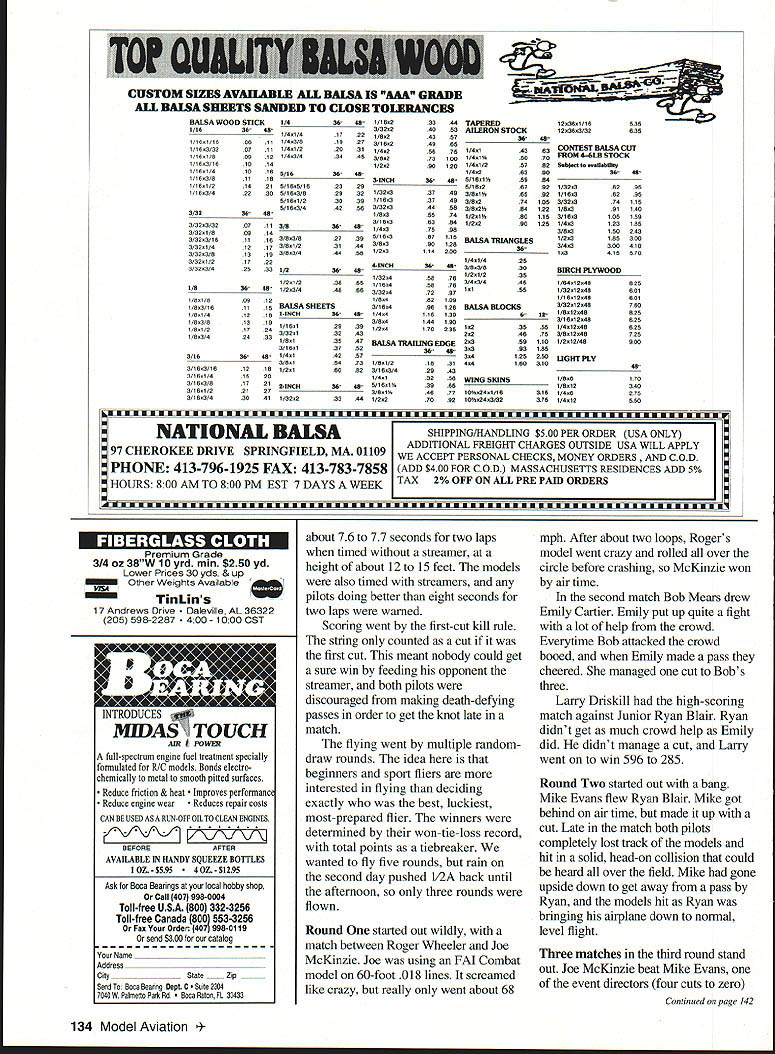
The finals between Joe McKinzie and Tom Fluker started like gangbusters. Fluker used new Wiley engines; McKinzie a Nelson. They traded big cuts and began to knot. McKinzie’s engine went lean after a few thrilling seconds and both models met in a spectacular midair. Tom Fluker took first with fine flying; Joe McKinzie was second.
FAI (F2D) Combat
Four FAI entries lined up Wednesday morning. FAI Combat (F2D) has faced steadily declining entries—two-models-per-match rules force fliers to use more expensive equipment, rules change frequently, and procedures are more complicated for judges. Despite this, new, lower-cost equipment from former Eastern Bloc countries might fuel a resurgence: decent engines under $100 and ready-to-fly models for about $29 apiece.
Mack Henry and David Owen used the now-mandatory mufflers; the contest director, Mike Urban, didn’t require them for Tom Fluker and Joe McKinzie, who hadn’t gotten mufflers yet. Mufflers add nose weight and slow models slightly but do little to reduce overall noise. With engines turning at 28,000–30,000 rpm, two models still sound extremely loud.
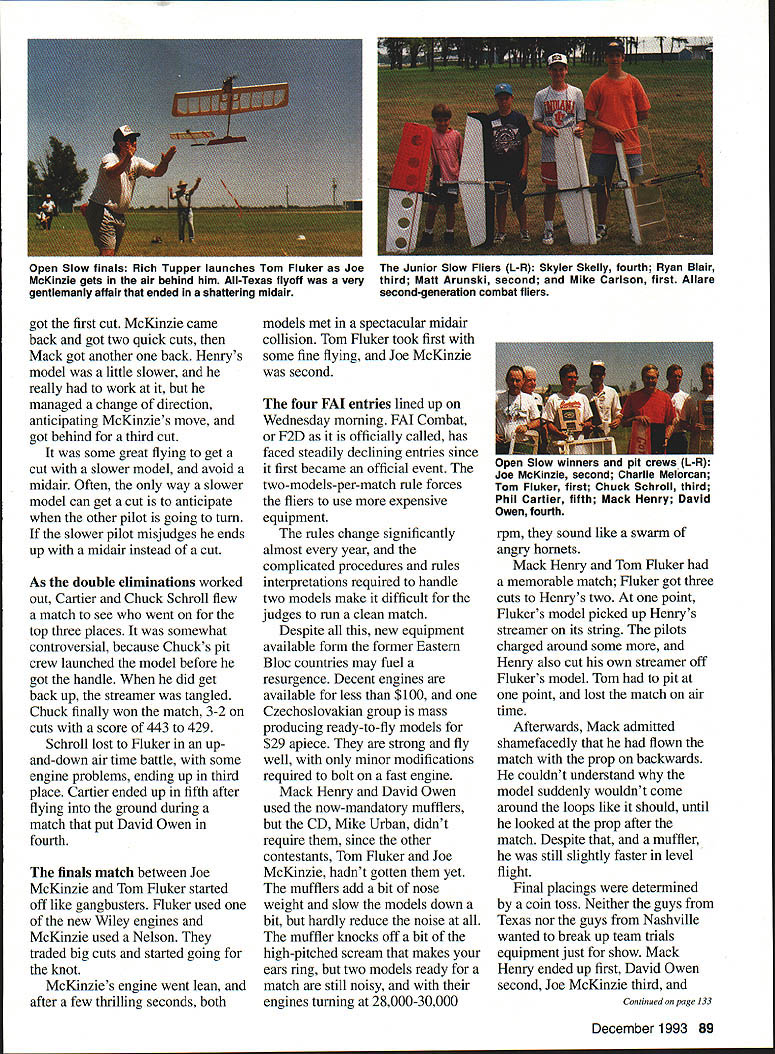
Mack Henry and Tom Fluker had a memorable match; Fluker got three cuts to Henry’s two. At one point Fluker’s model picked up Henry’s streamer on its string; Henry also cut his own streamer off Fluker’s model later. Tom had to pit and lost the match on air time. Final placings (decided by coin toss when teams didn’t want to break up equipment for show):
- 1st: Mack Henry
- 2nd: David Owen
- 3rd: Joe McKinzie
- 4th: Tom Fluker
Super Slow (Unofficial)
For the second year MACA (Miniature Aircraft Combat Association) and the Core House sponsored Super Slow at the Nats as an unofficial event. Twenty fliers entered and flew. Super Slow was intended as a beginners/sportsman event; about one-third of the entries were there primarily for Super Slow. Two Juniors and the lone Senior also flew and did well.
Rules/features:
- Speed limit: 70 mph (7.5 seconds for two laps)
- Modified scoring and multiple rounds to encourage fun and participation
- Any-plane-goes: competitors used choked-down Fast models, FAI models, Stunt .35s, and detuned Slow models
The speed limit was set from a survey of about 15 Fox Stunt .35 models; the best of those could go a bit faster. Stunt .35s rarely got consistent, high runs—often running like a flat four-cycle and losing 5–10 mph. FAI models turned tight but had issues with lost air time or uneven runs; bladders and pacifiers require careful handling for consistency.
Event winners:
- Sportsman: John Holliday
- Sig Skygray Carrier: Bill Bischoff
The Super Slow event ended before its scheduled time, demonstrating the Carrier committee’s efficiency.
Carrier and .15 Carrier
Twelve fliers entered the .15 Carrier event—possibly a record. The event was notable for camaraderie: the group spent a few minutes tearing down AMA’s deck and support equipment for storage until 1994. The Carrier events closed with mixed feelings—heat and frustrations forgotten, the deck remaining as a memory until next year.
1/2A Combat
Eight 1/2A Combat fliers turned out Thursday morning. Required rain arrived and lasted until after lunch; the 1/2A fliers hustled and completed 16 matches in about 2½ hours so the Super Slow crowd could finish Round Three.
Bad starts plagued many. Even experienced fliers had trouble with one-flip starts; the high-tech engines were especially temperamental. In one match Roger Wheeler failed to get up due to a countdown mixup and an over-primed engine. Bob Mears used old, reliable Tee Dees to take first. Results:
- 1st: Bob Mears
- 2nd: Larry Driskill
- 3rd: Pat Currier
Fast Combat
Fast Combat, the top-drawing event, started Friday at 1 p.m. Matt Arunski put in a flight for the Juniors, then 18 top fliers lined up. Late in the afternoon two rounds looked rough: midairs every other match, one-up/one-down decisions by air time, flyaways from structural failures, bad starts, and close-in flying.
Saturday’s flying improved—far fewer midairs and no flyaways; at least half the matches ended in kills.
Notable matches and moments:
- Roy Krupa used a Wiley engine but it was set too lean; his engine tended to quit on outsides and I picked up a cut, then Krupa came back and the match was decided on air time.
- David Owen and Mack Henry used Russian-ready models from Czechoslovakia with large stabilators; they switched engines among Foxes, a Nelson, and a Wiley.
- Dennis Keeton and I met for fifth/sixth: Keeton had won the first match with a kill; in the rematch my wrecked model barrel-rolled into the ground, giving Dennis fifth.
- Bob Mears vs. Joe McKinzie: McKinzie got up first on a honking Nelson; Mears later got behind him for a kill 40 seconds in.
- Mears vs. Larry Driskill: Driskill misjudged speed and flew into the ground; Mears’ engine began to snag afterward.
- Mears (7-0) vs. David Owen (6-1): Owen needed two wins. A great match saw Mears collect two cuts to Owen’s one; both pitted and Owen won by four seconds.
- Joe McKinzie vs. Larry Driskill for third/fourth: Driskill crashed after a stabilizer failure; McKinzie took third.
The finals were everything Fast Combat should be. Bob Mears started with nearly a two-flip advantage. Owen, screaming in with a Wiley engine, mixed it up for about 15 seconds and appeared to get a kill; leveling out showed a knot still hanging on Mears’ model. At the signal they went again for five seconds and had a thunderous midair that destroyed both models. David Owen took first by one cut; Bob Mears was second.
All competitors appreciated the judges’ work—Mike Urban ran the matches fairly and ensured outcomes were decided in the air whenever possible. Many people helped count cuts and run the pits, including Jim Doiron, Roger Wheeler, Pat Currier, Jerry Hoover, Pam Kryza, Ryan Blair, Emily Cartier, Paul Bulach, Steve Kott, Mike Evans, Tom Fluker, Dianne Doiron, and Walt Siedleck. Mary Cartier helped at scoring during 1/2A and really kept things moving.
Night Combat
Iskandar Taib brought light sticks Wednesday evening. Half a dozen fliers stayed out after midnight flying matches with sticks on their models. Bert Allaire brought luminescent paint and a black light to mark the circle. It was a great time for everybody involved.
Technical Innovations and Equipment Notes
We saw several interesting technical developments:
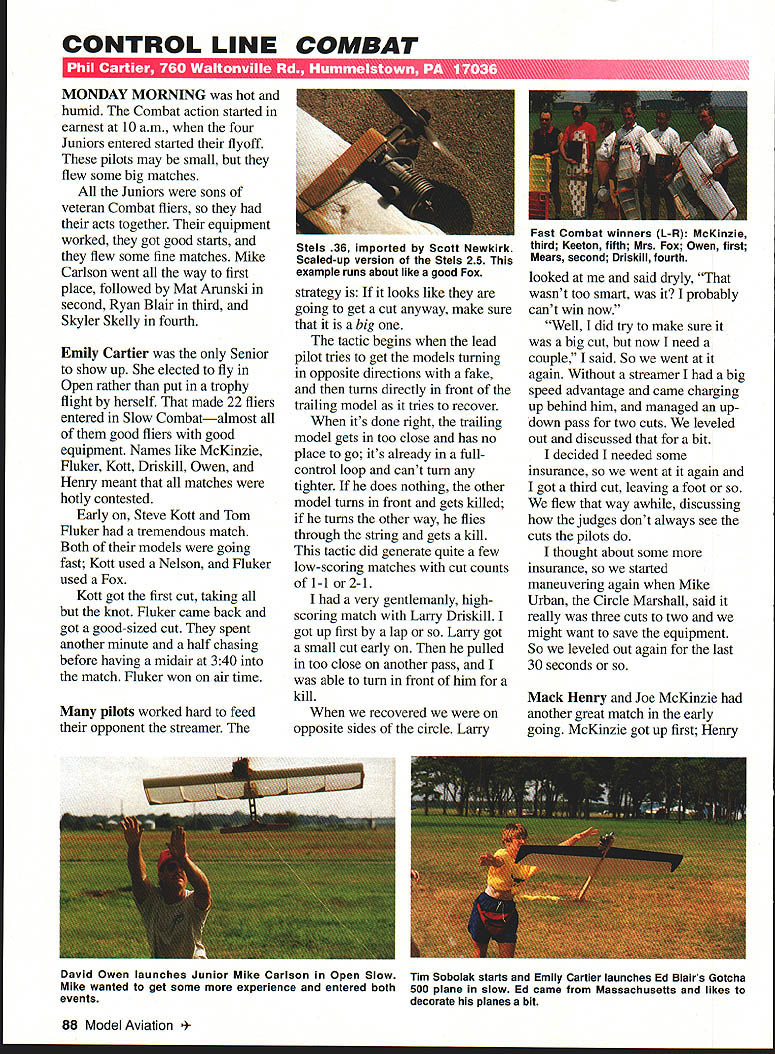
- Wiley engines: A new Wiley engine ran well in both Fast and Slow. It has a big angular case reminiscent of the Fox Mark VI, weighs about nine ounces, uses a chrome-plated aluminum sleeve, a 15 mm shaft with special extra-loose-fit riveted-cage bearings, bore .800, stroke .715, and timing similar to standard Fox numbers. Wiley claims a reliable plating method for the 7075 sleeve. At about $175 it offers excellent value.
- Nelson engines: Top-placing Nelsons ran well and weigh about eight ounces. Henry Nelson’s research produced features like a shorter stroke, a 17 mm shaft with thin-race main bearing, AAC piston and sleeve, chrome-plated titanium shafts weighing ~7 ounces, and custom glow plug/head inserts that seal tightly. Nelson engines are considered high-end custom engineering (around $275 for some variants).
- VA .049: Larry Driskill used the new VA .049 (imported by Dan Rutherford). Features include AAC construction with an aluminum piston in a nickel-plated case, ~1.2 ounces weight, setup for high-rpm bladder operation swinging a 4.25 x 3 cut-down Tornado prop (~28,000 rpm on 40% fuel), and a threaded-in wristpin carrier allowing timing and clearance adjustments via shims. It showed good handling and low weight.
- Arrowshaft models: Arrowshaft (composite pod-and-boom) models are strong and easy to build. While some argued a wooden boom is more in keeping with rules, current profile rules address fuselage thickness and resemblance to full-size aircraft; pod-and-boom arrowshaft designs resemble full-scale aircraft and are gaining use. Common composite shaft sizes are .505" diameter and a stiffer .524" size.
Performance notes:
- Slow models are not slow: current speeds with Nelson and Wiley engines exceeded 100 mph even in heat and humidity. I timed David Owen’s fast model at about 119 mph towing a piece of streamer.
- Many Slow matches are decided by knots; both fliers often get the streamer early then chase knots for minutes. Slow has become similar to Fast except a kill is worth only about a hundred points. Upward of half the matches ended in midairs as fliers tried for the winning knot.
Super Slow rules worked well. The low speed, modified scoring, and "any-plane-goes" policy brought out interesting combinations. Experienced fliers still had the advantage; the Stunt .35 rarely delivered consistent power, but when it did it could be competitive. FAI models ran well under calm conditions; in windier weather they and rich-running Stunt .35s would be at a disadvantage.
Pit crews and spectators sometimes mis-timed perceived speeds by timing models flying high in the circle; when pilots brought models down to 12–15 feet for a proper check they were usually legal by half a second or more. A couple of FAI models clocked right at eight seconds with a streamer—on the edge of the limit.
Final Observations
The Nats showcased great flying, close competition, technical innovation, and camaraderie. A few won prizes; most didn’t, but everyone shared the annual thrill of competition. As I left I remembered a comment to a young traveler I met at the beginning of the event: "We do this because we love it."
That wraps it up for this year. Next year promises more FAI Team Trials action, thousands of Super Slow matches, and plenty of combat fun for everyone who joins in.
Transcribed from original scans by AI. Minor OCR errors may remain.

