
CONTROL LINE COMBAT INTERNATIONAL CONTEST
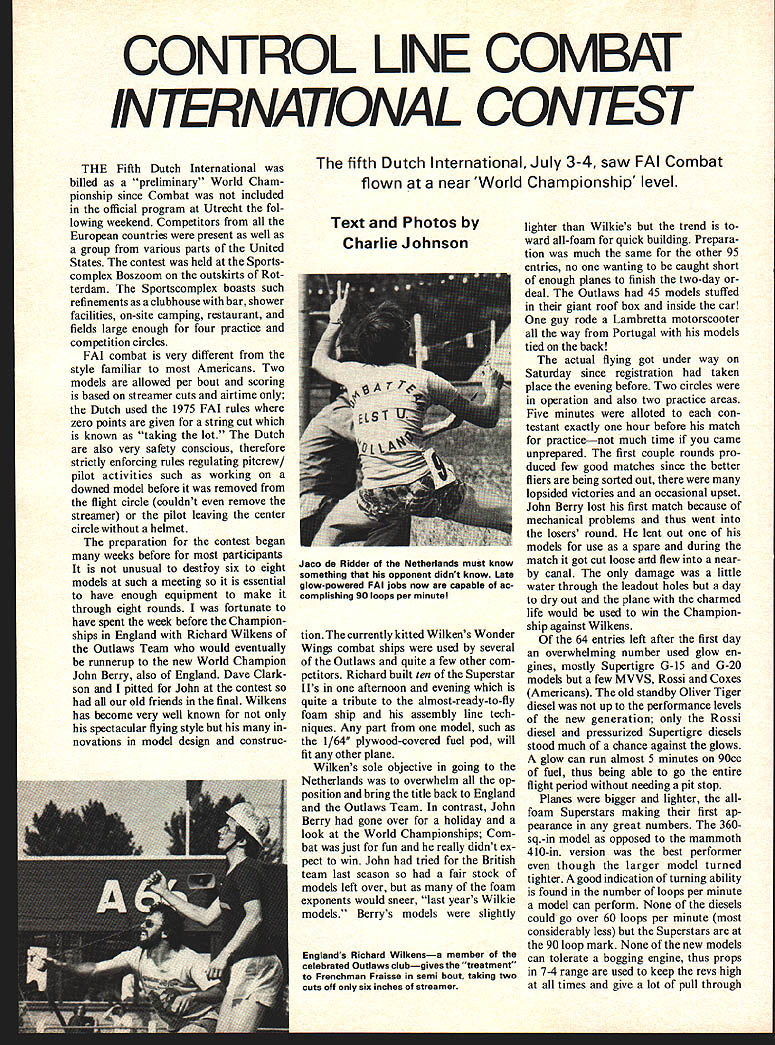
The Fifth Dutch International was billed as a "preliminary" World Championship since Combat was not included in the official program at Utrecht the following weekend. Competitors from all the European countries were present as well as a group from various parts of the United States. The contest was held at the Sportscomplex Boszoom on the outskirts of Rotterdam. The Sportscomplex boasts such refinements as a clubhouse with bar, shower facilities, on-site camping, restaurant, and fields large enough for four practice and competition circles.
FAI combat is very different from the style familiar to most Americans. Two models are allowed per bout and scoring is based on streamer cuts and airtime only; the Dutch used the 1975 FAI rules where zero points are given for a string cut which is known as "taking the lot." The Dutch are also very safety conscious, therefore strictly enforcing rules regulating pitcrew/pilot activities such as working on a downed model before it was removed from the flight circle (couldn't even remove the streamer) or the pilot leaving the center circle without a helmet.
The preparation for the contest began many weeks before for most participants. It is not unusual to destroy six to eight models at such a meeting so it is essential to have enough equipment to make it through eight rounds. I was fortunate to have spent the week before the Championships in England with Richard Wilkens of the Outlaws Team who would eventually be runnerup to the new World Champion John Berry, also of England. Dave Clarkson and I pitted for John at the contest so had an all or full of sort. Wilkens has become very well known for not only his spectacular flying style but his many innovations in model design and construction.
The currently kitted Wilkens' Wonder Wings combat ships were used by several of the Outlaws and quite a few other competitors. Richard built ten Superstar IIs in one afternoon and evening which is quite a tribute to the almost-ready-to-fly foam ship and his assembly line techniques. Any part from one model, such as the 1/64" plywood-covered fuel pod, will fit any other plane.
Wilkens' sole objective in going to the Netherlands was to overwhelm all the opposition and bring the title back to England and the Outlaws Team. In contrast, John Berry had gone over for a holiday and a look at the World Championships. Combat was just for fun and he really didn't expect to win. John tried for the British team last season so had a fair stock of models left over, but as many of the foam exponents would sneer, "last year's Wilkie models." Berry's models were slightly lighter than Wilkie's but the trend is toward all-foam for quick building. Preparation was much the same for the other 95 entrants, no one wanting to be caught short of enough planes to finish the two-day ordeal. The Outlaws had 45 models stuffed in their giant roof box and inside the car! One guy rode a Lambretta motorscooter all the way from Portugal with his models tied on the back!
The actual flying got under way on Saturday since registration had taken place the evening before. Two circles were in operation and also two practice areas. Five minutes were allotted to each contestant exactly one hour before his match for practice — not much time if you came unprepared. The first couple rounds produced few good matches since the better fliers were being sorted out; there were many lopsided victories and an occasional upset. John Berry lost his first match because of mechanical problems and thus went into the losers' round. He lent out one of his models for use as a spare and during the match it got cut loose and flew into a nearby canal. The only damage was a little water through the leadout holes but a day to dry out and the plane, charmed life would be used to win the Championship against Wilkens.
With 64 entries left after the first day the overwhelming number used glow engines, mostly Supertigre G-15 and G-20 models but a few MVVS, Rossi and Coxes (Americans). The old standby Oliver Tiger diesel was not up to the performance levels of the new generation; only the Rossi diesel and pressurized Supertigre diesels stood much chance against the glows. A glow can run almost 5 minutes on 90cc of fuel, thus being able to go the entire flight period without needing a pit stop.
Planes were bigger and lighter, the all-foam Superstars making their first appearance in any great numbers. The 360-sq.-in. model as opposed to the mammoth 410-sq.-in. version was the best performer even though the larger model turned tighter. A good indication of turning ability is found in the number of loops per minute a model can perform. None of the diesels could go over 60 loops per minute (most considerably less) but the Superstars are at the 90 loop mark. None of the new models can tolerate bogging engines thus props in the 7-4 range are used to keep the revs high at all times and give a lot of pull through.
Text and Photos by Charlie Johnson the turns. Some of the Americans used clipped 7-6 nylons on their Cox 15's but during violent turning the motor would often be pulled off its power band even though one motor was reported to turn in excess of 20,000 rpm in the air, which is about what a Supertigre does with a 7-4 — anything more and the prop self destructs.
The Italian Rossi operators solved their prop problems by using 7-5 fiberglass props. The Italian Champion, Sergio Tommelleri, was chief proponent of this combination and was very fast on the level and had more power through manoeuvres than anyone else. Thrown prop blades changed the course of many matches at the Championships including the final where Berry's prop actually grew another inch!
The competition on Sunday was very exciting with many good matches even though all the Americans were out by the sixth round (Smith, Kruse, and Reese had mechanical problems; Harris and Johnson just lost). Richard Wilkens soundly defeated ex-Champ Vernon Hunt in a dazzling display of glow dominance over the Oliver diesel. Vernon is one of the very best offensive fliers but was never able to mount an attack, being chased into the ground several times. Wilkens' opponents found that the only safe place to be was on the ground and many of them found their way there either on purpose or as a result of some "treatment" as the Outlaws call it.
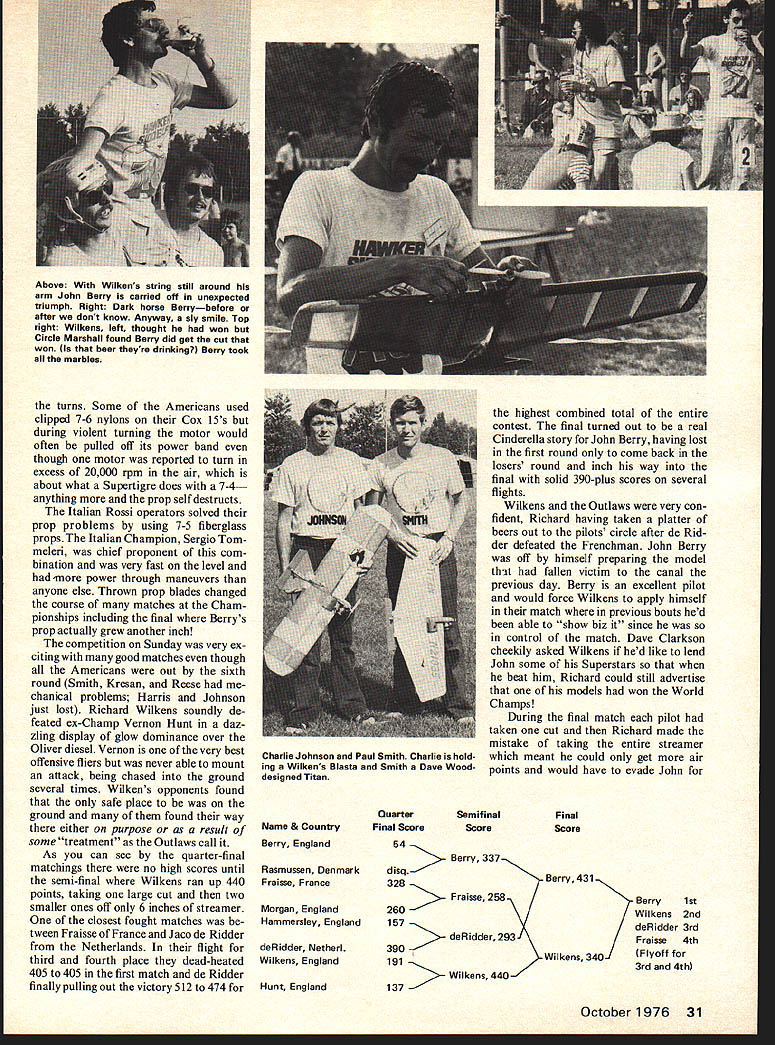
As you can see by the quarter-final matchings there were no high scores until the semi-final where Wilkens ran up 440 points, taking one large cut and then two smaller ones off only 6 inches of streamer. One of the closest fought matches was between Fraisse of France and Jaco de Ridder from the Netherlands. In their fight for third and fourth place they dead-heated 405 to 405 in the first match and de Ridder finally pulling out the victory 512 to 474 for the highest combined total of the entire contest. The final turned out to be a real Cinderella story for John Berry, having lost in the first round only to come back in the losers' round and inch his way into the final with solid 390-plus scores on several flights.
Wilkens and the Outlaws were very confident, Richard having taken a platter of beers out to the pilots' circle after de Ridder defeated the Frenchman. John Berry was off by himself preparing the model still half fallen victim to the canal the previous day. Berry is an excellent pilot and would force Wilkens to apply himself in their match where in previous bouts he'd been able to "show biz" since he was so in control of the match. Dave Clarkson cheekily asked Wilkens if he'd like to lend John some of his Superstars so that when he beat him, Richard could still advertise that one of his models had won the World Champs!
During the final match each pilot had taken one cut and then Richard made the mistake of taking the entire streamer which meant he could only get more air points and would have to evade John for the remainder of the match. John, being the astute flier he is, put every ounce of pressure on Richard and finally got the cut that counted. The decision was a narrow one but John Berry emerged the new World Champion with Wilkens second, de Ridder third and Fraisse fourth.
Name & Country Quarter Final Score Semifinal Score Final Score Berry, England 54 Berry, 337 Berry, 431 Rasmussen, Denmark disq. Fraisse, France 328 Fraisse, 258 Morgan, England 260 Hammersley, England 157 deRidder, Netherl. 390 deRidder, 293 Wilkens, England 191 Wilkens, 440 Wilkens, 340 Hunt, England 137
Berry 1st Wilkens 2nd deRidder 3rd Fraisse 4th (Flyoff for 3rd and 4th)
Combat International
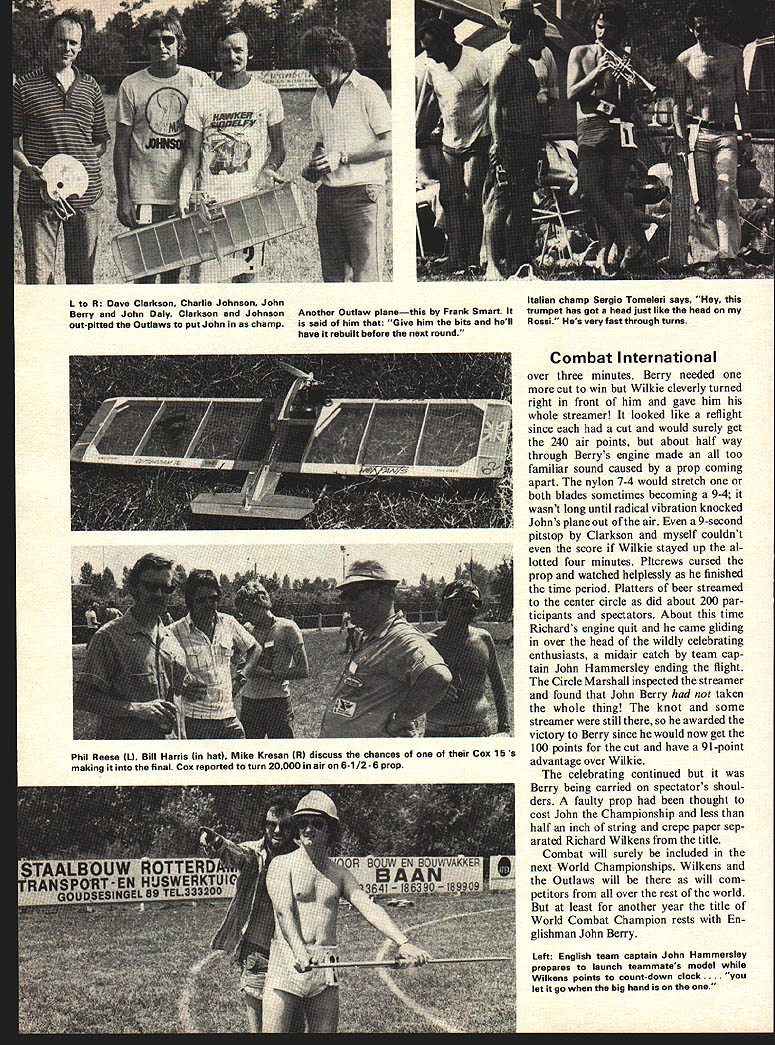
over three minutes. Berry needed one more cut to win but Wilkens cleverly turned right in front of him and gave him his whole streamer! It looked like a refight since each had a cut and would surely get the 240 air points, but about halfway through Berry's engine made an all too familiar sound caused by a prop coming apart. The nylon 7-4 would stretch one or both blades sometimes becoming a 9-4; it wasn't long until radical vibration knocked John's plane out of the air. Even a 9-second pit stop by Clarkson and myself couldn't even the score if Wilkens stayed up the allotted four minutes. Pilcrescu cursed the prop and watched helplessly as he finished to the time period. Platters of beer streamed into the center circle as did about 200 participants and spectators. About this time Richard's engine quit and he came gliding in over the head of the wildly celebrating enthusiasts, a midair catch by team captain John Hammersley ending the flight. The Circle Marshal inspected the streamer and found that John Berry had not taken the whole thing! The knot and some streamer were still there, so he awarded the victory to Berry since he would now get the 100 points for the cut and have a 91-point advantage over Wilkens.
The celebrating continued but it was Berry being carried on spectators' shoulders. A faulty prop had been thought to cost John the Championship and less than half an inch of string and crepe paper separated Richard Wilkens from the title.
Combat will surely be included in the next World Championships. Wilkens and the Outlaws will be there as will competitors from all over the rest of the world. But at least for another year the title of World Combat Champion rests with Englishman John Berry.
Transcribed from original scans by AI. Minor OCR errors may remain.

