
Control Line: General
Dr. Laird Jackson
The 1980 Control Line World Championships held in Poland must be viewed with mixed reactions. The weather, generally, was poor, and there were problems with practice sites and, to some extent, with the political system. Still, the U.S. had victories and near-victories.
Arrival and travel problems
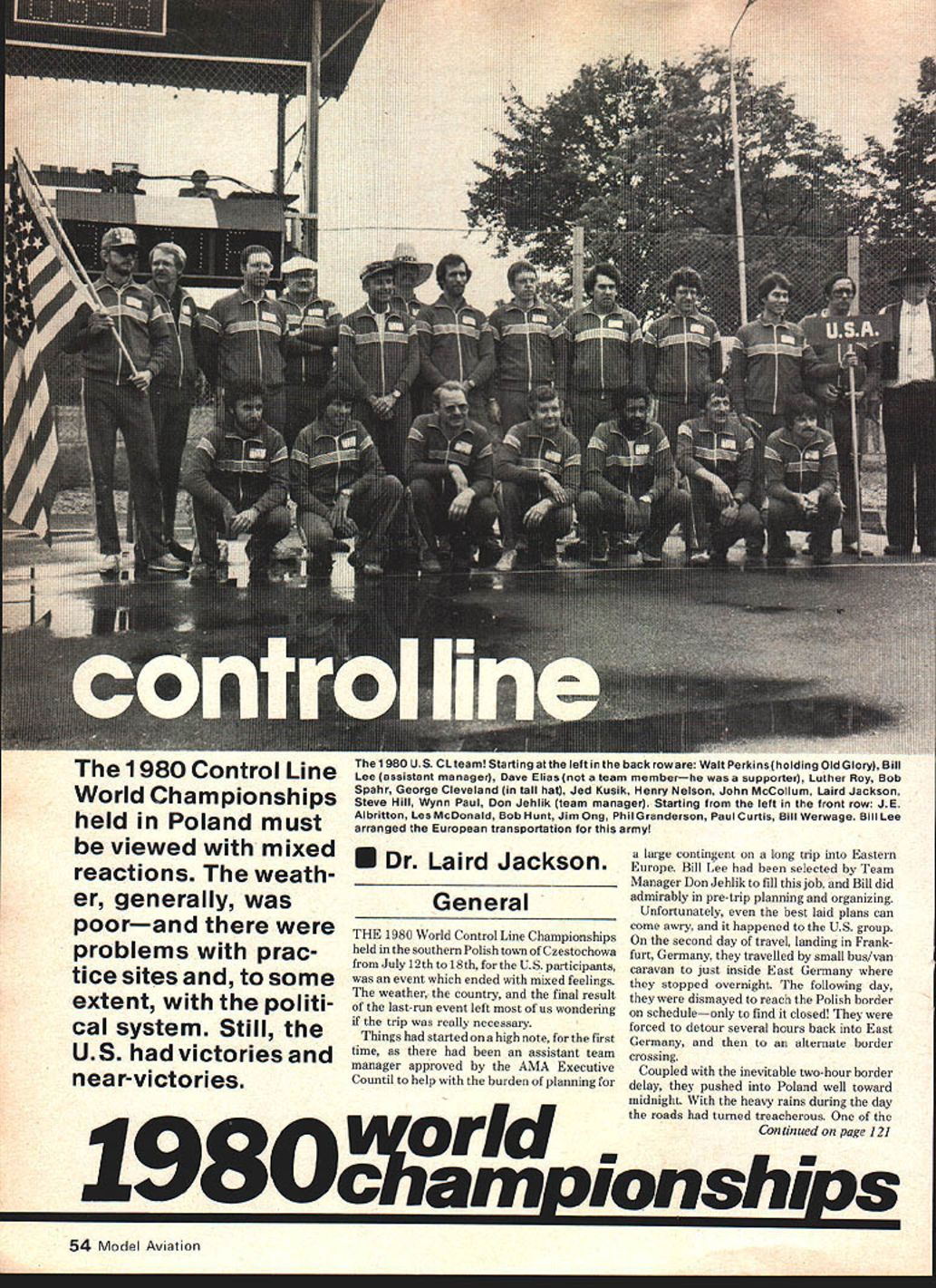
The 1980 World Control Line Championships were held in the southern Polish town of Czestochowa from July 12 to 18. For the U.S. participants the event ended with mixed feelings. The weather, the country, and the final result of the last-run event left most of us wondering if the trip was really necessary.
Things had started on a high note: for the first time an assistant team manager had been approved by the AMA Executive Council to help with planning for a large contingent on a long trip into Eastern Europe. Bill Lee had been selected by Team Manager Don Jehlik to fill this job, and Bill did admirably in pre-trip planning and organizing.
Unfortunately, even the best laid plans can come awry. On the second day of travel, landing in Frankfurt, Germany, the team traveled by small bus/van caravan to just inside East Germany where they stopped overnight. The following day they were dismayed to reach the Polish border on schedule—only to find it closed. They were forced to detour several hours back into East Germany and then to an alternate border crossing.
Coupled with the inevitable two-hour border delay, they pushed into Poland well toward midnight. With the heavy rains during the day the roads had turned treacherous. One of the cars that had gone ahead of the main group ran afoul of the road conditions and ended up off the road, its occupants and model equipment much wetter for the experience. Fortunately, although the delay put everyone to bed about 4 a.m. in Wroclaw, the incident set the tone. The rain, the incident, and near misses appeared to be the norm for the rest of the stay.
Accommodations and practice
Czestochowa completed registration and we settled comfortably into the large student dormitories in town. Living and eating arrangements were of a high standard throughout our stay (probably we were fed more meat than local citizens, given the recent meat shortage), and aside from occasional cold showers the rooms were quite comfortable. Unfortunately, facilities for training and practice flights were less satisfactory. Although the local organizers had done their best to arrange adequate practice areas, few countries have a number of large parking lots; the actual contest site was still being finished and was off-limits to us.
The main practice area for Aerobatics and Team Racing was a parking area next to a large high-rise housing development, resulting in hordes of small children, on foot and on bicycles, being attracted to the area. As kids are likely to do in any country, they crowded around the models and modelers and frequently darted through the circle just before one was ready to launch. That no one was hurt was more a matter of good luck than good management.
The rain came down with depressing regularity, and the winds blew fiercely at times. Evenings were spent drying shoes and clothes and repairing models, as well as in frantic conferences about what propeller might give some additional speed or why the fuel tank that worked in New Jersey didn't work in Poland.
Team prospects and expectations
All of this is fairly normal activity at a World Championships, and all signs pointed toward the U.S. teams being in good positions to do well.
- Aerobatics: The team was strong, as usual, and seemed certain to win the team title. The only open question appeared to be who would win the individual title.
- Speed: The team seemed strong, with Luke Roy posting a very fast time in practice—using less than his best equipment. Charles Liebert and Bob Spahr were suffering assorted ills, but we expected them to sort these out.
- Team Race: Albritton/Perkins were circulating consistently at high speed. McCollum/Kusik were running fast but inconsistently, and Jackson/Nelson were going slow but steady.
- Combat: Harder to predict, especially with Paul Curtis coming in as a last-minute substitute and with the additional disadvantage of not having a familiar pattern. George Cleveland and Phil Granderson looked ready, however, and we had high hopes on opening day.
Contest site and organization
The contest site itself was situated in a sports stadium apparently used for motorcycle racing. Combat was flown on two large grass circles within the stadium, and there was plenty of area for pits, helpers, and spectators. The Speed and Team Race circles were immediately outside; they appeared to be permanent sites with completely enclosed fencing, timer stands, line pit areas, and individual pit cages for each team. The Aerobatics area was at the stadium end in a converted parking area; it had a roped-off circle that was fairly open, but some turbulence-inducing obstacles were near the circle. All the surfaces were good asphalt and well marked for their respective events.
All in all, the housing and food were excellent, the overall organization quite good, and the contest site was very good. Only the practice arrangements were poor. Contest management was generally good, but technical processing was a bit slipshod in some areas (for example, my 6.9 cc Team Race tanks measured 6.0 cc). The Jury personnel had less clout than I had expected in Team Race, and the FAI Jury seemed to miss the presence of Sandy Pimenoff, who had to withdraw due to some unexplained emergency.
Conclusion
Poland was a nice place to visit (perhaps more briefly than we did), but I wouldn't choose to compete there again despite the warm hospitality. The overriding presence of the socialist community atmosphere is a downer that is hard to fight.
Transcribed from original scans by AI. Minor OCR errors may remain.

