
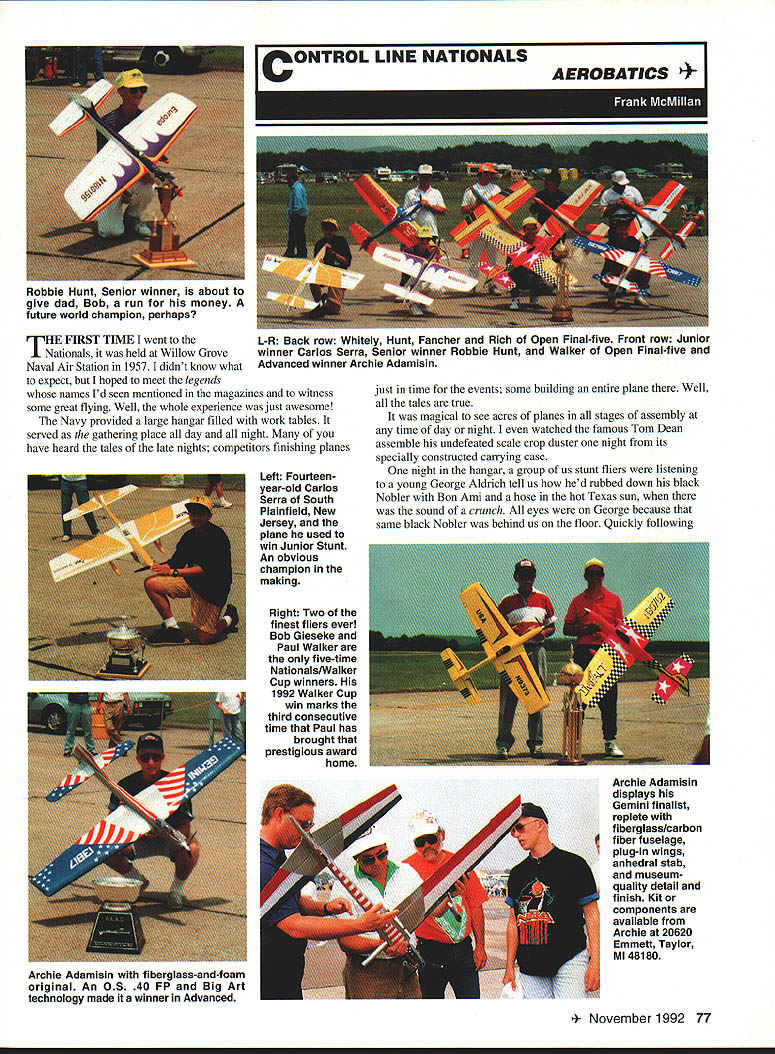
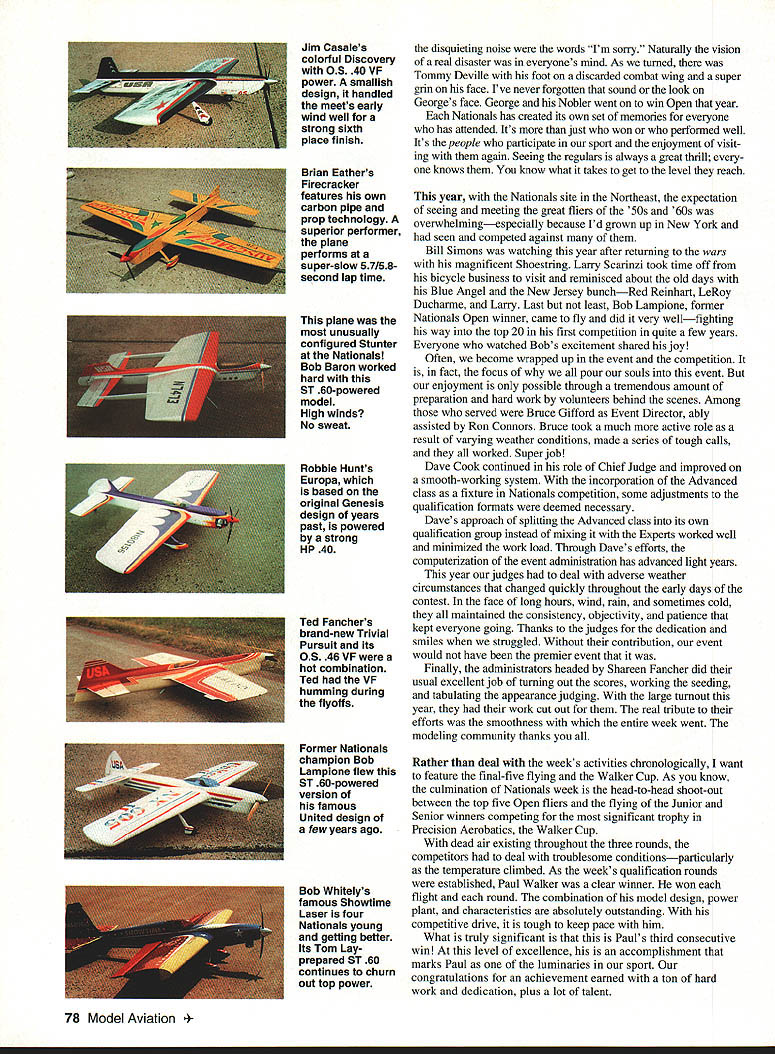
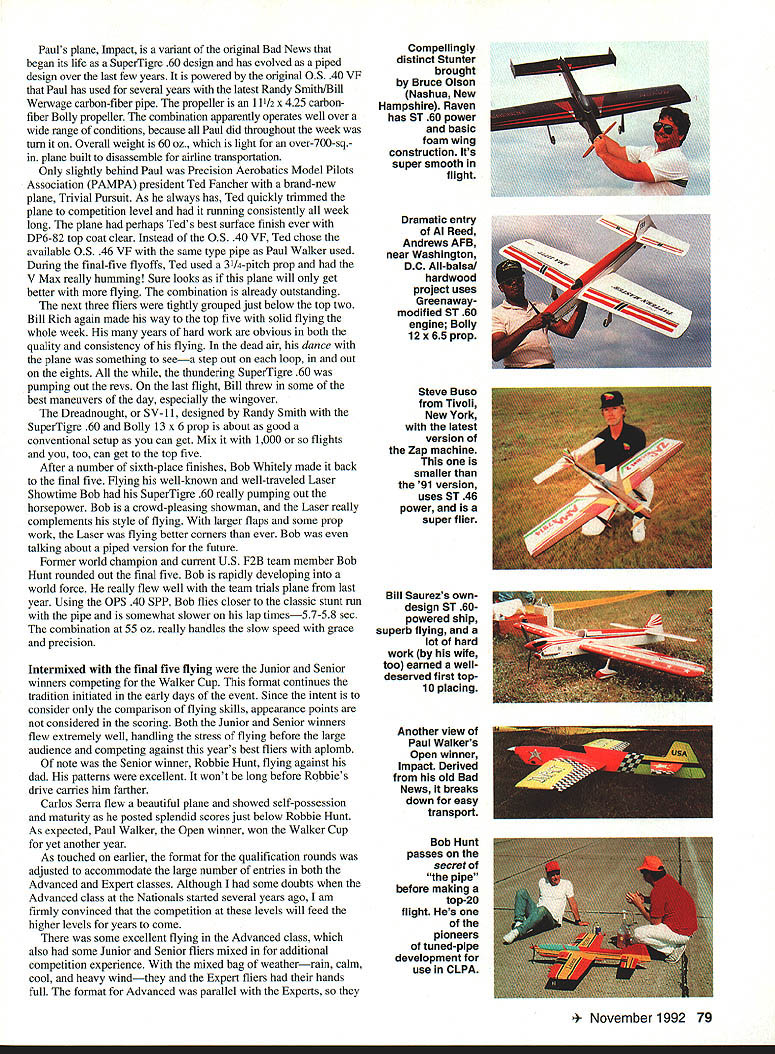
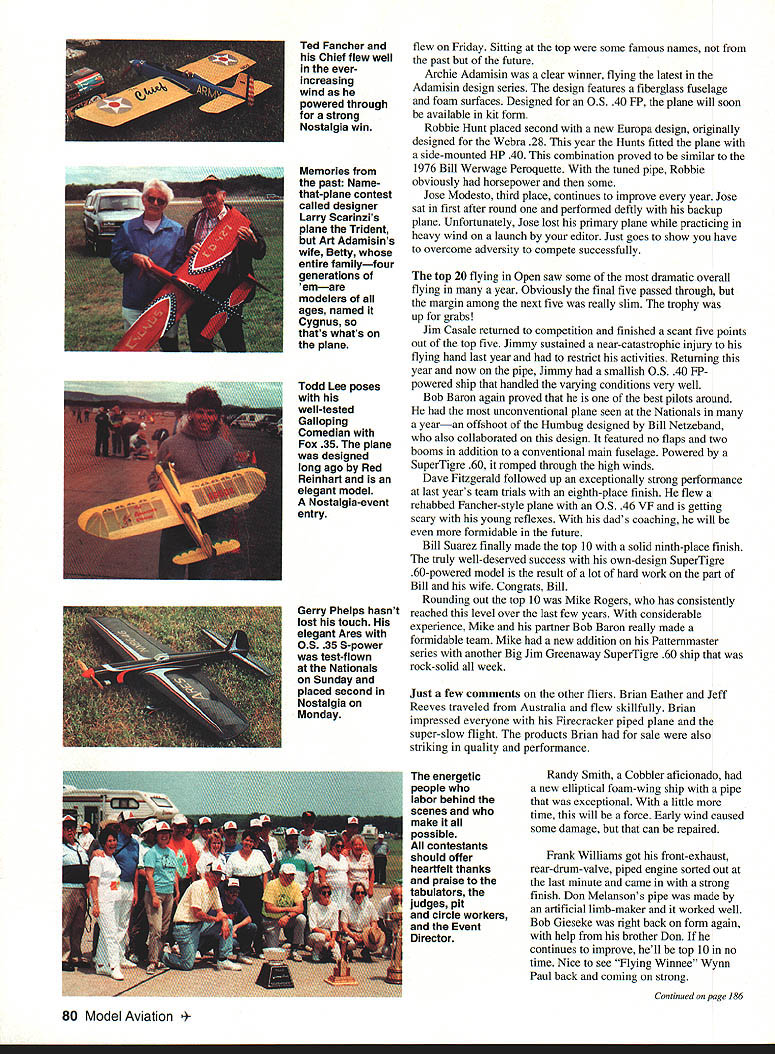
CONTROL LINE NATIONALS
AEROBATICS
Frank McMillan
The first time I went to the Nationals it was held at Willow Grove Naval Air Station in 1957. I didn't know what to expect, but I hoped to meet the legends I'd read about in the magazines and to witness some great flying. The whole experience was awesome.
The Navy provided a large hangar filled with work tables that served as the gathering place day and night. Many of you have heard the tales of late nights—competitors finishing planes just in time for events, some building an entire plane there. All the tales are true. It was magic to see acres of planes in all stages of assembly at any hour. I even watched Tom Dean assemble his undefeated scale crop duster one night from its specially constructed carrying case.
One night in the hangar a group of us stunt fliers were listening to a young George Aldrich tell us how he'd rubbed down his black Nobler with Bon Ami and a hose in the hot Texas sun. Suddenly there was the sound of a crunch. All eyes turned because that same black Nobler was behind us on the floor. We looked up to see Tommy Deville with his foot on a discarded combat wing and a super grin on his face. I've never forgotten the sound or the look on George's face. George and his Nobler went on to win Open that year.
Each Nationals creates its own set of memories for everyone who attends. It's more than who won or who performed well—it's the people who participate and the enjoyment of visiting with them again. Seeing the regulars is always a great thrill; everyone knows what it takes to get to the level they reach.
This year, with the Nationals site in the Northeast, the expectation of seeing and meeting the great fliers of the '50s and '60s was overwhelming—especially for those of us who grew up in New York and had competed against many of them. Old friends and characters reappeared: Bill Simons returned to the wars with his magnificent Shoestring; Larry Scarinzi took time off from his bicycle business to reminisce about the old days; the New Jersey contingent—Red Reinhart and LeRoy Ducharme—were present; and Bob Lampione, former Nationals Open winner, came to fly and did very well, fighting his way into the top 20 in his first competition in quite a few years. Everyone who watched Bob's excitement shared his joy.
Organization and volunteers
It's easy to become wrapped up in the competition, but the enjoyment of the event is only possible through a tremendous amount of preparation and hard work by volunteers behind the scenes. Among those who served:
- Bruce Gifford — Event Director, ably assisted by Ron Connors. Bruce took a much more active role due to varying weather and made a series of tough but effective calls.
- Ron Connors — Assistant to the Event Director.
- Dave Cook — Chief Judge. He improved a smooth-working system and implemented qualification adjustments to accommodate the Advanced class. His approach of splitting Advanced into its own qualification group instead of mixing it with Experts worked well and reduced workload. Computerization of event administration also advanced significantly under his efforts.
- The judging corps — Worked long hours in wind, rain, and cold, maintaining consistency, objectivity, and patience.
- Sharen Fancher and the administrators — Turned out scores, worked seeding, and tabulated appearance judging; their work helped the week run smoothly.
The modeling community thanks you all.
Final Five and the Walker Cup
With dead air throughout the three rounds and temperatures that climbed during the week, conditions were troublesome. As qualification rounds played out, Paul Walker was a clear winner, taking every flight and round. His combination of model design, power plant, and setup is outstanding, and his competitive drive is formidable. This is Paul's third consecutive Nationals win, a mark of sustained excellence.
Paul's plane, Impact, is a variant of the original Bad News. It began as a SuperTiger .60 design and has evolved into a pipped design over the last few years. It is powered by the original O.S. .40 VF with the Randy Smith/Bill Werwage carbon-fiber pipe and an 11-1/2 x 4.25 carbon-fiber Bolly prop. Overall weight is about 60 oz., light for an over-700-sq.-in. plane built to disassemble for airline transport.
Close behind Paul was PAMPA president Ted Fancher with a brand-new plane, Trivial Pursuit. Ted trimmed it quickly to competition level and had it running consistently all week. The plane had perhaps Ted's best surface finish ever with DP6-82 top coat clear. He chose the O.S. .46 VF with a similar pipe to Paul's and used a 3-1/4-pitch prop in the final-five flyoffs.
The next three fliers were tightly grouped:
- Bill Rich — Returned to the top five with solid flying all week. In dead air his flying was notable for precise loop and eight maneuvers, powered by a SuperTiger .60. His last flight included some of the best maneuvers of the day, especially the wingover. His Dreadnought (SV-11), designed by Randy Smith, with SuperTiger .60 and a Bolly 13 x 6 prop, is a proven conventional setup.
- Bob Whitely — After several sixth-place finishes he made the final five flying his Laser Showtime with a SuperTiger .60. Bob is a showman and the Laser complemented his style. With larger flaps and prop tweaks the Laser was flying corners better than ever.
- Bob Hunt — Former world champion and current U.S. F2B team member, rounding out the final five. Using an OPS .40 SPP and flying closer to the classic stunt run with a pipe, Bob flew a bit slower (lap times 5.7–5.8 sec). His 55-oz. setup handled slow speed with grace and precision.
Intermixed with the final-five flying were the Junior and Senior winners competing for the Walker Cup. Appearance points are not considered in this format; only flying skills are compared. Both winners flew extremely well under the stress of a large audience.
- Senior winner: Robbie Hunt — Flew excellent patterns against his dad; his drive will carry him farther.
- Carlos Serra — Posted splendid scores just below Robbie Hunt.
- Walker Cup: Paul Walker, the Open winner, won the Walker Cup for another year.
Qualification formats and the Advanced class
To accommodate large entries in both Advanced and Expert classes, qualification formats were adjusted. The Advanced class, now a fixture, was split into its own qualification group rather than being mixed with Experts. This change minimized workload and helped smooth operations. Advanced flying was excellent and included some Junior and Senior participants for additional experience. Advanced competitors were eligible for final-five flyoffs when formats permitted.
Advanced-class highlights
The Advanced class (and similar divisions) saw strong performances:
- Archie Adamisin — A clear winner flying the latest Adamisin design series, featuring a fiberglass fuselage and foam surfaces, designed for an O.S. .40 FP. The plane will soon be available in kit form.
- Robbie Hunt — Placed second with a new Europa design, originally for the Webra .28 but fitted this year with a side-mounted HP .40 and a tuned pipe. The combination provided abundant horsepower.
- Jose Modesto — Third place; continues to improve every year. Jose led after round one and performed deftly with his backup plane after losing his primary plane practicing in heavy wind.
The top 20 flying in Open produced some of the most dramatic flying in many years. The margin among places just outside the final five was very slim.
Open — notable top-20 performances
- Jim Casale — Returned to competition and finished five points out of the top five. After a near-catastrophic injury to his flying hand last year, Jimmy returned this year on the pipe with a smallish O.S. .40 FP-powered ship that handled varying conditions well.
- Bob Barone — Proved he's one of the best pilots around with an unconventional aircraft—an offshoot of the Humbug designed by Bill Netzband with collaboration on the design. It featured no flaps and two booms in addition to a conventional main fuselage, powered by a SuperTiger .60; it handled high winds well.
- Dave Fitzgerald — Followed up a strong team-trials performance with an eighth-place finish flying a rechabbed Fancher-style plane with an O.S. .46 VF.
- Bill Suarez — Made the top 10 with a solid ninth-place finish flying his own design powered by a SuperTiger .60.
- Mike Rogers — Rounded out the top 10 with a Patternmaster series addition, a SuperTiger .60 ship that was rock-solid all week.
Other notable fliers and entries:
- Brian Eather and Jeff Reeves (from Australia) — Flew skillfully. Brian impressed with a Firecracker-piped plane and very slow flight; his products for sale were striking in quality.
- Randy Smith — Debuted a new elliptical foam-wing ship with an exceptional pipe; early wind caused some damage but it showed promise.
- Frank Williams — Sorted a front-exhaust, rear-drum-valve piped engine at the last minute and finished strong.
- Don Melanson — His pipe, made by an artificial-limb maker, worked well.
- Bob Gieseke — Back on form with help from his brother Don; improving toward top-10 status.
- Wynn Paul — Nice to see him back and coming on strong.
- Windy Urtnowski — Had the misfortune of running out of fuel during his first flight's Four Leaf Clover. The resulting crash destroyed the plane that had won the Concours d'Elegance trophy; Windy flew last year's ship on his second flight.
Old-Time and Nostalgia events
Monday at the Nationals has become a fun day with Old-Time and Nostalgia events run as unofficial parts of the contest. With many entries this year both events were run concurrently—fortunate given winds gusting above 15 mph.
Old-Time (19 entries) was hard fought:
- Allen Brickhaus — First place with a rebuilt Stuntwagon after last year's crash.
- Todd Lee — Second place with a strong second flight.
- Don McClave — Third with a superbly flying Smoothie (Fox .35 power).
Nostalgia had a good turnout and strong flying despite the winds:
- Bob Whitely — Posted the high flight of the first round but returned from lunch too late to improve; finished fourth.
- Ted Fancher — Won Nostalgia after getting his Chief going in the second round.
- Gerry Phelps — Flew exceptionally well with an O.S. .355-powered Ares.
- Don McClave — Again flew his Smoothie for an excellent third.
Notable model and display
One standout entry featured original-design in-flight mixture control and retractable landing lights—the judges awarded the model generously. Charley's model and documentation package were superb, and his flight presentation was consistently professional. The judges' recognition was well deserved.
Technical notes and final thoughts
Tuned-pipe technology has really matured; numerous successful setups were on display. In heavy wind (approaching 25 mph) Walker's flying was awesome; his setup performed particularly well. Pipes tended to have an advantage in the wind because of their ability to use pitch props and produce more power. Eather's own pipe was notably quiet and powerful. The .60s ran well overall, but pipped setups often held the edge in windy conditions.
The 1992 AMA National Aeromodeling Championships has gone on to its place in modeling history. What of '93? Will you be content to read about it, or will you make plans to attend in person? The articles are fun, but being there is a whole lot better. Give it a shot — I think you'll enjoy yourself. Build straight, and fly safely. I'll talk with you later.
Transcribed from original scans by AI. Minor OCR errors may remain.

