
Control Line Nationals: Combat
Phil Cartier
We arrived at Westover Saturday night and finally found the motel after getting lost. Sunday early arrivals used open fields to fine-tune and test-fly models. Event Director Mike Urban arrived in the afternoon and set up the flying circles; the Air Force had knocked down tall grass but two circles still needed mowing and marking. The setup was finished by a small crew:
- Eric Gunn
- Steve Kott
- Gil Reedy
- Mike Urban
- Steve Wilk
- Pat Currier
- Terry Weinberg
- Bob Moller
- Vince Mankowski
- Joe Fustolo
Other key people who helped make the event successful included John Lowrey, Roy Glenn, Neil Simpson (Super Slow Combat), and Herb Johnson (RC scale flier and judge). Thanks to the Miniature Aircraft Combat Association (MACA) for corralling Mike Urban into the Event Director role and for championing Super Slow Combat. Club treasurer Chip Giordano (absent due to family illness) delegated organizational tasks to Steve Wilk, who handled lists, gear and T-shirt sales all week.
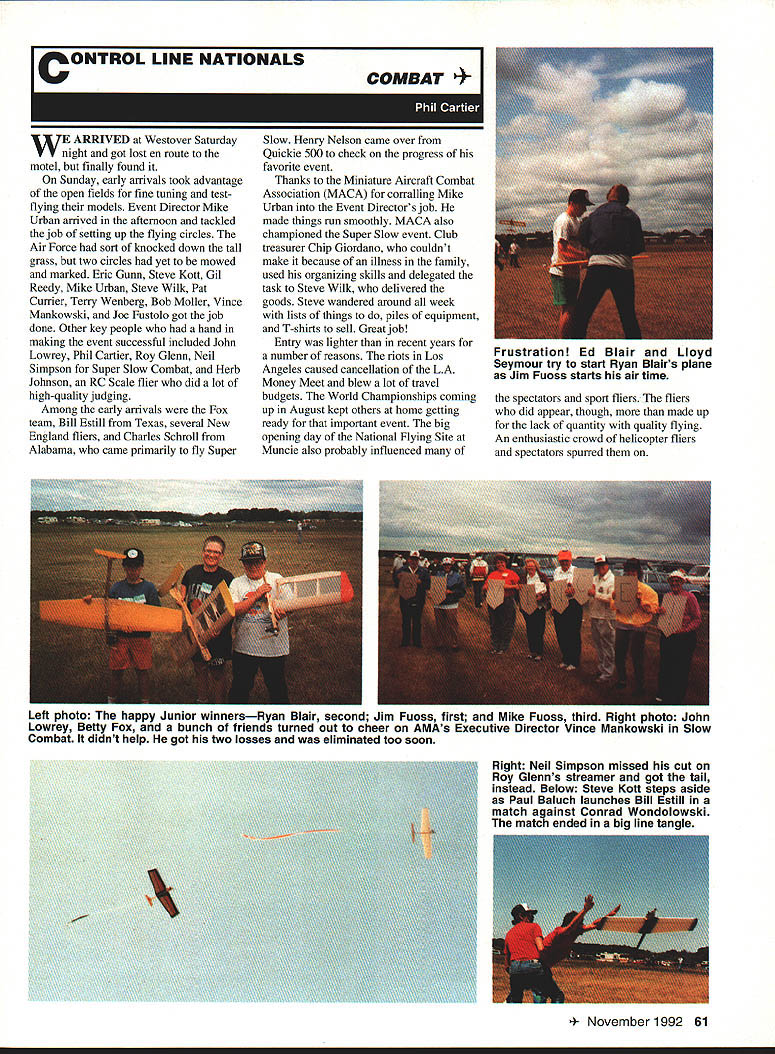
Entry was lighter than in recent years for several reasons: the Los Angeles riots canceled the LA Money Meet and cut travel budgets, many stayed home to prepare for the World Championships in August, and the big opening at the National Flying Site in Muncie drew some sport fliers away. Those who did attend made up for smaller numbers with high-quality flying and enthusiastic spectator turnout, including helicopter fliers.
Slow Combat
Monday morning’s Slow Combat began with round-robin traffic matches to fill matrices caused by odd numbers of entries. Junior entries were Ryan Blair, Jim Fuoss and Mike Fuoss; Senior was Aaron Moskel; Open included Eric Gunn. Junior results:
- Ryan Blair
- Jim Fuoss
- Mike Fuoss
Eric Gunn used a double-elimination warm-up in Open. In one match his tail broke in flight; after a hasty repair he faced Aaron Moskel, who had a better engine run (thanks to a borrowed prop) and managed the decisive charge on the streamer knot to take first in Open Slow.
Several Open matches stood out:
- Steve Wilk vs Steve Kott: very fast planes, traded cuts, spectacular midair; Wilk won on air time.
- Bill Estill vs Lloyd Seymour: Seymour’s Formula GX-style following and speed pressed Estill. Estill’s defensive low eights and a well-timed fake put Seymour into the ground; Seymour later struggled but fought on until the wing separated.
- Paul Kubek vs Eric Gunn: Kubek’s slower, meticulous GX-style flying paid off—he timed a sneak cut and later removed Gunn’s tail, finishing with a high score (566–456) that held as the event high until the finals.
- Neil Simpson vs Steve Kott: Kott had large airspeed advantage; Simpson followed and executed inside passes to score cuts, winning a crowd-pleasing match without a midair.
Notable midairs and incidents:
- Lloyd Seymour and Eric Gunn had a full 60-second skirmish before a spectacular midair; both planes landed with full streamers.
- Conrad Wondolowski tangled lines with Bill Estill and crashed after a chaotic sequence.
- Roy Glenn and Lloyd Seymour engaged in a gentlemanly battle that included mutual discussion between passes and ended with a big midair. That midair allowed Roy to test a new aluminum backplate engine mount he developed: a light backplate attached with two 8-32 Allen bolts into a 5/16-in. vertical aluminum rod through the fuselage. The mount withstood several severe crash tests.
Late-round drama:
- George Connors appeared to have a win when Bill Estill’s engine quit and Estill stepped out of the circle to land. Estill protested when George tried to cut while Estill was out of the circle; judges refl ew the match and Estill won convincingly on better engine run.
- The final rounds narrowed the field to Bill Estill, Lloyd Seymour and Chuck Schroll (each 5–1). Estill beat Schroll when Schroll’s engine quit and after a confusing snag-of-lines sequence. In the Estill vs Seymour final, Seymour flew a smooth, fast plane and avoided Estill’s fakes; he used speed to secure a double cut and survived a midair with both planes staying up. Seymour won the final 599 to 364—the highest score of the contest.
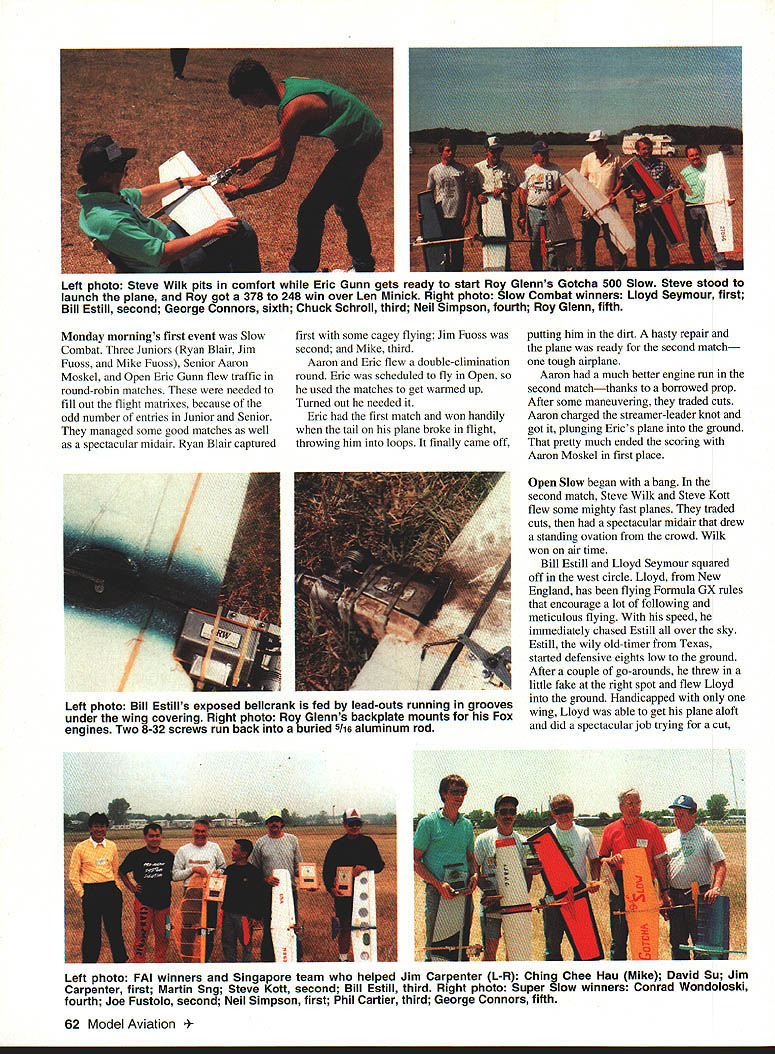
Slow Combat top finishers:
- Lloyd Seymour
- Bill Estill
- Chuck Schroll
- Neil Simpson
- Roy Glenn
- George Connors
Equipment notes from Slow Combat:
- Lloyd Seymour flew a stretched Connecticut Slow (Gotcha 460 wing on a 3/4-in. balsa fuselage).
- Bill Estill flew his own-design foam wings with removable metal motor mounts and a partially buried bellcrank; lead-outs ran through grooves in the foam under the covering.
- Many teams used APC 7.8 x 6 props (D-1 series) and moderately rich nitro (25–40%) to get honest 100+ mph speeds without tricks.
- Mark VI and other more powerful engines gave heavier planes an edge in wind and steadiness compared with Fox Stunt .35-powered ships.
- Maverick Enterprises (Mark Smith) did popular Slow engine mods: black anodized head clamp/prop driver, aluminum prop washer, larger bypasses, and new cylinder/piston with clips—avoiding the roll-pin sleeve failure.
Super Slow Combat
The unofficial Super Slow event was outstanding. Scheduled for 24 pilots, two dropped out before the first round and two more after day one; the remaining pilots ran 50 matches in five rounds (nonstop Thursday afternoon and Friday morning). Rules that encouraged clean flying:
- 74-mph speed limit (approx. 3.5 seconds per lap)
- Cutting the string scored 100 points only as a first cut (discouraged late-match midairs)
- Ties after five rounds were broken by total points scored, encouraging attempts at small cuts and avoiding midairs
The format kept midair rates low (about five or six midairs in 50 matches vs roughly 50% midair rate in Slow).
Top Super Slow results:
- Neil Simpson — 5–0, 2,097 points
- Joe Fustolo — part of a four-way tie, 1,967 points
- Phil Cartier — 1,917 points
- Conrad Wondolowski — 1,652 points
- George Connors — 4–1, 587 points (note: fewer point totals despite wins due to scoring detail)
6–10. Five-way tie at 3–2: Lloyd Seymour (1,815), Price (Bub) Reece (1,745), Steve Wilk (1,387), Ed Blair (1,130), Gerry Pompeii (1,063)
Typical Super Slow setups:
- Neil Simpson: Doc Passen–modified O.S. .35 FP, 9x4 prop, “Coyote Ugly” airframe (own design)
- Joe Fustolo: Mark III with restrictor in a Steve Sacco Super Nova; borrowed a Connecticut Slow with Mark VI later
- Phil Cartier: Gotcha Super Slow with a stock Fox Stunt .35 (heat-treated piston/liner, SuperTigre needle, lapped/fitted but otherwise stock)
- Conrad Wondolowski: Bushing Fox .40 with stock restrictor and 9x4 prop
- George Connors: G.21-35 with 9x6 prop and replacement wing; held Gotcha 400 wing on with rubber bands
A few pilots tried higher-pitch props with rich settings to induce a two-cycle effect in maneuvers for speed advantage; overheating occasionally caused near-forfeits.
FAI Combat
FAI Combat flew Wednesday afternoon after morning rain. Jim Carpenter teamed with the Team Race team from Singapore and won the finals 2–1. Steve Kott placed second and Steve Wilk took third.
Half-A Combat
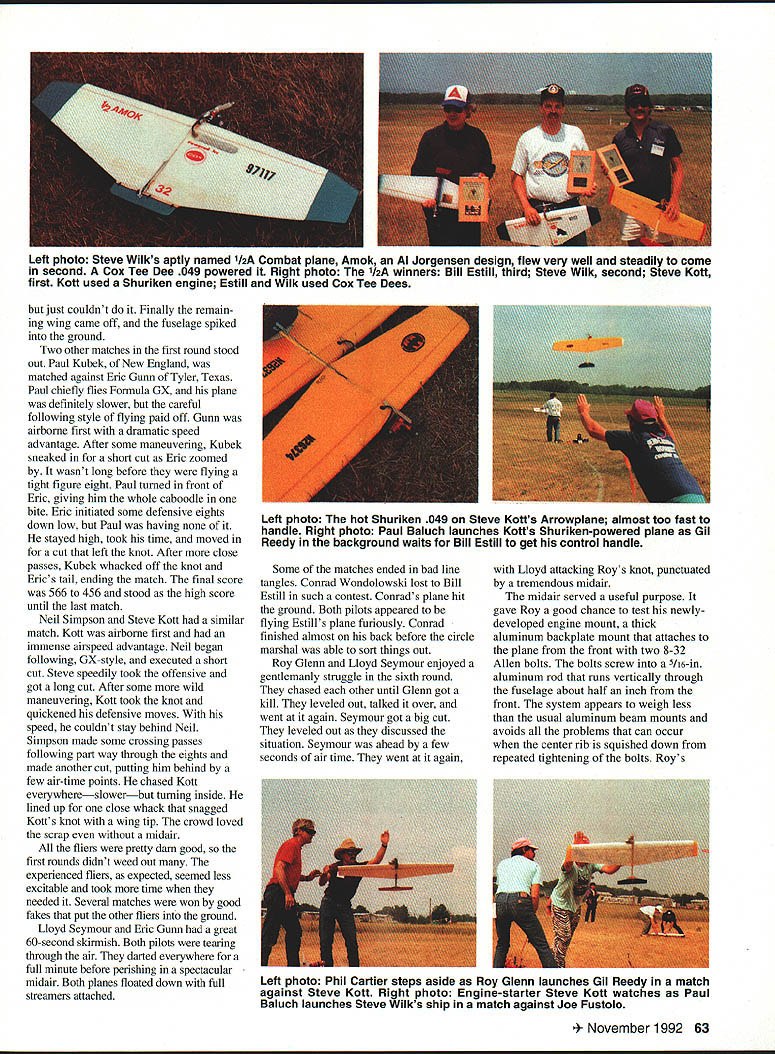
Half-A Combat saw limited entry (five fliers). Most started with Tee Dees; Steve Kott switched early to Shuriken-powered planes (same size, much faster). The Shuriken speed helped him win several matches but created start and handling headaches—he spent two minutes trying to start the engine for the first-place match and had a hair-raising time at speed. He managed key kills (including a line-ball kill just before a midair) but the event was small and fast.
Fast Combat
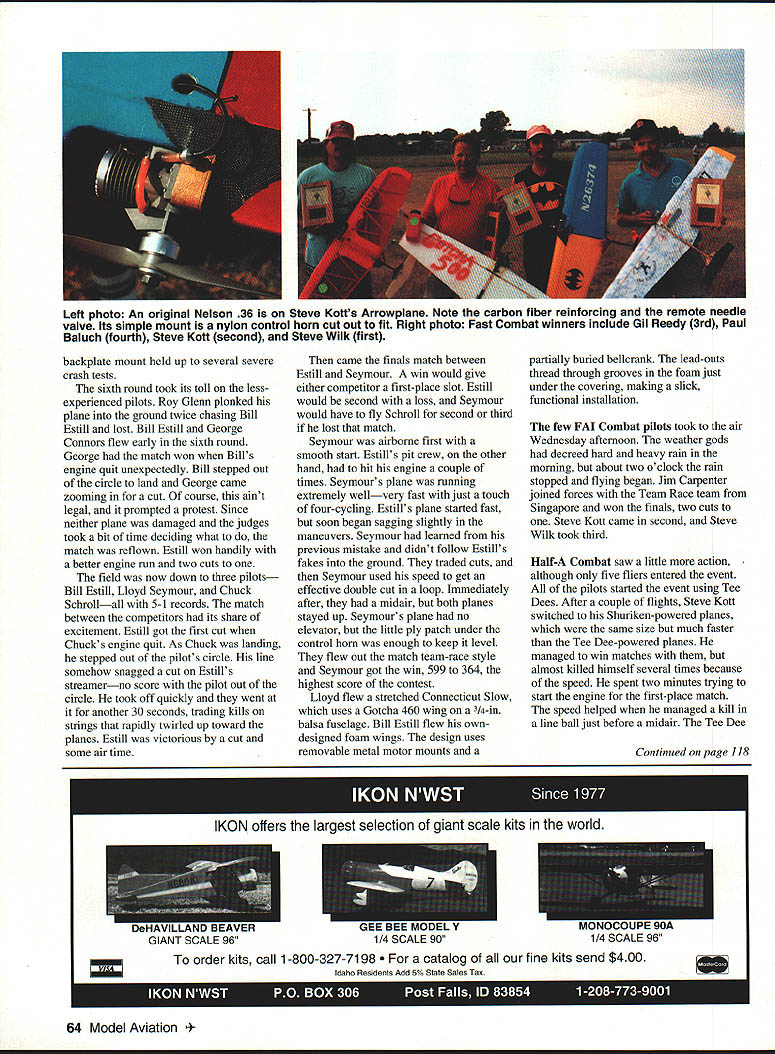
Fast Combat ran Friday afternoon after Super Slow. Eight fliers entered a triple-elimination tournament that produced eight rounds of action. The field included Paul Baluch, Steve Kott, Steve Wilk, Phil Cartier, Gil Reedy and others. Notable moments:
- Paul Baluch used a screaming Mark VI twin (Wisniewski piston and sleeve) to score quick kills on Gil Reedy and Chuck Schroll.
- Phil Cartier and Gil Reedy had a match with multiple pit mistakes (broken battery, bad plug, crew tripping over lines) that made for a memorable “circus act.”
- In late rounds, Wilk and Kott fought two intense matches. In one match both streamers remained tied despite violent midair foam damage; Wilk won the overall event.
Fast Combat final standings:
- Steve Wilk — 6–2
- Steve Kott — 5–3
- Gil Reedy — 4–3
- Paul Baluch — 3–3
Equipment and engine trends seen in Fast/Slow:
- Nelson .36 engines appeared (used by Steve Kott in several matches). They are lighter than Fox engines and come ready to run; need modified planes for ideal balance.
- APC 7.8 x 6 (D-1 series) prop from Landing Products is widely used in both Fast and Slow; recent mold updates beefed up hubs and blade sweep for better durability at high RPM.
- Many pilots run modified Mark VI or other higher-power engines for stability and wind penetration; a heavy ship with Mark VI on 9x4 seems steadier than a Stunt .35 ship.
- Paul Baluch experimented with geodetic construction behind spars and mixed foam/balsa techniques (all-foam wing with cutaway back half, added trailing edge and angled half ribs) to stiffen structure and save weight.
- Trailing-edge stiffeners (1/8 x 1/2-in. balsa, tapered to the airfoil and reinforced at the boom with carbon fiber) were common to stiffen foam wings. Some pilots used heavy-duty booms (3/8-in. or even 1/2-in.) for added stiffness.
- New products and hop-ups: Paul Baluch’s PB-1 oil additive (raises fuel flash point and improves lubrication under high temps) and Phil Cartier’s yellow bladder tubing (better sun resistance than plain latex) were in use.
Conclusion
Despite lighter entries, the meet delivered intense, high-quality combat flying across Slow, Super Slow, Fast, FAI and Half-A events. The combination of innovative engine mods, improved props, and varied airframe techniques produced high speeds and tight matches while Super Slow rules proved effective at reducing midairs and encouraging clean fights. The organizers, judges and pit crews, especially MACA, Mike Urban and Steve Wilk, earned praise for running a smooth, well-attended Nationals.
Transcribed from original scans by AI. Minor OCR errors may remain.

