
Control Line Nationals: Racing
John Ballard
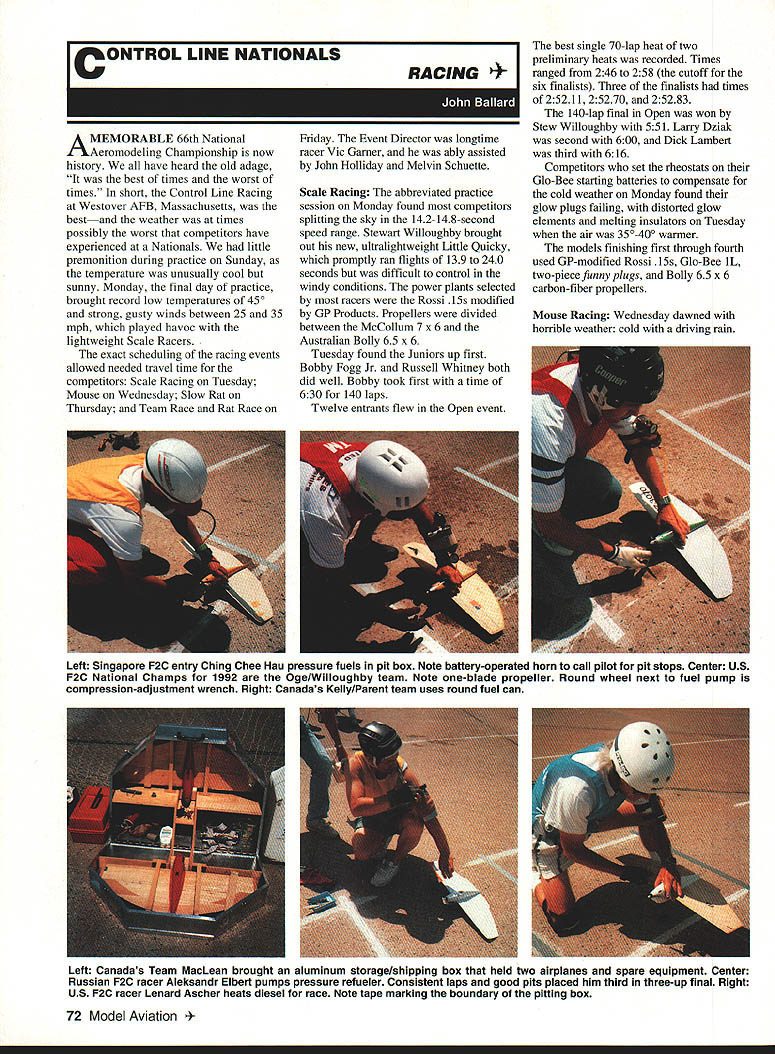
A memorable 66th National Aeromodeling Championship is now history. Control Line Racing at Westover AFB, Massachusetts, was the best of times for the competition — although the weather was, at times, possibly the worst Nationals competitors have experienced. Practice on Sunday was cool but sunny, but Monday, the final day of practice, brought record low temperatures of 45°F and strong, gusty winds of 25–35 mph, which played havoc with the lightweight Scale Racers.
The racing schedule allowed needed travel time for competitors:
- Scale Racing — Tuesday
- Mouse Racing — Wednesday
- Slow Rat — Thursday
- Team Race and Rat Race — Friday
The Event Director was longtime racer Vic Garner, assisted by John Holliday and Melvin Schuette.
Scale Racing
An abbreviated practice session on Monday found most competitors splitting the sky in the 14.2–14.8-second speed range. Stewart Willoughby brought out his new, ultralightweight Little Quicky, which promptly ran flights of 13.9 to 24.0 seconds but was difficult to control in the windy conditions. Most racers selected Rossi .15 engines modified by GP Products. Propellers were split between the McCollum 7 x 6 and the Australian Bolly 6.5 x 6.
Tuesday saw the Juniors fly first. Bobby Fogg Jr. and Russell Whitney performed well; Bobby took first with a time of 6:30 for 140 laps.
Twelve entrants flew in the Open event. The best single 70-lap heat of two preliminary heats was recorded; preliminary times ranged from 2:46 to 2:58 (the cutoff for the six finalists). Three finalists posted very close preliminary times: 2:52.11, 2:52.70, and 2:52.83. The 140-lap Open final was won by Stew Willoughby with 5:51, Larry Dziak was second with 6:00, and Dick Lambert third with 6:16.
Some competitors who had set the rheostats on their Glo-Bee starting batteries to compensate for Monday’s cold found that their glow plugs failed on Tuesday when the air warmed by 35–40°F; failures included distorted glow elements and melting insulators.
The models finishing first through fourth in Open used:
- GP-modified Rossi .15 engines
- Glo-Bee II two-piece "funny" plugs
- Bolly 6.5 x 6 carbon-fiber propellers
Mouse Racing
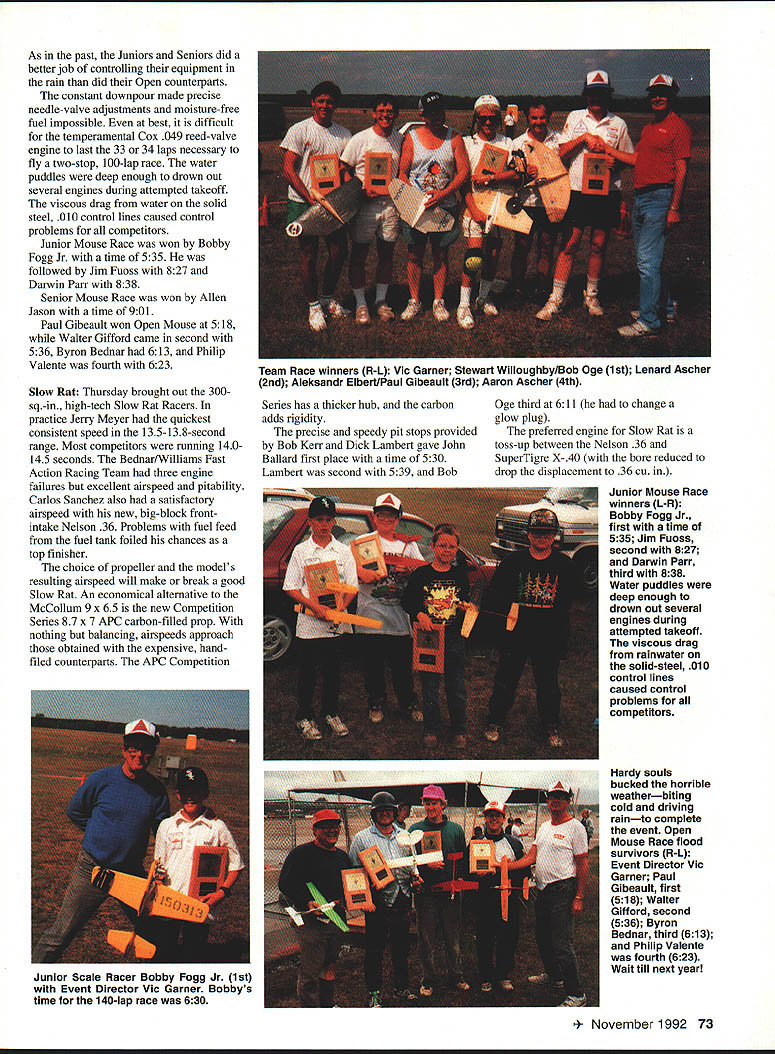
Wednesday dawned with terrible weather: cold with driving rain. The downpour made precise needle-valve adjustments and moisture-free fuel impossible. Junior and Senior pilots generally did a better job controlling equipment in the rain than Open pilots. The temperamental Cox .049 reed-valve engine was especially problematic, losing power in the last 33–34 laps needed to complete a two-stop 100-lap race. Water puddles were deep enough to drown several engines during attempted takeoffs. Viscous drag from water and the solid-steel .010 control lines caused control problems.
Results:
- Junior Mouse: 1st Bobby Fogg Jr. (5:35), 2nd Jim Fuoss (8:27), 3rd Darwin Parr (8:38)
- Senior Mouse: 1st Allen Jason (9:01)
- Open Mouse: 1st Paul Gibeault (5:18), 2nd Walter Gifford (5:36), 3rd Byron Bednar (6:13), 4th Philip Valente (6:23)
Slow Rat
Thursday brought out 300-sq-in high-tech Slow Rat racers. Practice showed Jerry Meyer the quickest, consistently in the 135–138-second range; most others ran 140–145 seconds. The Bednar/Williams Fast Action Racing Team suffered three engine failures despite excellent airspeed and pitability. Carlos Sanchez showed good airspeed with a new big-block front-intake Nelson .36, but fuel-feed problems to the tank ruined his chances for a top finish. Choice of propeller, balancing, and matching airspeeds can make or break a Slow Rat effort.
Propeller notes:
- Economical alternative: McCollum 9 x 6
- New APC Competition Series 8 x 7 carbon-filled prop: thicker hub, added rigidity, requires less balancing than hand-filed props
Precise, speedy pit stops (notably by Bob Kerr) helped the competition. Results:
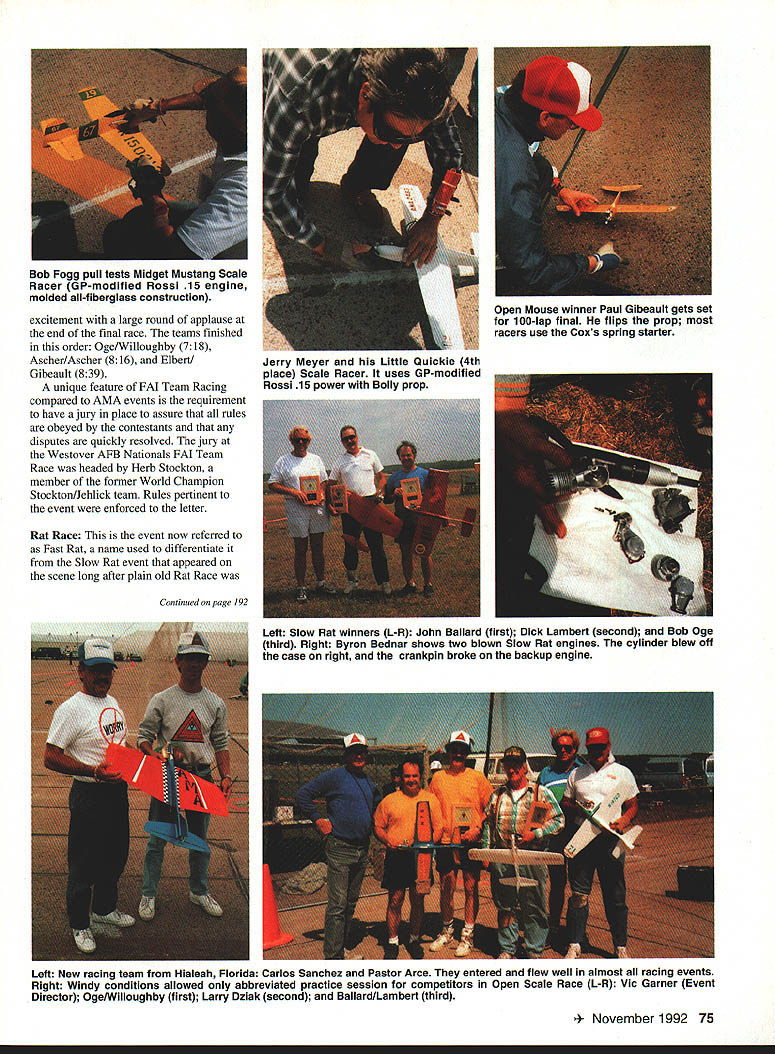
- John Ballard — 5:30
- Dick Lambert — 5:39
- Bob Oge — 6:11 (Bob Oge had to change a glow plug)
Preferred engines for Slow Rat were a toss-up between the Nelson .36 and the SuperTigre X-40 (modified to .36 cu. in.). Engines with AAC (aluminum pistons running in a chromed aluminum cylinder liner) and ABC (aluminum pistons running in a chromed brass cylinder liner) appeared equal in power and pit-stop capability. Most glow plugs were the Nelson one-piece variety, available in standard or heavy-duty glow-element configurations.
Team Race
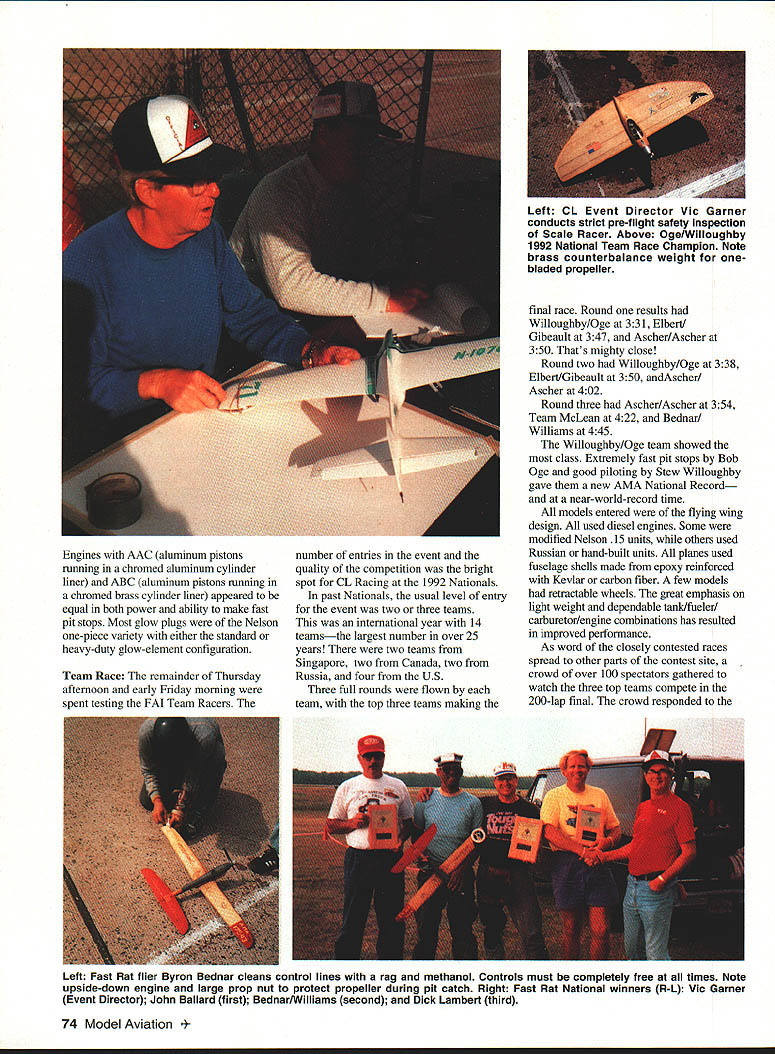
Thursday afternoon and early Friday morning were spent testing the FAI Team Racers. The number and quality of entries was a bright spot for CL Racing at the 1992 Nationals. In past Nationals, entries were typically two or three teams; this international year featured 14 teams — the largest number in over 25 years — including two teams each from Singapore, Canada, and Russia, and four from the U.S.
Format:
- Three full rounds were flown by each team; the top three teams advanced to the final.
Round results:
- Round One: Willoughby/Oge 3:31, Elbert/Gibeault 3:47, Ascher/Ascher 3:50
- Round Two: Willoughby/Oge 3:38, Elbert/Gibeault 3:50, Ascher/Ascher 4:02
- Round Three: Ascher/Ascher 3:54, Team McLean 4:22, Bednar/Williams 4:45
Willoughby/Oge combined extremely fast pit stops by Bob Oge with expert piloting by Stew Willoughby to set a new AMA National Record — near a world-record time. All entered models were flying-wing designs using diesel engines (some modified Nelson .15s, others Russian or hand-built units). Fuselage shells were epoxy reinforced with Kevlar or carbon fiber; some models had retractable wheels. Emphasis on light weight and dependable tank/fuel/carburetor/engine combinations improved overall performance.
A crowd of over 100 spectators watched the 200-lap final. Final order:
- Oge/Willoughby — 7:18
- Ascher/Ascher — 8:16
- Elbert/Gibeault — 8:39
FAI Team Racing requires a jury to ensure rules are followed and disputes resolved quickly. The jury at Westover was headed by Herb Stockton, of the former World Champion Stockton/Jehlik team, and rules were enforced strictly.
Rat Race (Fast Rat)
The Rat Race, now commonly called Fast Rat to differentiate it from Slow Rat, followed the Team Racers. Airspeeds for these winged bullets were in the 11.2–11.9-second range, with Larry Dziak appearing the most consistent. The lengthy Team Race and a shortage of Fast Rat pilots eliminated time for practice.
New AMA Safety Code provisions require that all Fast Rat practice and races be flown inside a safety barrier (net).
Dominant engines: K&B .40 (6.5 cc) and SuperTigre X-40. Some competitors used FS-designed cylinder heads (glow plug at .160-in. depth and combustion chamber machined with a .150-in. diameter ball mill) and were able to run one-piece Nelson heavy-duty glow plugs; others used two-piece Glo-Bee II plugs.
In the first 140-lap race, the Ballard/Lambert team finished first with a time of 5:01, slowed by a flooded engine that delayed a pit restart. Dee Williams had carburetor problems racing Larry Dziak, which opened the door for a possible repeat by 1991 champion Larry Dziak — but gremlins intervened.
The final race between Bednar and Lambert was the highlight of the day. Final standings:
- John Ballard — 5:01
- Byron Bednar — 5:08
- Dick Lambert — 5:21
As noted earlier, the Team Racing event was the highlight of Control Line Racing at the 1992 Nationals. U.S. fliers appreciated the strong foreign participation. Many thanks are owed to the officials and workers who assisted in race timing and other aspects of the competition. The program was aided by K&B Manufacturing.
The weather had one last blast on Saturday morning when six inches of hail fell on Chicopee.
Transcribed from original scans by AI. Minor OCR errors may remain.

