
CONTROL LINE NATIONALS: SCALE
Stan Alexander
Overview
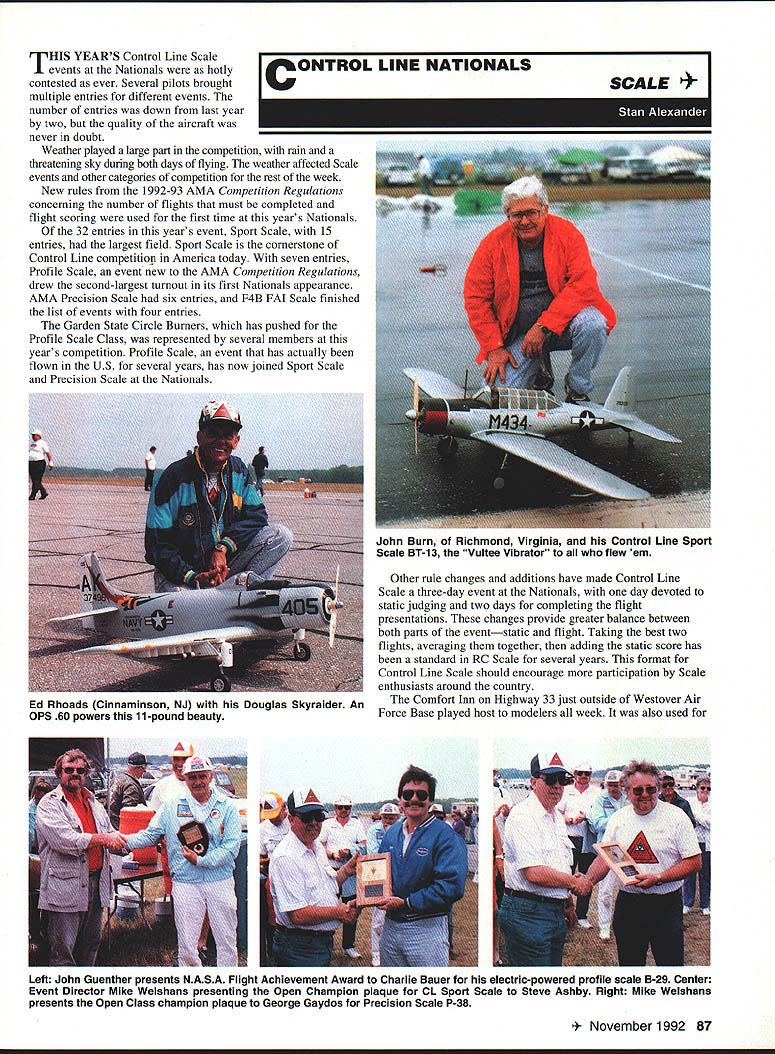
This year's Control Line Scale events at the Nationals were as hotly contested as ever. Several pilots brought multiple entries in different events. The total number of entries (32) was down slightly from last year, but the quality of aircraft remained high. Weather — rain and threatening skies on both days of flying — played a large role and affected the competitions.
New rules in the 1992–93 AMA Competition Regulations governing the number of flights and flight scoring were used for the first time at the Nationals. Control Line Scale was run as a three-day event: one day for static judging and two days for flight presentations. Flight scoring used the format of taking the best two flights, averaging them, and adding the static score — a format long standard in RC Scale.
Entries and events
- Total entries: 32
- Sport Scale: 15 entries (largest field)
- Profile Scale: 7 entries (first Nationals appearance under AMA regs)
- AMA Precision Scale: 6 entries
- F4B / FAI Scale: 4 entries
The Garden State Circle Burners have long supported Profile Scale and were well represented.
Venue
- Static judging and modelers were hosted at the Comfort Inn on Highway 33, just outside Westover Air Force Base.
- Flying site: Westover AFB. There were two flying circles with the pit area between them; pilots appreciated the smooth surface.
Static judging
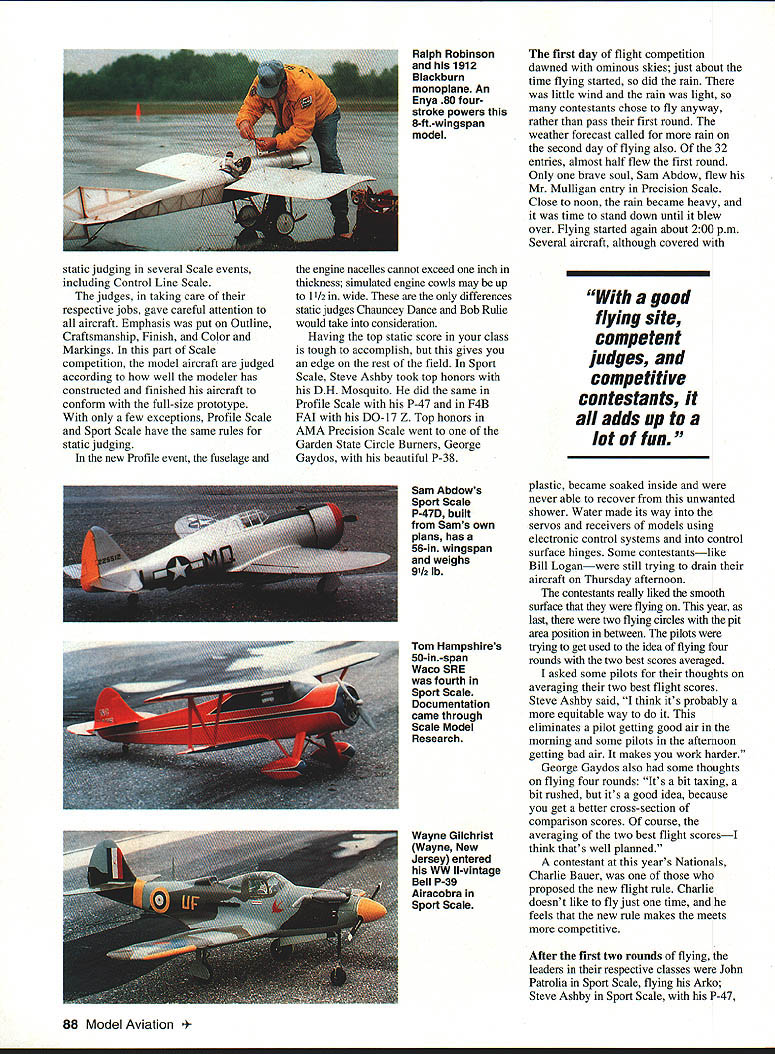
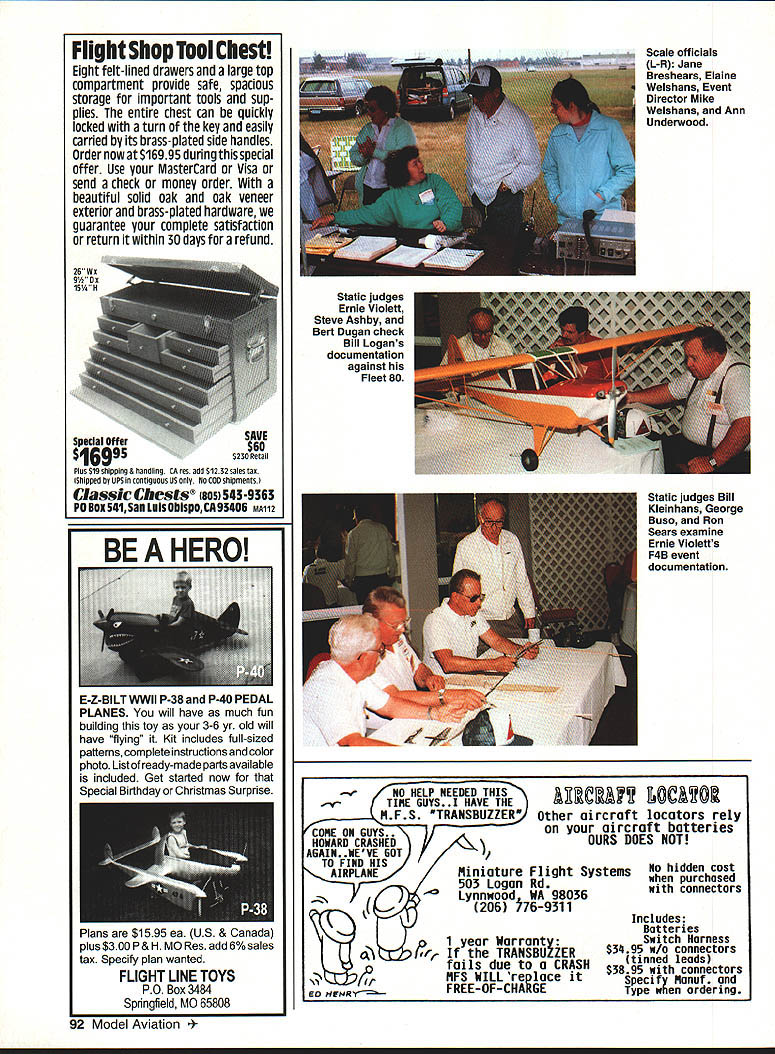
Judges emphasized outline, craftsmanship, finish, color, and markings, judging models on how well they conformed to the full-size prototypes. With few exceptions, Profile Scale and Sport Scale used the same static rules. In Profile Scale the fuselage and engine nacelles cannot exceed 1 in. in thickness; simulated engine cowls may be up to 1-1/2 in. wide.
Top static honors:
- Sport Scale: Steve Ashby (D.H. Mosquito)
- Profile Scale: Steve Ashby (P-47)
- F4B/FAI: Steve Ashby (Dornier DO-17Z)
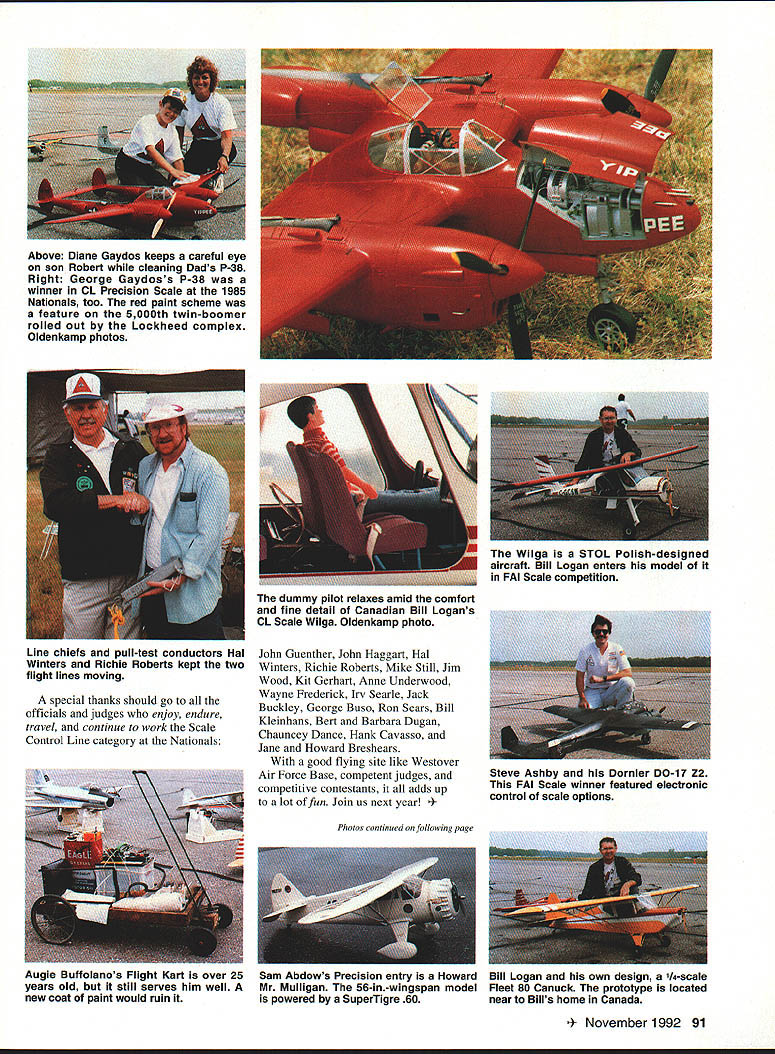
- Precision Scale: George Gaydos (P-38)
Flight competition — weather and format
The first day of flying dawned with ominous skies and light rain. With little wind, many contestants chose to fly rather than pass the first round. Close to noon the rain became heavy and flying was suspended until about 2:00 p.m. Several aircraft, though covered with plastic, were soaked internally; water entered servos, receivers, and control-surface hinges, and some pilots (e.g., Bill Logan) spent Thursday draining aircraft.
Pilots flew four rounds, with their two best flights averaged. Competitors generally approved of the new averaging method as more equitable and more representative of overall performance.
Pilot comments on the averaged-two-best rule:
- Steve Ashby: "I think it's probably a more equitable way to do it. This eliminates a pilot getting good air in the morning and some pilots in the afternoon getting bad air. It makes you work harder."
- George Gaydos: "It's a bit taxing, a bit rushed, but it's a good idea, because you get a better cross-section of comparison scores."
- Charlie Bauer (rule proponent): prefers more than one flight and feels the rule makes meets more competitive.
Line chiefs and pull-test conductors Hal Winters and Richie Roberts kept the two flight lines moving.
Event results and highlights
AMA Precision Scale
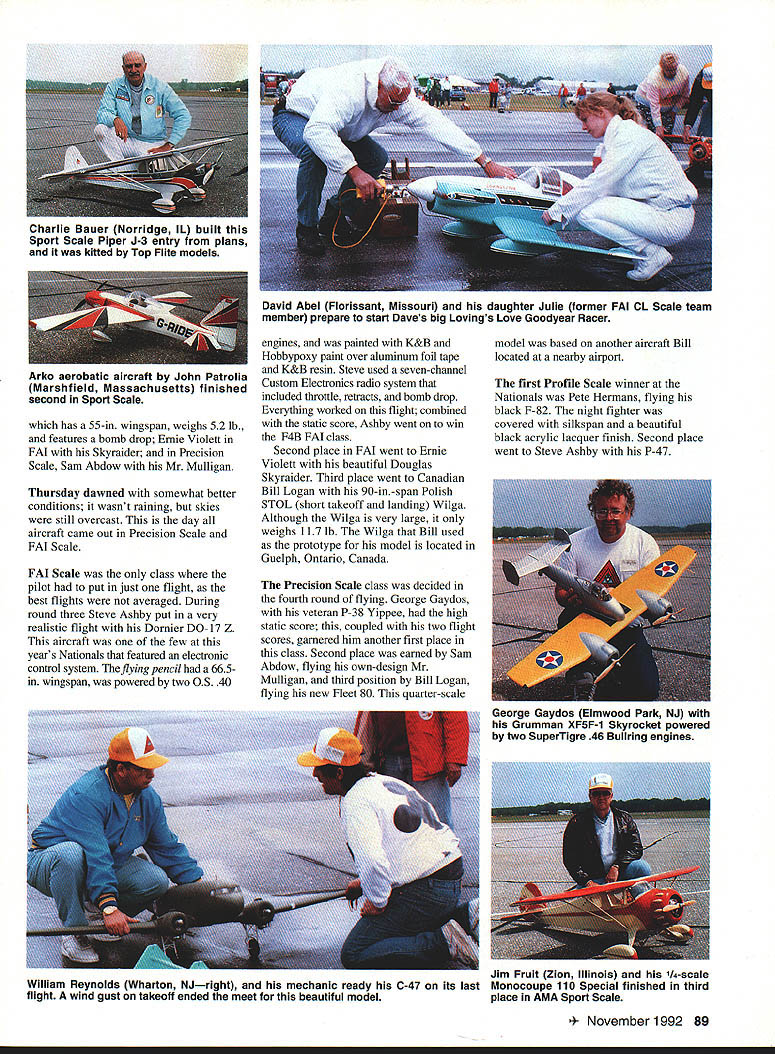
- George Gaydos — P-38 "Yippee" (high static score + two flight scores)
- Sam Abdow — Mr. Mulligan (own design)
- Bill Logan — Fleet 80 (quarter-scale model based on a full-size aircraft he located)
Notes:
- The Precision Scale class was decided in the fourth round of flying.
Sport Scale
- Steve Ashby — De Havilland Mosquito (silkspan, Aerogloss finish; powered by two O.S. .35 engines)
- John Patrolia — Arko (colorful acrobatic scheme)
- Jim Fruit — Monocoupe 110 Special (1930s vintage, four-stroke O.S. .90, 69-in. wingspan)
Notes:
- Sport Scale remains the cornerstone of Control Line competition and continues to draw the largest entry list.
- George Gaydos entered a Grumman SF5-1 Skyrocket but handling issues kept him from contention despite a high static score.
- Junior entry: Jeremiah McMillin (FW-190) was the only Junior competitor this year.
Profile Scale
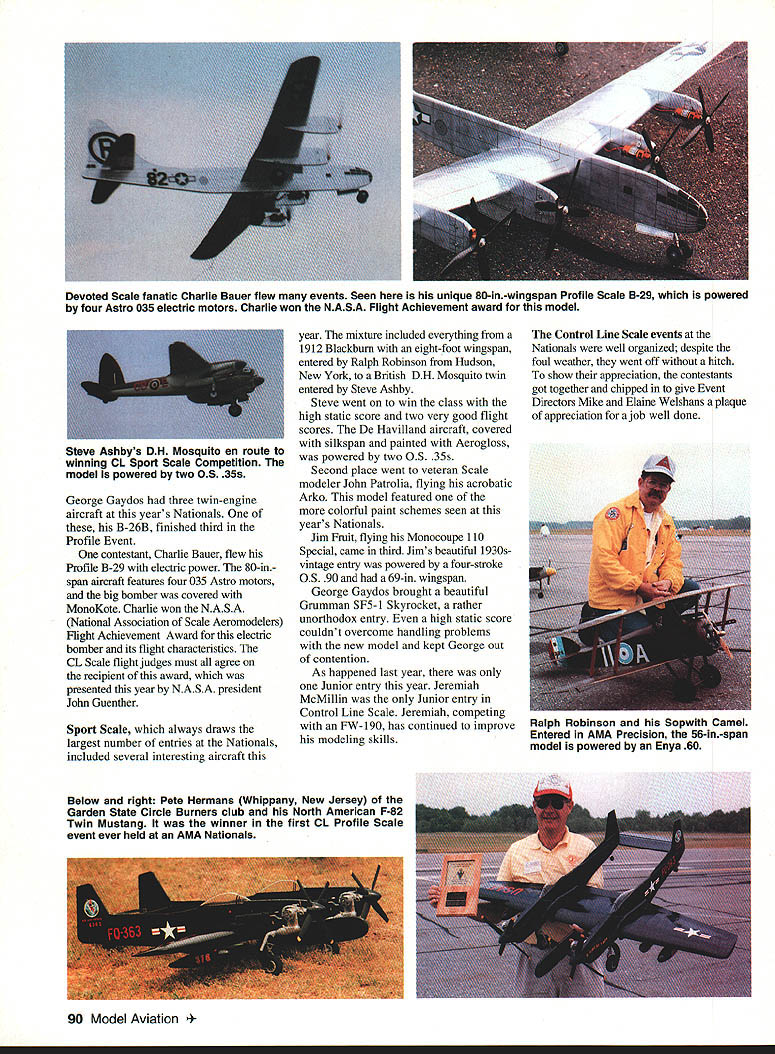
- Pete Hermans — F-82 night fighter (silkspan covering, black acrylic lacquer finish)
- Steve Ashby — P-47
- George Gaydos — B-26B (one of three twin-engine entries Gaydos brought; finished third in Profile)
Notes:
- Profile Scale has been flown in the U.S. for years and has now joined Sport and Precision Scale at the Nationals.
F4B / FAI Scale
- Steve Ashby — Dornier DO-17Z (66.5-in. wingspan; two O.S. .40 engines; paint over aluminum foil tape; seven-channel Custom Electronics radio with throttle, retracts, and bomb drop)
- Ernie Violett — Douglas Skyraider
- Bill Logan — Polish STOL Wilga (90-in. span, 11.7 lb.; prototype located in Guelph, Ontario)
Notes:
- FAI Scale required only one flight (best flights were not averaged); Ashby's realistic flight and working systems secured the class win.
Notable aircraft and achievements
- Charlie Bauer — Profile B-29 with electric power (80-in. span; four .035 Astro motors; covered with MonoKote). Bauer received the N.A.S.A. (National Association of Scale Aeromodelers) Flight Achievement Award; the CL Scale flight judges unanimously agreed on the recipient. The award was presented by N.A.S.A. president John Guenther.
- A wide mix of entries included a 1912 Blackburn (eight-foot wingspan) entered by Ralph Robinson and Steve Ashby's D.H. Mosquito twin.
- Several contestants were affected by water intrusion into electronics and control linkages following the rain.
Officials, judges, and volunteers
Special thanks to the event officials and judges who worked the Control Line Scale category:
- John Guenther
- John Haggart
- Hal Winters
- Richie Roberts
- Mike Still
- Jim Wood
- Kit Gerhart
- Anne Underwood
- Wayne Frederick
- Irv Searle
- Jack Buckley
- George Buzo
- Ron Sears
- Bill Kleinhans
- Bert and Barbara Dugan
- Chauncey Dance
- Hank Cavasso
- Jane and Howard Breshears
- Mike and Elaine Welshans (Event Directors — received a plaque of appreciation from the contestants)
Closing
Despite the foul weather, the Control Line Scale events at Westover were well organized and ran smoothly. With a good flying site, competent judges, and competitive contestants, the Nationals delivered a lot of fun. Join us next year!
Transcribed from original scans by AI. Minor OCR errors may remain.

