
Control Line Nationals: Speed
Glenn Lee
Overview
The Control Line Nationals Speed competition drew 131 entrants, 199 flights, and 83 attempts over four days of competition despite nasty weather and several new, restrictive rules.
- Rule changes and restrictions:
- Longer lines required in 1/2A and B.
- Fuel limited to 10% nitro in all engine classes except 1/2A.
- Jet fuel limited to an 80/20 mixture of methanol and methyl ethyl ketone (MEK).
As we drove across New York toward Massachusetts, a cold Alberta Clipper brought strong north winds and temperatures in the 40s. Summertime Nationals, indeed.
Monday — 1/2A Day
Processing ran from 7:00–9:00 a.m. each morning under Event Director Elmer Huff and his assistants Hilda Huff, Fran Garzon, and Roxy Brown. The wind and cold made contestants hesitant to fly small models, so action started slowly.
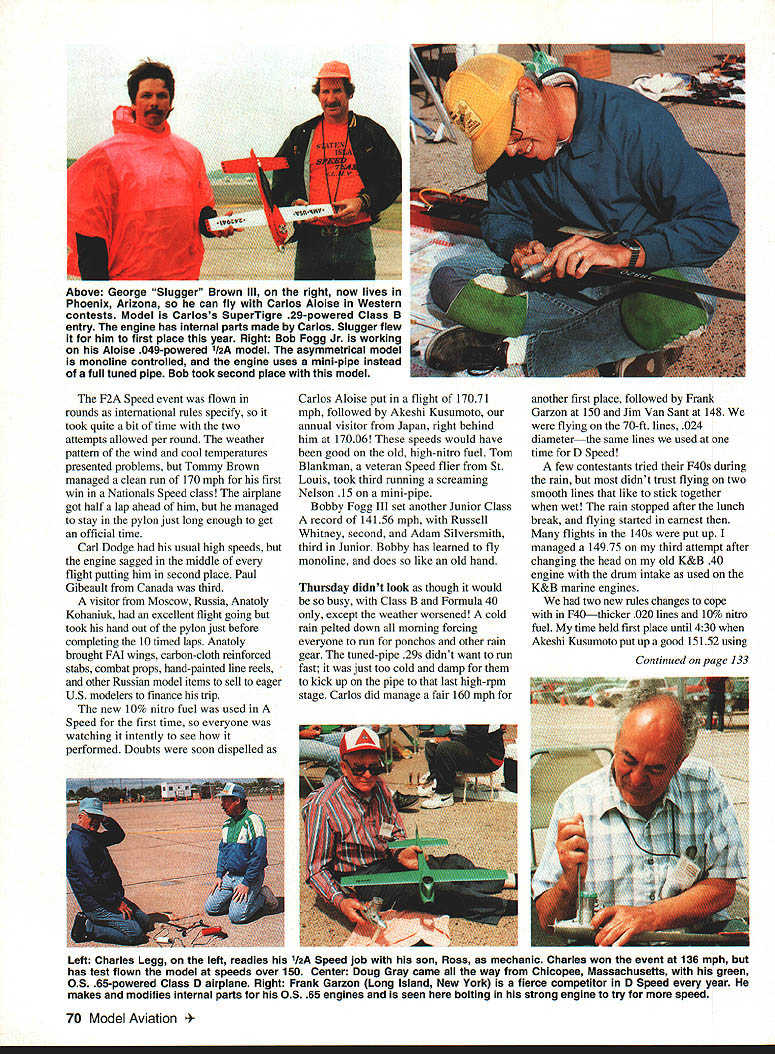
Charles Legg (previous Nationals winner and record holder from Iowa) attempted an early flight with his Sidewinder FAI-type model powered by a home-built engine but kissed the concrete on the downwind side of the circle. The model wasn't damaged, so he waited for better conditions.
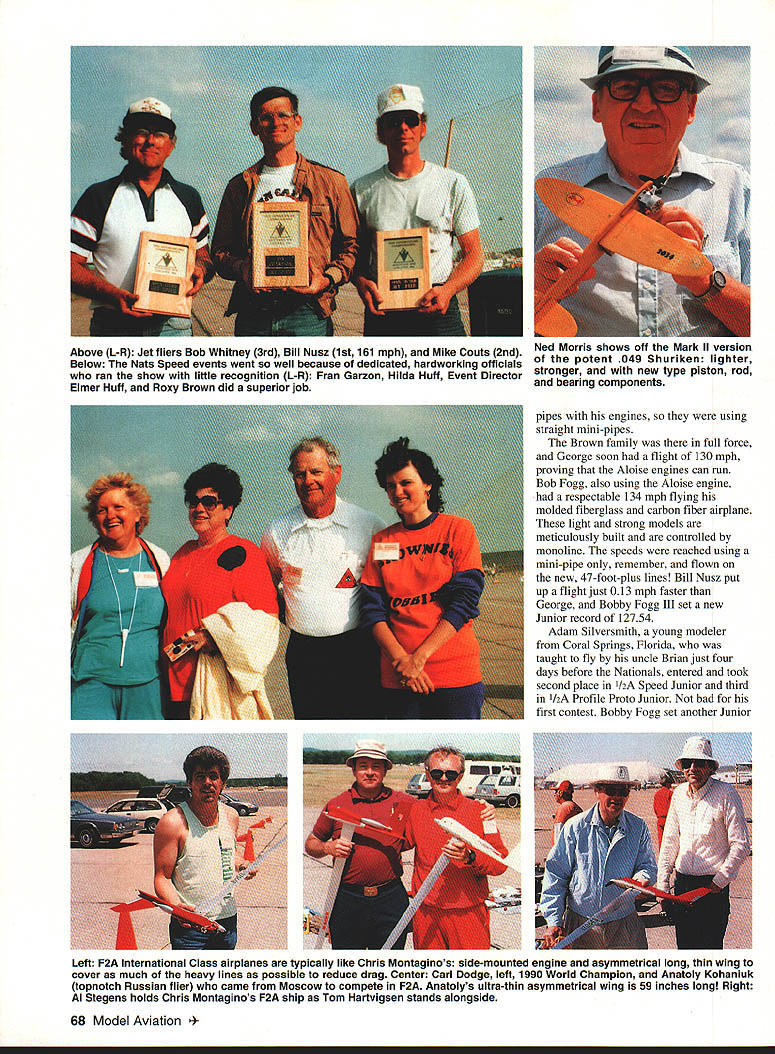
Despite the weather, turnout was excellent: more than 40 entrants in 1/2A Speed and 1/2A Profile Proto, including five juniors in each class. Several engines were used—no longer dominated solely by the .049 Shuriken. Competitors used the Shuriken, Chinese CS engines, and specials built by Carlos Aloise. Carlos didn’t have time to work out tuned-pipe issues.
Highlights and results:
- George Brown flew 130 mph, proving Aloise engines can run.
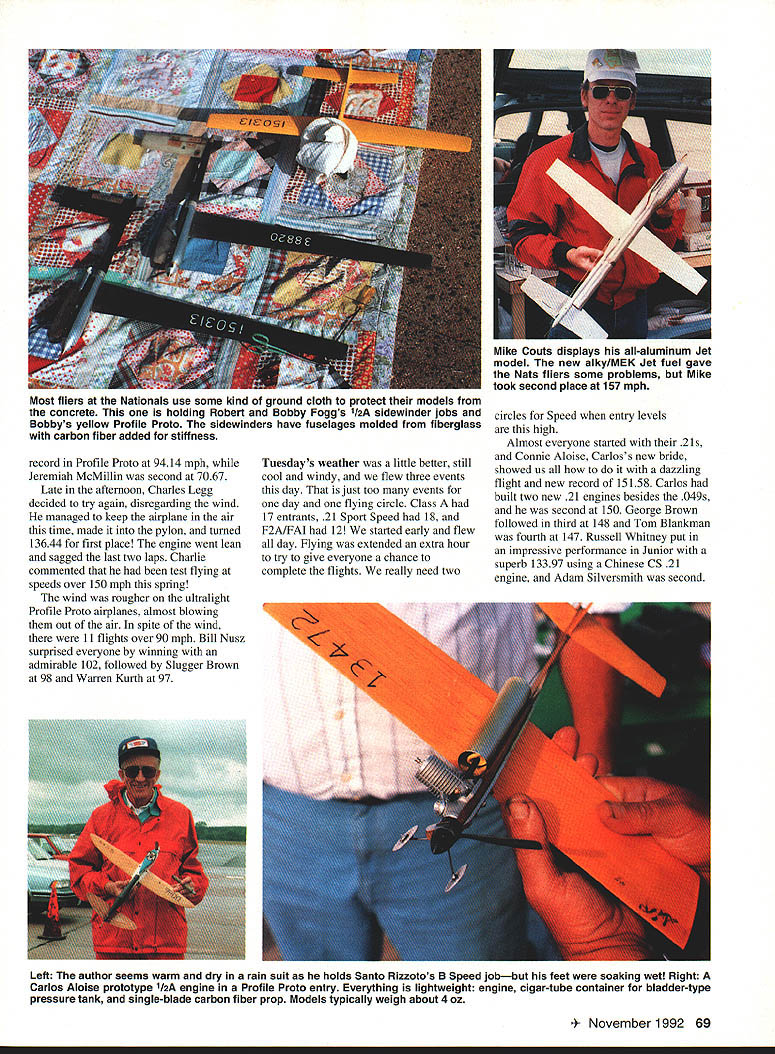
- Bob Fogg recorded 134 mph flying a molded fiberglass/carbon-fiber model.
- Bill Nusz posted a flight 0.13 mph faster than George.
- Bobby Fogg III set a new junior record: 127.54 mph.
- Adam Silversmith (young modeler from Coral Springs, Florida) took second in 1/2A Speed Junior and third in 1/2A Profile Proto Junior; he had been taught to fly by his uncle Brian just four days before the Nats.
Late afternoon, Charles Legg tried again, disregarded the wind, kept the airplane aloft, made the pylon, and turned 136.44 mph. The engine went lean and sagged the last two laps; Charlie noted he had been test flying at speeds over 150 mph that spring.
Ultralight Profile Proto planes suffered in the rough wind—almost blown out of the air—but 11 flights exceeded 90 mph. Bill Nusz won with 102 mph, Slugger Brown was second at 98, and Warren Kurth third at 97.
Tuesday — Class A, .21 Sport Speed, and F2A
Weather was a bit better but still cool and windy. Three events were flown in one day (too many for a single circle): Class A had 17 entrants, .21 Sport Speed had 18, and F2A had 12. Flying extended an extra hour to try to accommodate everyone.
Class .21:
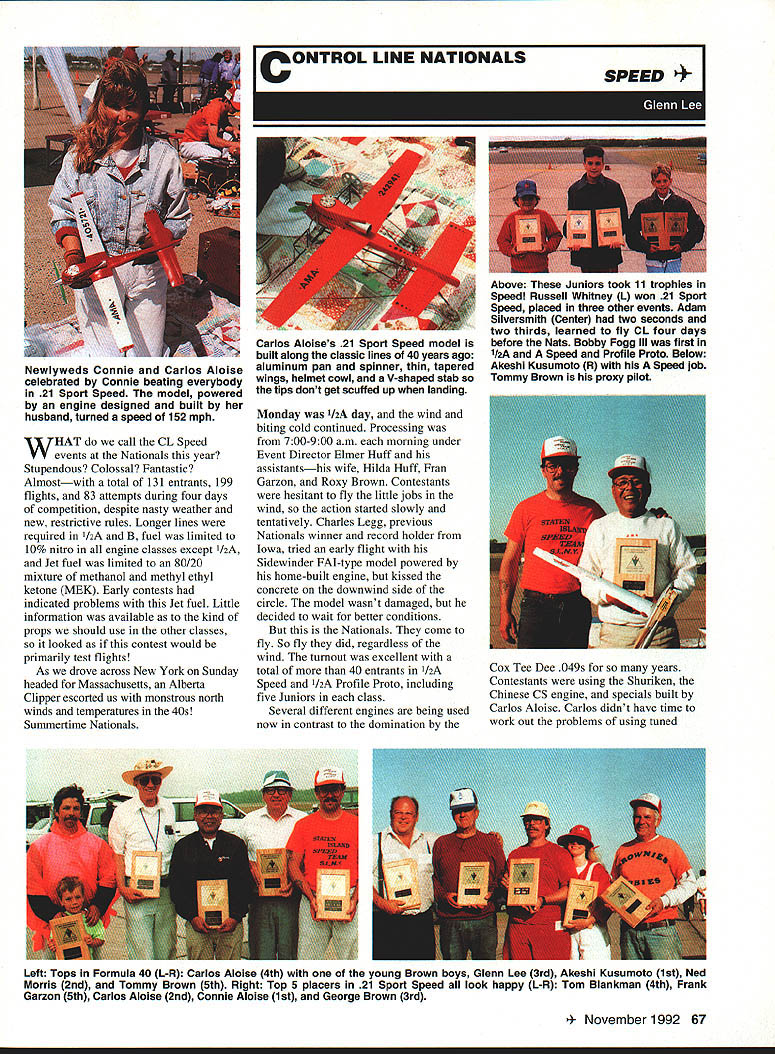
- Connie Aloise (Carlos’s new bride) set a new record with 151.58 mph.
- Carlos Aloise, using newly built .21s, was second at 150 mph.
- George Brown placed third at 148 mph.
- Tom Blankman was fourth at 147 mph.
- Junior: Russell Whitney won Junior with 133.97 mph using a Chinese CS .21; Adam Silversmith was second.
F2A Speed:
- Flown in rounds per international rules, with two attempts allowed per round.
- Tommy Brown managed a clean 170 mph run to win his first Nationals Speed class; his airplane got half a lap ahead but he stayed in the pylon long enough for an official time.
- Carl Dodge posted high speeds but experienced engine sag mid-flight and finished second.
- Paul Gibeault (Canada) finished third.
- Anatoly Kohaniuk (visitor from Moscow) nearly completed a strong flight but removed his hand from the pylon just before the 10 timed laps finished. He brought Russian model items for sale to finance his trip.
Class A with 10% nitro fuel:
- The new fuel performed well. Carlos Aloise recorded 170.71 mph, and Akeshi Kusumoto followed closely at 170.06 mph—speeds comparable to old high-nitro fuels.
- Tom Blankman took third running a Nelson .15 on a mini-pipe.
- Junior: Bobby Fogg III set another Junior Class A record at 141.56 mph; Russell Whitney was second and Adam Silversmith third in Junior.
Thursday — Class B and Formula 40 (F40)
The morning brought cold rain; tuned-pipe .29s struggled in the cold, damp conditions and didn’t reach high-rpm stages easily.
Class B:
- Carlos Aloise managed 160 mph for first place.
- Frank Garzon was second at 150 mph.
- Jim Van Sant third at 148 mph.
- Flying used 70-ft lines, .024-inch diameter—the same lines once used for D Speed.
Formula 40 (F40):
- Many pilots avoided flying in the rain since two smooth lines tend to stick together when wet.
- After lunch the rain stopped and flying resumed. Many flights in the 140s were posted.
- Personal note: I achieved 149.75 mph on my third attempt after changing the head on an old K&B .40 engine with a drum intake (as used on K&B marine engines).
- New F40 changes included thicker .020 lines and the 10% nitro fuel.
- Akeshi Kusumoto posted 151.52 mph using a prototype O.S. .40 engine featuring a massive crankcase, a high-silicon-content aluminum piston, and a nickel-plated brass sleeve with embedded carbide particles (production uncertain).
- Ned Morris later flew 150.82 mph to move into second; flying had to stop at 5:00 since rain is not an excuse to extend flying.
Last Day — Class D and Jet
Weather improved. Eighteen contestants signed up in Class D and six in Jet.
Class D:
- The O.S. .65 dominated; competitors tried various props to find the best combination.
- I managed 171 mph using an 8 x 9 Rat Race prop.
- There were 49 official flights that day, 28 over 170 mph.
- Carlos Aloise won with a modified O.S. at 181 mph.
- Frank Garzon and Tommy Brown both recorded 179.21 mph; Frank took second on a better backup flight.
- Props that worked best were about 8½ inches in diameter with 10–11 inches of pitch.
Jet:
- The new alkyl/MEK fuel proved problematic in high humidity; ignition was difficult.
- Bill Nusz took first with a respectable 161 mph.
- Another competitor posted a best of 157 mph for second.
- Bob Whitney finished third at 146 mph.
- Several Jet pilots (including Ned Morris, Gordon Thomas, and myself) could not get engines started.
- Many Jet fliers did not enter because of fuel troubles; further testing for a better mixture was planned.
There was a large crowd watching the D jobs and Jets—many spectators came to see the noisy honkers.
Closing Remarks
The 1992 Nationals were enjoyable, especially with the 10% nitro fuel. Very few engines were damaged; they ran well and produced respectable speeds. I particularly enjoyed flying the old way—starting and setting my own engine, then running out to the handle to fly.
Despite the cold weather, we had a good time. At the banquet:
- Carlos Aloise was crowned Top Gun for gathering the most points.
- Bobby Fogg III was Junior Champion.
We observed a moment of silence for friends who have passed: Fred Randel, Ted Black, and Dave Williams’s wife.
Many thanks to all who helped run the events.
Transcribed from original scans by AI. Minor OCR errors may remain.

